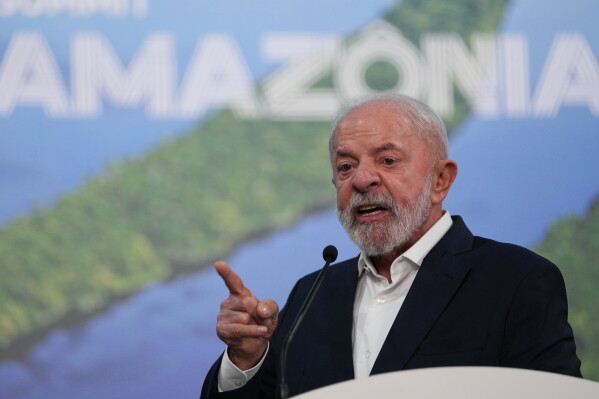
Brazil’s Supreme Court is set to evaluate several cases that could greatly affect the Amazon rainforest’s protection and the Indigenous communities reliant on it. These issues include Indigenous land rights, recent reductions in environmental safeguards, and infrastructure projects.
Legal Battles and Vetoes
A pattern has emerged in recent years where Brazil’s largely conservative Congress has passed measures environmentalists claim violate constitutional rights. President Luiz Inácio Lula da Silva has vetoed certain measures and parts of others. Nevertheless, Congress overrode some of these vetoes, leading these disputes to the Supreme Court. Environmental advocates view the Supreme Court as a crucial defender of Brazil’s environmental protections.
Lula’s administration has made notable achievements, such as reducing deforestation and promoting ecological investments. However, the government faces challenges due to a strong agribusiness influence in Congress. The legislative landscape is tough, according to Suely Araújo from the Climate Observatory, as the Lula administration often opposes anti-environmental bills but lacks political strength in Congress.
Agribusiness Control in Congress
In Congress, agribusiness holds sway and has pushed measures that weaken environmental protections. The Supreme Court often acts as a counterbalance, assisting in maintaining parts of Lula’s environmentally focused agenda.
The president’s chief of staff declined to comment on cases before the Supreme Court. Brazil is a leading producer of soybeans and beef, exporting mainly to China, which bought significant portions of Brazil’s exports from January to July 2026.
Deforestation in the Amazon is primarily due to Brazil’s agricultural expansion. Organizations within agribusiness argue against illegal deforestation, noting increased agricultural productivity alongside declining forest clearing.
Amazon’s Role in Climate Regulation
Protecting the Amazon rainforest is vital in tackling climate change. It plays a crucial role in regulating climate and rainfall patterns, storing large amounts of carbon that, if released, could accelerate global warming.
Indigenous Land Rights
Brazil’s Supreme Court is reviewing final motions regarding a 2025 ruling that dismissed the ‘time limit’ thesis. This legal theory, supported by agribusiness, restricts Indigenous land claims to areas occupied or under legal dispute beginning October 5, 1988.
While supporters say this cutoff provides landowners with legal certainty, Indigenous groups argue it overlooks years of expulsions and displacements. Motions from various stakeholders are expected to provide clarification on compensation rules and deadlines for completing land demarcations.
Ricardo Terena, a lawyer for the Articulation of Indigenous Peoples of Brazil, notes that certain proposals might hinder future demarcations by introducing extra administrative challenges. The Kawahiva Indigenous community, for example, remains isolated in the Amazon and may be impacted by these legal proceedings.
Cases Influencing Amazon Governance
Alongside Indigenous land rights cases, Brazil’s top court will review state laws affecting the soy moratorium and a new environmental license law. The soy moratorium prohibited soy cultivation on cleared Amazon lands, but recent legislation by top soy-producing states revoked tax benefits for companies participating in the pact. Justice Flávio Dino halted the state legislation temporarily, but the full court will now review this decision.
The environmental licensing law, enacted in February, speeds up permits for projects with notable impacts. Environmental advocates, such as Araújo, hope the Supreme Court will invalidate provisions seen as unconstitutional, notably those permitting self-licensing for projects with moderate environmental effects.
The environment ministry supports the soy moratorium and expresses concerns over the licensing law’s effect on national environmental standards. Brazil aspires for a licensing system that is efficient and robust enough to support infrastructure development while combating climate change and biodiversity loss.
The Associated Press provides climate and environmental coverage, supported by private foundations—yet all content remains independent.
 Navigating Global Challenges: Trump’s Legacy and Crisis Management
  Analyzing Oregon’s Wildfire Crisis and Its Implications
  Kansas Senate Race: Hamilton Criticized for Climate Views
  Trump Administration Targets H-1B Visa Use to Protect American Workers
  Controversy Over Proposed MLB Stadium in Grand Teton National Park
  The GOP’s Shift Toward Big Government