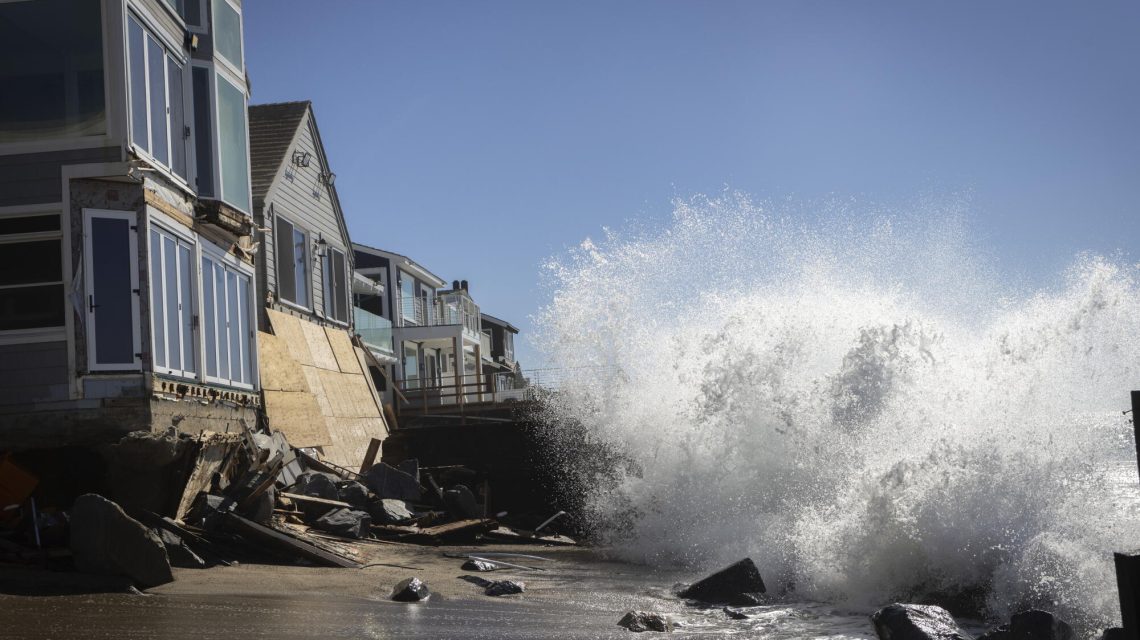
The initial weeks of an intense El Niño event have showcased the challenges and high costs of combating rising sea levels. Images of tidal flooding and damaged boardwalks along California’s coast highlight what even a small increase in sea level could bring. Experts suggest reevaluating current strategies instead of spending millions on temporary measures like seawalls, sandbags, and berms.
One alternative is for local governments to purchase properties at risk of ocean encroachment. They could rent these properties at market value to recover costs. Once flooding becomes severe, officials might demolish the properties and restore the land as natural areas, such as public beaches or marshes. This concept gained support in the California Legislature in 2021 and 2022, but the legislation was vetoed by Governor Gavin Newsom. Climate adaptation specialists believe there is still time to reconsider this plan. A pilot program could prove beneficial.
A.R. Siders, an expert on community relocation from the University of Delaware, stated, “This proposal presents a chance for California to lead. Although it seems costly, purchasing a few properties costs less in comparison to what is spent on disaster response.”
According to legislative analysts, property worth $8 billion to $10 billion might be underwater by 2050, with an additional $6 billion to $10 billion at risk during high tide. The need for immediate action is urgent to safeguard California’s iconic shoreline. But protecting infrastructure, homes, beaches, and neighborhoods from the sea is complex, with each solution bearing significant costs and controversies.
Seawalls, often the default choice, may defend physical structures but they essentially destroy beaches, disrupting the shoreline and reducing sand. Similarly, adding sand to combat erosion requires continuous effort and is only temporary. On the other hand, managed retreat involves moving properties and infrastructure away from vulnerable areas, offering a long-term solution.
Senator Ben Allen (D-Santa Monica) proposed the buy-and-rent-back strategy in 2021 through Senate Bill 83. This voluntary program would allow homeowners to sell their properties while they retain value. The aim was to save on enormous post-emergency costs. Some studies suggest saving $6 in avoided costs for every $1 spent to preemptively manage flood-prone buildings.
Allen stated, “The goal was to tackle the financial and moral dilemmas coastal cities face, pressured by homeowners facing dire situations.” This strategy aimed to avoid a net loss for taxpayers, potentially even providing gains by acting early.
Run through multiple state committees with significant support, Allen’s proposal was vetoed by the governor, who cited concerns about long-term costs not being clearly addressed. Attempts to pass an improved version of the bill in 2022 also met with a veto.
Climate challenges persist, with disasters like the storms in January 2023 causing significant destruction. As such, experts like Julia Stein from UCLA emphasize that careful planning can prevent disaster-driven relocations, making a case for solutions like the buy-and-rent-back plan.
Charles Lester, of UC Santa Barbara’s Ocean and Coastal Policy Center, warns of the current lack of planning, pointing out incidents such as worsening erosion in places like Pacifica. There, past El Niño damage left apartment buildings precariously perched on cliffs, resulting in prolonged legal battles and substantial public costs.
John Keener, former mayor of Pacifica, witnessed these challenges firsthand. Reflecting on past efforts to introduce proactive strategies, he hopes for change with less repetition of past mistakes.
 Failed UN Climate Talks in Turkey Highlight Fossil Fuel Dilemma
 Extreme Coastal Flooding Risks Loom Over California
 Shirley Heinze Land Trust’s New Headquarters: A Hub for Conservation
 Challenges and Innovations at White Oak Pastures
 Debate Rekindled Over Gray Wolves and Livestock Losses
 Protests Erupt Against Data Centers in Spain