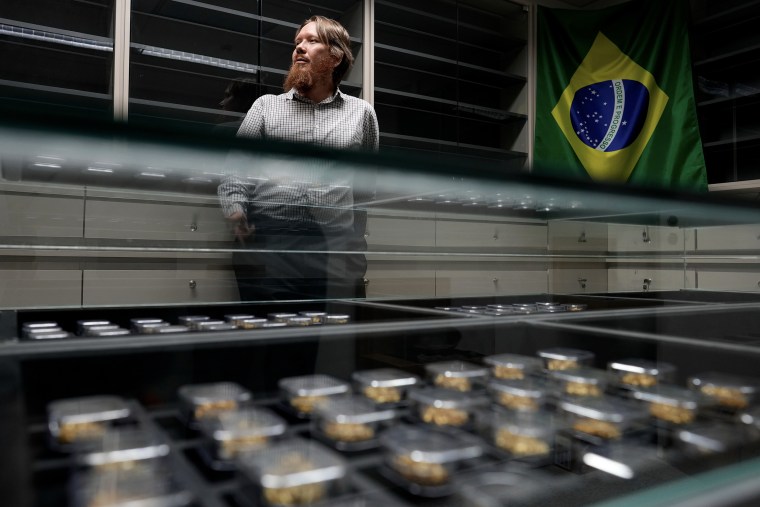
Brazil is employing forensic science to address the problem of illegal gold mining in the Amazon rainforest. This activity poses a significant threat to the forest, Indigenous groups, and other communities, leading to accelerated deforestation and dangerous mercury contamination levels.
Forensic work is conducted at the National Institute of Criminalistics in Brasilia, the capital of Brazil. The federal police have established a “gold lab” at this location to collect and analyze samples from around the country. Their goal is to identify whether gold samples, such as those seized in police raids, originate from protected areas, indicative of illegal mining. This process, known as “gold fingerprinting,” involves tracing the gold’s origin with high accuracy.
Experts compare gold tracing to analyzing a person’s DNA. Each gold sample has unique data attributes because, during its natural formation in a rock or riverbed, it absorbs particles like silver and copper. These particles serve as a fingerprint, helping investigators verify whether gold was mined legally from claimed locations or sourced unlawfully from protected areas, like national forests or Indigenous lands.
Forensics expert Gustavo Geiser notes that since 2019, this method has developed in partnership with Brazilian universities. Investigators apply tools such as X-ray fluorescence spectrometry, scanning electron microscopy, and laser ablation mass spectrometry. Despite increasing complexity in forensic examinations, their primary query is consistent: “Where did this gold come from?”
When forensics confirm illegal mining, the information supports police in building cases and potentially pressing charges.
Criminals frequently commit fraud to introduce illegally mined gold into legal markets globally, a strategy not limited to gold but extending to goods like cattle and timber. The rising global gold prices have intensified mining rushes within the Amazon.
A platform called Amazon Mining Watch, utilizing satellite imagery, reports that approximately 496,000 hectares (1.2 million acres) of rainforest have been cleared for mining since 2023, including 223,000 hectares (551,000 acres) in Brazil.
In Brazil, the Federal Court of Accounts highlighted evidence suggesting misuse of mining permits by the National Mining Agency to sell gold extracted from protected Amazon areas. Greenpeace conducted independent investigations using records and satellite imagery to expose this scheme, referred to as the “ghost mine” scam.
In response, a federal court in Para, a state heavily affected by illegal mining, ordered better control and traceability of gold transactions, from mines to markets, by entities like the Central Bank and the National Mining Agency. Federal prosecutors have filed lawsuits seeking improved oversight of mining permits.
Prosecutor André Porreca argues these permits serve as fronts to “launder gold extracted by criminal organizations from Indigenous territories and protected areas.” The efforts of Brasilia’s gold lab are crucial in combating crime and fortifying international gold supply chains.
Geiser emphasizes the importance of confirming gold’s legitimate origin for inclusion in financial reserves, bolstering market and national financial integrity. Although there’s no specific data on criminals apprehended due to the lab’s work, Geiser remarks on increasing tactics by crime networks leveraging neighboring regions like Venezuela.
Illegal gold mining contributes to severe mercury contamination within the Amazon. As the world’s largest rainforest and climate regulator, any degradation could accelerate global warming.
A MapBiomas analysis revealed over 90% of Brazil’s mining occurs in the Amazon, with nearly 40% of activities illicitly breaching protected zones.
While agriculture remains a higher cause of deforestation, illegal mining’s environmental damage, mainly from mercury use, is nearly irreversible. Mercury separates gold, and once released, contaminates water sources and fish—integral to Indigenous life.
A Fiocruz study in 2023 found that 21.3% of Amazon market fish exceeded World Health Organization mercury safety thresholds. Mercury intake in children aged 2 to 4 was found to be up to 31 times the recommended limit.
Brazil’s commitment to the U.N.’s Minamata Convention on Mercury aims at eliminating mercury usage in gold mining. Current draft proposals to phase out mercury are under federal discussion, lasting until August 7. Prosecutors advocate for Indigenous groups’ input as the parties most affected by mercury contamination.
Geiser believes a mercury ban would curb environmental harm and enhance forensic investigations. The ability to detect mercury in samples will clarify illegal practices.
Regional cooperation has strengthened through the Amazon International Police Cooperation Center headquartered in Manaus to address this increasing crime.
 Data Centers in Virginia face Growing Opposition
  EPA Dismantles Greenhouse Gas Rules, Causing Concern
  How Battery Innovations Transform Renewable Energy
  Data Centers Stir Controversy in Texas Amid Growth Boom
  Urgent Archaeological Efforts in Quinhagak Stay Ahead of Erosion
  Concerns Rise Over NIPSCO Permit In Jasper County