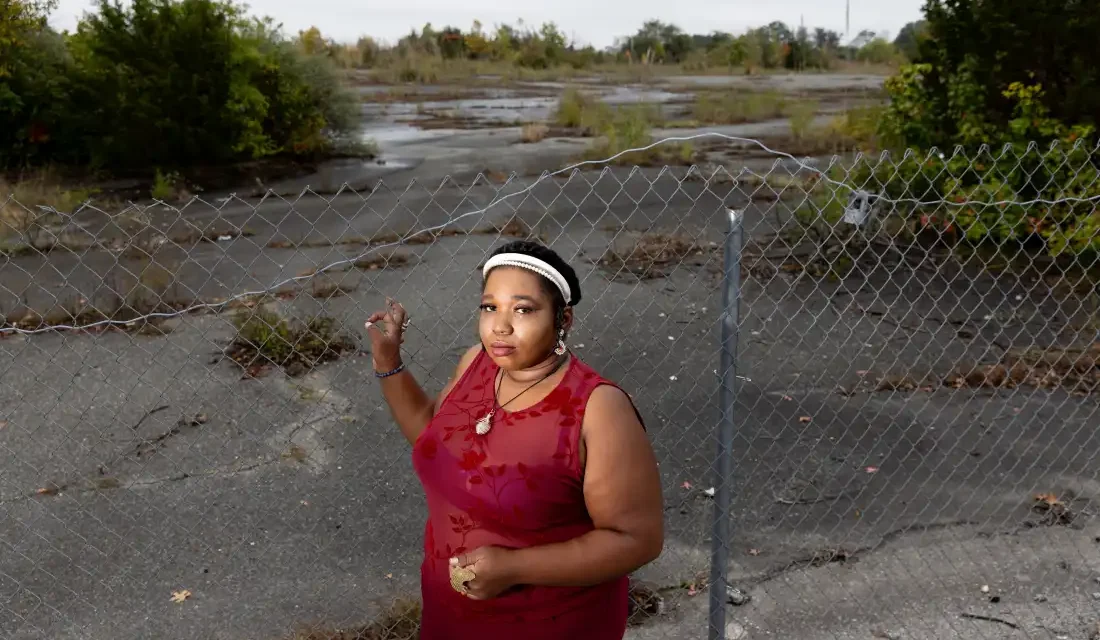
Taylor Frazier McCollum has stood firmly against the proposed data center at the site of the former Landover Mall in Prince George’s County. The potential development could cover over 80 acres of land, less than a mile from where she resides.
The mall, now closed since 2002, left nearly 90 acres vacant. In 2024, developers received approval for a $5 billion data center on this site. News of the project quickly spread through the nearby community, predominantly Black. “I was like, ‘Oh, hell no,'” expressed Frazier McCollum upon hearing the news. She questioned the rationale behind placing water-polluting, diesel-powered data centers so close to where people live and work.
Her opposition reflects a broader trend in America, where locals voice concerns against data centers, resulting in roughly 500 moratoriums across the nation. Frazier McCollum’s activism is distinctive; she doesn’t own a home. In 2024, eviction forced her and her young daughter from their apartment after her job at a waxing center reduced wages. She sought shelter at her grandfather’s home when she learned of the data center proposal.
Determined, Frazier McCollum launched a petition garnering over 25,000 signatures, leading to large protests and multiple moratoriums on data centers in the county, effectively stalling the $5 billion project planned for 2026-2027. Her efforts thrust her into local politics, resulting in testimonies before legislators, endorsements of candidates, and media attention, earning her the nickname “the Landover girl” within data center circles.
Staci Hartwell, a veteran environmental activist, acknowledges Frazier McCollum’s significant impact. However, concerns about economic effects linger in Prince George’s County. Recently, a Six Flags amusement park shut down, and the Washington Commanders football team plans to move back to Washington, D.C. These changes, along with job losses, have left the county facing a budget deficit.
During a county council meeting, Frazier McCollum advocated for a fund to address home repair needs, like those of her grandfather’s home. Council member Wanika Fisher highlighted the necessity of development for economic sustainability. “Our county has an economic future that we have to grapple with,” Fisher remarked, stressing the need for hard discussions on growth and development.
With the Landover project on pause, Frazier McCollum now pushes for a complete ban on such projects. She has connected with communities in Atlanta, Memphis, and even Zambia to resist data center growth. “I feel like so many people are depending on this fight,” she said, viewing it as a precedent for others opposing large data centers.
Her work has led her to sacrifice job opportunities and rely on family for support. Her father, Lacy McCollum Jr., views her activism as a continuation of civil rights. “We needed the Medgar Everses, the Martin Luther Kings, the Malcolm X’s,” he compared, affirming the importance of trailblazers like her.
Some encourage Frazier McCollum to run for office, although she prioritizes settling debts and finding stable housing. Meanwhile, she proposes alternatives for the Landover site, such as a sports complex or affordable housing, though she admits these might not be as financially rewarding as a data center campus.
Jenny Abamu reports for WAMU.
 Senator Elizabeth Warren and the Future of Crypto Regulation
 Bipartisan Opportunities in Foreign Policy
 Political Shifts and Concerns Post-Midterms
 North Siders Debate Over Proposed Electrical Substation
 Closing the Foreign Financing Loophole in American Lawsuits
 Cumberland Island Land Swap Proposal Sparks Controversy