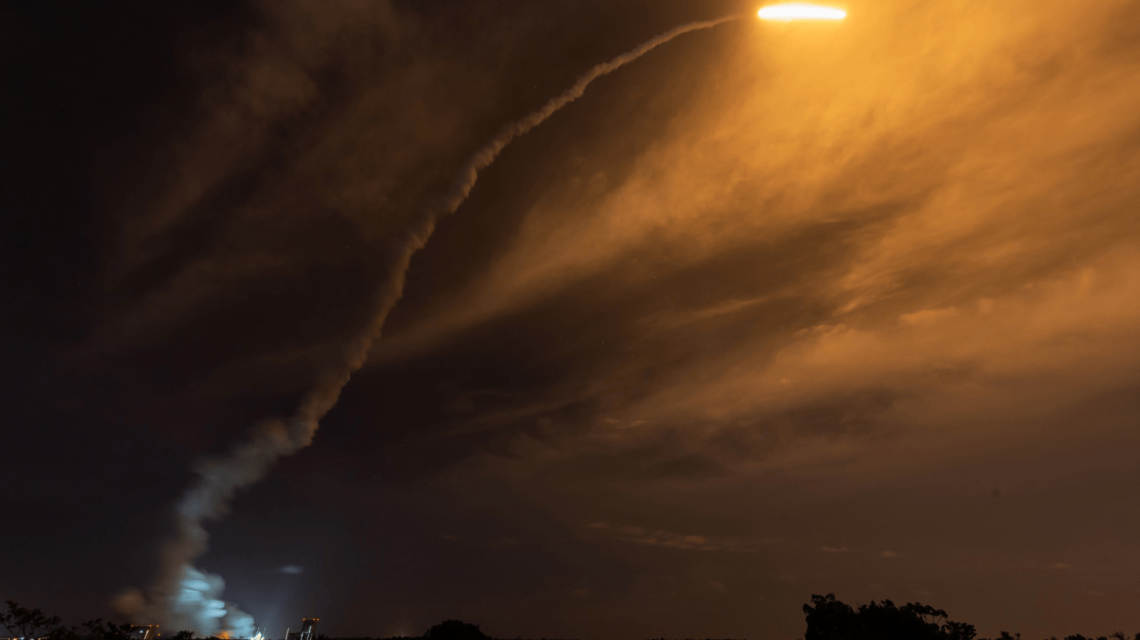
The BepiColombo mission has achieved a significant milestone by reaching Mercury after an eight-year journey through the solar system. This joint mission, led by the European Space Agency (ESA) in collaboration with the Japan Aerospace Exploration Agency (JAXA), aims to study Mercury, the closest planet to the Sun.
Arrival at Mercury
BepiColombo arrived at Mercury on November 21 and began orbiting the planet. The mission consists of two spacecraft that will eventually separate and orbit Mercury independently to conduct simultaneous studies.
Mission Launch and Journey
Launched from the European Spaceport in Kourou, French Guiana, on October 20, 2018, BepiColombo has traveled a complex path through the inner solar system. Instead of flying directly to Mercury, the spacecraft navigated a carefully planned route. This included flybys past Earth once, Venus twice, and Mercury six times, utilizing gravitational assists to change speed and direction while conserving fuel.
The mission’s total travel distance is estimated at about 10.2 billion kilometers (6.35 billion miles), reflecting its winding trajectory rather than the straight-line distance from Earth to Mercury.
The Challenge of Reaching Mercury
Traveling to Mercury poses unique challenges despite its proximity to Earth. Approaching the Sun increases gravitational pull, requiring the spacecraft to slow down sufficiently for Mercury’s weak gravity to capture it. Reaching a stable orbit around Mercury demands more energy than missions to Pluto, which is further away.
To address these challenges, BepiColombo incorporated multiple flybys and utilized special engines for continuous propulsion. As it neared Mercury, it fired small engines to reduce speed, allowing Mercury’s gravity to draw it into an orbital path. Initially, BepiColombo’s orbit varies from as close as 590 kilometers to more than 11,000 kilometers from Mercury.
Harsh Conditions at Mercury
Mercury’s proximity to the Sun creates a severe environment for spacecraft. It’s exposed to sunlight ten times more intense than that at Earth, and surface temperatures can reach about 430 degrees Celsius. Such conditions present significant engineering challenges for the mission.
Mission Objectives
BepiColombo stands out with its dual spacecraft configuration. ESA’s Mercury Planetary Orbiter (MPO) will focus on Mercury’s surface and internal structure. JAXA’s Mercury Magnetospheric Orbiter (Mio) will study the planet’s magnetic field and surrounding environment.
This dual approach allows scientists to take simultaneous measurements from different locations, aiding in distinguishing planetary influences from solar wind effects. The mission aims to enhance understanding of Mercury’s origin and evolution, with broader implications for rocky planet formation, including Earth.
Future Plans
BepiColombo’s arrival in orbit is a first step towards its scientific goals. The two spacecraft are set to separate on December 9-10, marking the first instance of dual spacecraft orbiting Mercury concurrently.
Post-separation, each will establish individual orbits, with MPO adjusting its path for optimal scientific operations by March 2027. The main research phase for both will commence in April 2027, transitioning from journey to discovery in the study of one of the most enigmatic planets in our solar system.
 Bayer Settles Massive Roundup Lawsuit Over Cancer Claims
 AI and Mathematics: A Potential Breakthrough on the Riemann Hypothesis
 Mathematicians Race to Solve the Riemann Hypothesis Amid AI Controversy
 Key Developments in California, Melania Trump Series, Controversial Execution, and More
 3,300-Year-Old Sword Found in Italian Lake, Still Sharp
 NASA Explores Unusual Martian Formations