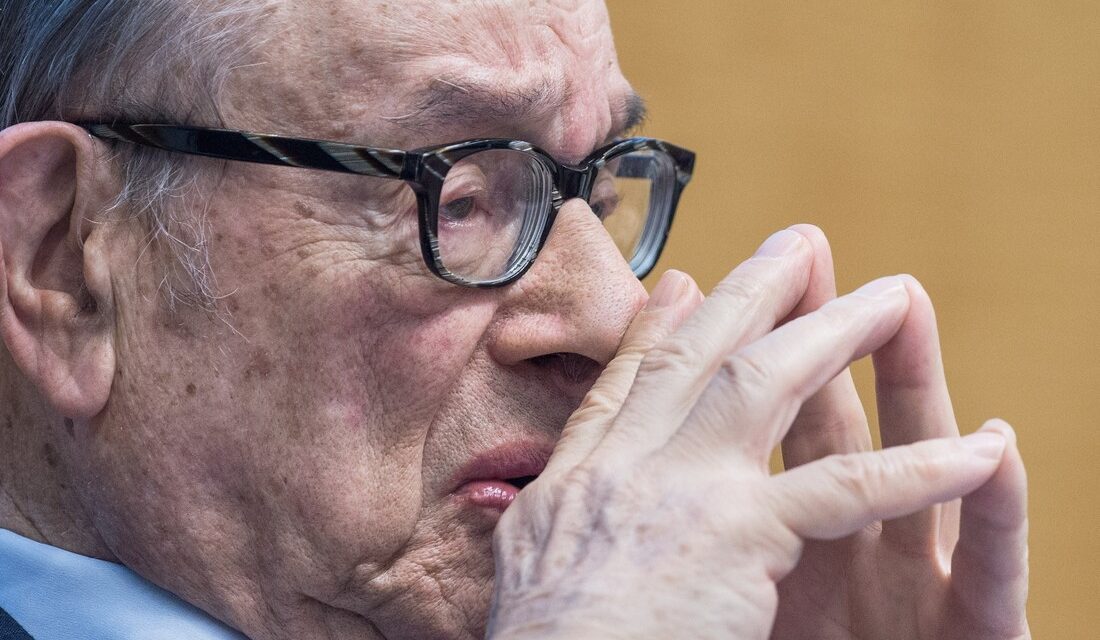
Alan Greenspan, the man who guided the Federal Reserve through extended periods of economic prosperity in the United States, passed away at his home in Washington at the age of 100. He was one of the few central bankers to achieve celebrity status, praised for his economic leadership during the 1990s.
Economic Boom and Controversy
Greenspan’s tenure at the Federal Reserve spanned nearly two decades, during which he oversaw some of the longest economic booms in U.S. history. Despite his stellar reputation in the 1990s, his legacy was later clouded by the global financial crisis in 2008, which occurred after he had left the Fed.
He employed unique communication methods, once noting that he intentionally mangled his syntax to prevent market fluctuations. One famous instance was his 1996 remark at the American Enterprise Institute warning of “irrational exuberance” in asset pricing, a comment that temporarily impacted global stock markets.
A Personal and Professional Icon
Greenspan, a talented jazz musician, had studied clarinet and saxophone at Juilliard. His marriage to NBC news anchor Andrea Mitchell formed a notable power couple in Washington. Comedian Jay Leno humorously referred to Greenspan as “the most powerful man in the world,” surpassing even the then-First Lady Hillary Clinton.
Strategies and Innovations
Greenspan led the central bank under four different U.S. presidents starting in 1987. His approach often diverged from traditional practices, including maintaining low interest rates during periods of dropping unemployment. This strategy led to a sustained economic boom but also attracted criticism for fostering bubbles, such as the dot-com bubble and subprime mortgage crisis.
Philosophical and Regulatory Views
Greenspan’s regulatory philosophy was influenced by his association with novelist Ayn Rand, with whom he shared a belief in minimal regulation based on self-interest. He contributed writings to Rand’s book, “Capitalism: The Unknown Ideal.” His views favored a libertarian approach, assuming that bankers would self-regulate to avoid excessive risks.
Yet, his faith in self-regulation was tested during the global financial crisis in 2008. Despite evidence suggesting the contrary, Greenspan had long supported minimal regulatory intervention. In a rare admission before Congress, he acknowledged his miscalculations, citing that the crisis took him by surprise.
Lasting Influence and Legacy
Greenspan’s career reflected both achievements and limitations in his approach to monetary policies and regulation. His push for deregulation faced challenges, notably in the savings-and-loan crisis. As a private economist, Greenspan was involved in the scenario surrounding Lincoln Savings and Loan, which later collapsed.
Economist Vincent Reinhart noted Greenspan’s courage in ultimately recognizing the flaws in relying solely on market self-interest. This aspect of his legacy shaped his image as a “maestro” of monetary policy and a hesitant regulator.
His contributions to economic strategy will be remembered alongside the economic boom he fostered and the subsequent financial bust he couldn’t prevent.