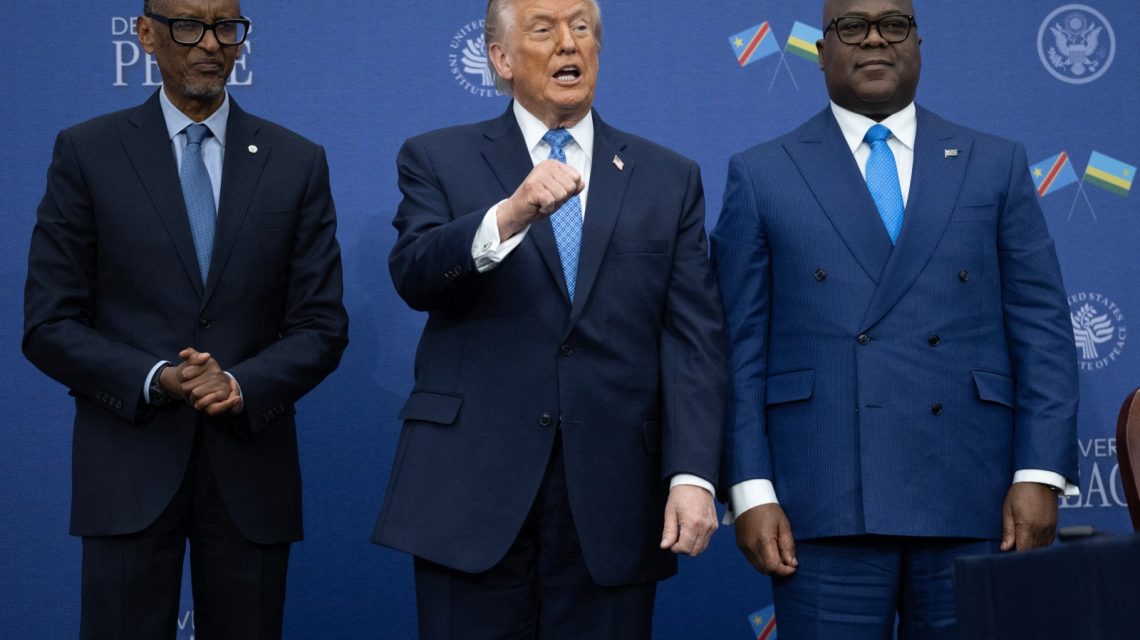
Nearly a year after Congo and Rwanda signed a U.S.-supported peace agreement, efforts to bring peace to Africa’s Great Lakes region are stalled. To secure the historic Washington Peace Accords, the U.S. must press its Congolese allies to honor their commitments.
The United States has recently taken a firm stance against Rwanda and its M23 allies. Rwanda’s backing of M23’s attempt to capture Uvira, South Kivu’s second-largest city, coincided with President Trump’s meeting with Congolese President Félix Tshisekedi and Rwandan President Paul Kagame to finalize the peace framework. This move undermined U.S. efforts to end a decades-long conflict and bring peace through significant U.S. investment.
The U.S. reacted strongly, imposing sanctions and visa restrictions on senior Rwandan officials. In March, sanctions targeted former Congolese President Joseph Kabila for supporting M23, and Rwanda’s army became only the second African national army sanctioned by the U.S.
On the other hand, the Trump administration has favored Tshisekedi and the Congolese government. Congo signed a strategic partnership with the U.S. in December, granting U.S. firms access to the Copperbelt region and rerouting mineral exports via the U.S.-funded Lobito railway. Additionally, Congo aligned with U.S. immigration policies by agreeing to accept deportees.
Despite these moves, Congo’s behavior is not exemplary. Although M23 has retreated in response to U.S. demands, the Congolese army has intensified attacks, sometimes harming civilians. Kinshasa has stalled in talks with M23 and continued supporting nonstate armed groups, including the FDLR, considered a threat by Rwanda.
Tshisekedi has little motivation to negotiate sincerely if he believes he has full U.S. support. He views M23 as an illegitimate group to be defeated militarily, with U.S. backing reinforcing this belief.
Conversely, Rwanda and M23 see the peace process as biased. Kagame criticized the U.S., stating Rwanda would not yield. U.S. measures targeting Rwanda perpetuate perceptions of hostility.
Meanwhile, the U.S. might inadvertently support a power grab. Tshisekedi uses the ongoing conflict to delay elections and seek a third term, cracking down on opposition by labeling them as M23 sympathizers. This strains the Congo-U.S. partnership, potentially jeopardizing it when Tshisekedi leaves power.
The U.S. needs to exert more pressure on Congo to comply with the Washington Accords. The U.S. should insist on Congo ending collaboration with the FDLR and considering sanctions on officials obstructing peace efforts.
The Qatari-led negotiations, closely tied to the Washington Accords, call for U.S. involvement. The U.S. must urge Kinshasa to negotiate in good faith, making necessary concessions, such as allowing M23 transitional control over some territories. Simultaneously, the U.S. should support Tshisekedi in handling domestic backlash through their minerals partnership.
Ensuring peace requires accountability for all parties, including U.S. allies in Kinshasa. While incentivizing peace, the U.S. must address Congo’s disruptive actions to fulfill the promise of peace and partnerships in the region.
Liam Karr and Yale Ford from the American Enterprise Institute express their views in this article.
 Austin Tice: A Search for Answers
  President Trump Warns of Escalating War with Iran at UN Assembly
  Tariffs and Their Impact on Everyday Products
  U.S., Denmark, and Greenland Forge New Security Agreement
  Senator Criticizes Drug Policy After Ohio Tragedy
  Secretary Rubio Discusses Middle East Conflict and NATO Relations