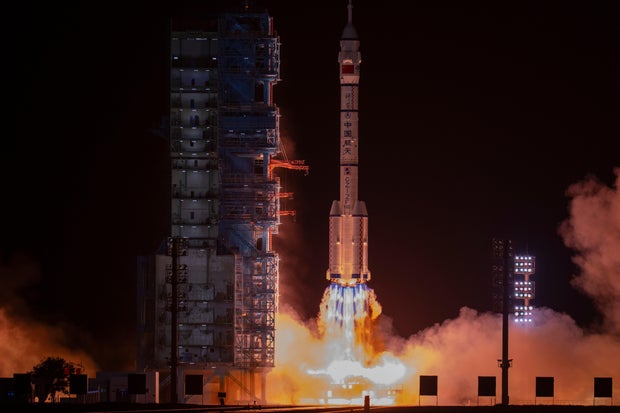
On Sunday, China launched the Shenzhou 23 spacecraft from the Jiuquan Satellite Launch Center. This mission will deliver three astronauts to the Tiangong space station.
Among the crew, one astronaut plans to remain at the station for a year. This duration is significant in the context of space missions globally. According to the official at the launch center, Li Benqi, the liftoff was “a complete success.”
This mission aligns with China’s objective to conduct a crewed lunar landing by 2030. The mission’s crew comprises Zhu Yangzhu, the commander, Zhang Zhiyuan, and Lai Ka-ying. Lai, from Hong Kong, is notable for being the first astronaut from the city and the fourth Chinese woman in space. Chinese media also refer to her as Li Jiaying.
The astronauts will engage in multiple scientific and application projects while in orbit. An in-orbit rotation with Shenzhou 21’s crew is also planned. The Shenzhou 21 mission launched in late October with China’s youngest astronaut and several mice.
During this mission, an astronaut will stay at the space station for a year to study human adaptability and performance over long durations in space. China’s space program continues to evolve, especially after its exclusion from the International Space Station due to U.S. security concerns.
As NASA aims for a lunar landing in 2028, China advances its space initiatives. The Tiangong space station, meaning “Heavenly Palace,” hosted its first crew in 2021. A previous mission faced challenges due to a damaged spacecraft, Shenzhou 20, which was deemed unsafe for astronaut travel.