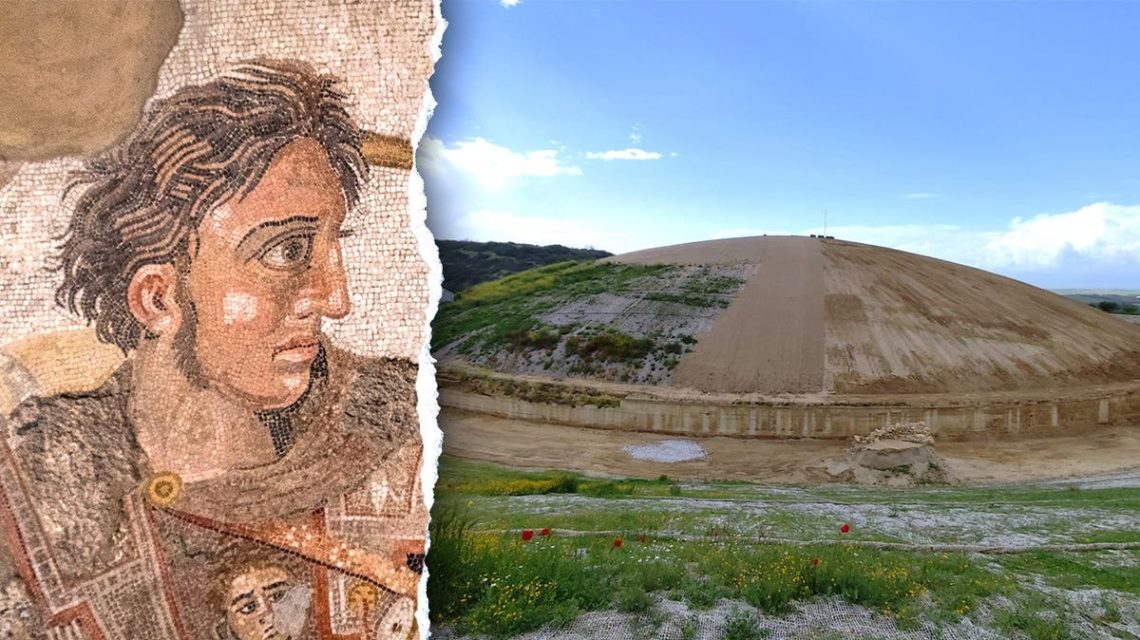
Greek officials have revealed the inside of an ancient tomb at Amphipolis, possibly linked to Alexander the Great. The Greek Ministry of Culture announced developments on May 11, highlighting ongoing excavation and restoration efforts.
The Kasta Tomb is located in the ancient city of Amphipolis, northern Greece, around 60 miles northeast of Thessaloniki. Recent restoration work uncovered the entire tomb enclosure for the first time, demonstrating its impressive size and significance. Built in the fourth century B.C., the tomb’s enclosure stretches approximately 1,630 feet in circumference, encompassing a vast burial area spanning over 20 acres.
Images from the Greek Ministry of Culture show detailed marble-lined pathways and intricate architectural designs, indicating the tomb’s association with elite members of the Macedonian society. Officials have removed old metal supports, and future plans include installing a monumental double-leaf Macedonian marble door and rebuilding parts of the sphinx sculptures that once adorned the entrance.
“The Kasta Tomb is a unique and magnificent Macedonian monument,” stated Lina Mendoni, Greek Minister of Culture. “Restoring its geometry and revealing its entire enclosure highlight its historical importance.”
Amphipolis is historically linked with prominent figures from Macedonia, such as Alexander the Great’s generals Nearchus, Hephaestion, and Laomedon. According to the Ministry’s website, after Alexander’s passing, the city remained loyal to his mother Olympias. Eventually, Cassander, one of Alexander’s successors, took control and imprisoned Alexander’s wife, Roxana, and son, Alexander IV, in Amphipolis.
Alexander the Great, known for creating the expansive Macedonian Empire, lived from 356 B.C. to 323 B.C. He defeated the Persian Empire but died under uncertain circumstances at 32 without losing a battle. The Kasta Tomb in Amphipolis is believed to be built for someone intimately connected to Alexander, possibly his mother, a wife, or a close friend.
The ongoing excavation is one of several projects related to Alexander the Great. Earlier, a long-hidden city established by him, named Alexandria on the Tigris, was discovered near the Persian Gulf in southern Iraq.
 Baltimore Rock Opera Society Faces Scrutiny and Resignations After Director’s Dismissal
  Innovative Use of AI and Digital Technology in Restoring the Basilica of Saint Francis of Assisi
  Amir Odom: Perspectives on LGBTQ Movement and Political Identity
  The Legacy of Ken Kesey’s ‘Furthur’ Bus
  Abraham Lincoln’s Pocket Watch: A Piece of History
  Reflections on 30 Years at Fox News