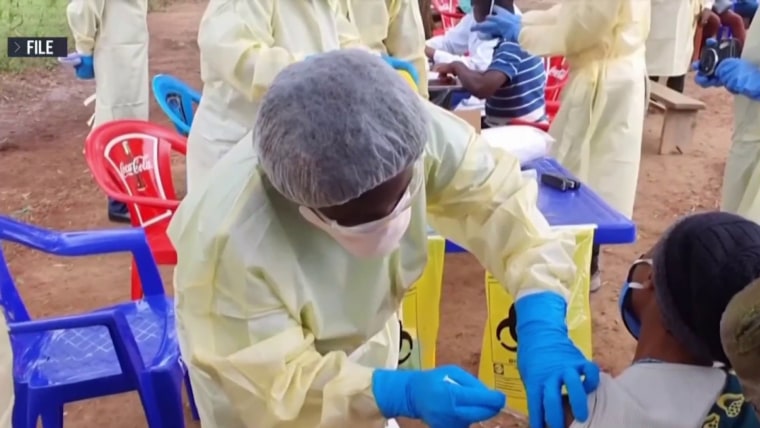
Until the previous year, the U.S. Agency for International Development (USAID) played a vital role in a longstanding system addressing Ebola outbreaks. However, a dozen former federal employees informed NBC News that the U.S. response to the current Ebola outbreak has been slow and fragmented without USAID’s involvement.
The Trump administration significantly reduced USAID’s operations last year, terminating most programs and dismissing the majority of its employees. Approximately 1,000 programs were transferred to the State Department. Interviews with past officials from USAID, the Centers for Disease Control and Prevention (CDC), National Institutes of Health, and the White House suggested USAID’s resources might have aided in containing the outbreak and saving lives.
The outbreak was identified last week in Congo, though Ebola likely spread unnoticed for weeks. As of Wednesday, suspected deaths stood at 139, and cases at 600, according to the World Health Organization, with fears that actual figures are higher.
“What we’ve lost is speed, which is the most important thing in an outbreak like this,” said Nicholas Enrich, former acting assistant administrator for global health at USAID.
Enrich and other experts noted USAID programs helped labs in Congo detect the virus earlier, expedited delivering personal protective equipment (PPE) to hospitals, and deployed community health workers to identify symptoms and trace exposure. Enrich observed these systems, effective in past outbreaks, unravel as the Trump administration reduced foreign assistance.
Community health workers with expertise from earlier outbreaks have found other employment, noted Dr. Daniel Bausch, a visiting faculty member at the Geneva Graduate Institute and a former CDC medical officer. “Now they’re driving a taxi in Kinshasa or selling fruit somewhere,” Bausch remarked on their displacement. “This cadre of reasonably trained people that you can employ just isn’t around.”
The International Rescue Committee (IRC), a former USAID contractor, noted U.S. funding cuts forced a reduction in their presence in Ituri, the outbreak’s focal province, leading to scaled-back surveillance and sanitation measures like handwashing stations. Heather Reoch Kerr, IRC’s Congo country director, stated a lack of donor funding diminished their ability to distribute PPE kits. “Today many facilities in affected areas are operating without basic protective supplies,” she remarked.
The State Department denied allegations that reforms at USAID negatively impacted U.S. Ebola detection or response. “It is false to claim the USAID reform has negatively impacted our ability to respond to Ebola,” said spokesman Tommy Pigott.
In a news release, the department noted mobilizing $23 million in foreign assistance to support response efforts, including surveillance, lab capacity, and safe burials. A senior official highlighted that USAID partner organizations, typically first to hear of outbreaks, remain active.
Kyeshero Hospital in Goma is readying isolation areas for potential cases. Dr. David Heymann, a former CDC medical epidemiologist, highlighted the main issue isn’t U.S. funding but international cooperation. The U.S. withdrew from the World Health Organization (WHO) last year, with the Trump administration criticizing its handling of the Covid pandemic.
The CDC has since stepped up its role. The agency assists with surveillance, diagnostics, contact tracing, and PPE distribution in Congo and Uganda. Dr. Satish Pillai, the Ebola response incident manager, expressed plans to deploy more staff. Enrich noted the CDC’s previous major role was providing technical knowledge of Ebola. “They’re not equipped or prepared or organized to coordinate a broad response,” said Enrich.
Bausch expressed concern that CDC staff can’t replace USAID workers. “They don’t speak the language. They don’t know the culture… Those people who really make things work are local people hired, who may have experience with this from previous outbreaks.” A CDC official noted security concerns hamper U.S. government efforts in affected regions, highlighting ongoing conflict between the Congolese government and the rebel group M23.
Andrew Nixon from the Health and Human Services Department noted the CDC’s extensive expertise in viral hemorrhagic fevers, including Ebola. He emphasized the CDC’s capacity to protect Americans and manage risks.
The first suspected case in the current outbreak dates nearly a month back, with a health worker showing symptoms on April 24. The virus’s strain wasn’t identified until three weeks later, confirming the Bundibugyo virus strain on May 15. A lab in Ituri province lacked the equipment for testing and mishandled samples sent for analysis.
Enrich stated USAID might have offered necessary technical help. “The fact this has been circulating for this long indicates the system has degraded,” shared a former USAID official. Under USAID, comprehensive U.S. involvement was noted in the DRC’s emergency operations center.
Hospitals in Congo and Uganda await resources from the CDC, WHO, and humanitarian groups. Dr. Herbert Luswata from Bwera Hospital, Uganda, reported shortages in N95 masks and healthcare workers. He criticized the slow response, saying, “We are not safe at all.” The CDC hasn’t yet visited his hospital, despite past swift arrivals.
Luswata criticized the response as slow and insufficient for an epidemic like Ebola, with its high fatality. “We are too exposed as health workers.”
 Artist Speaks Out on Rare Condition Impacting Her Career
  Durham’s HEART Program: A New Approach to Public Safety
  Mindfulness: Manage Stress by Embracing the Present
  Missouri’s Abortion Policy: Conflicting Amendments and Voter Decisions
  The Impact of Extended Job Searches on Mental Health
  Philanthropic Shift Towards Supporting Women in Midlife