School districts across the country are grappling with declining student enrollment, reduced funding, and expiring pandemic relief, leading to intensified discussions on school closures and rightsizing. Both large urban systems and smaller districts face pressure to consolidate and cut costs while still fostering academic recovery for students.
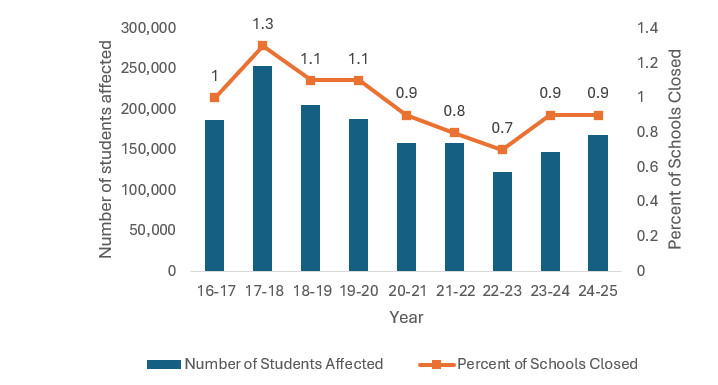
However, school closures impact communities unevenly. Research indicates that these closures disproportionately affect Black students and those from low-income backgrounds, who already encounter significant educational challenges post-pandemic. Data reveals that about 1% of public schools have closed annually over the past decade, displacing 100,000 to 250,000 students each year. This is equivalent to uprooting the student body of a large school district annually.
The COVID-19 pandemic temporarily slowed permanent school closures due to paused accountability policies and federal relief funding. As these supports faded, closure rates returned to pre-pandemic levels. The national closure rate peaked at 1.3% in 2017-2018, decreased to 0.7% in 2022-2023, then rose back to 0.9% over the past two years, reflecting the persistence of closure pressures.
Unequal Impact on Vulnerable Communities
School closures frequently hit Black and low-income communities hardest. Research highlights that majority-Black and high-poverty schools are often targeted for closure. In the 2024-2025 timeframe, schools serving mostly Black students accounted for about a quarter of closures, although they comprise less than 10% of all schools. High-poverty schools show a similar pattern.
This trend is not merely a result of enrollment drops. Schools serving Black students are likelier to close, even if experiencing identical enrollment declines. In high-poverty areas experiencing 50% enrollment drops, schools serving all Black students closed at twice the rate of those serving none.
Marginalized students faced the largest academic setbacks during the pandemic. While high-poverty and schools with students of color showed significant post-pandemic gains, stability is vital to sustaining these achievements. Closing schools disrupts relationships and environments, threatening this progress.
Consequences of School Closures
Closures often disrupt academics and behavior, especially for students moving to similar or lower-quality schools. In various cities, short-term achievement drops are common. In Chicago, displaced students saw setbacks in reading and math unless transferred to higher-performing schools. Philadelphia found no overall achievement gains for displaced students, except when moving to significantly better schools. Additionally, displaced students affected the receiving schools’ achievement levels and faced increased absences and suspensions due to longer commutes.
Systemic barriers like long commutes, inadequate transportation, and limited school seats limit displaced students’ access to better schools, thus hampering potential academic benefits from closures. Moreover, fiscal savings from closures are inconsistent. Research from Texas links closures to declines in test performance, increased disciplinary incidents, lower graduation rates, reduced college attainment, and decreased employment and earnings in adulthood. Negative effects are more severe for students from low-performing and economically disadvantaged schools.
Addressing Inequities in Closure Decisions
District leaders must confront inequities in closure decisions to avoid harming Black and low-income students. Schools are vital in anchoring communities, and closures can destabilize these areas. Equitable and transparent closure processes are essential when unavoidable. These should include ensuring displaced students don’t attend worse schools and supporting receiving schools through smaller classes, transportation aid, and counseling to mitigate predictable declines in student outcomes.
Policymakers need to tackle underlying challenges prompting closures, such as gentrification displacing families, reduced state education funding, and broader housing and economic trends diminishing school enrollment. District leaders should not bear sole responsibility for addressing these structural issues.
School closures alter children’s daily lives. While some closures are perhaps unavoidable, continuously asking the same communities to shoulder the most significant burdens is unacceptable. State and district leaders can select strategies that safeguard student progress and prevent those with the greatest educational needs from making the most sacrifices.
Megan Kuhfeld, Ph.D., is director of growth modeling and data analytics at Northwest Evaluation Association. Ayesha K. Hashim, Ph.D., is a lead research scientist.
© 2026 Nexstar Media Inc. All rights reserved. This material may not be published, broadcast, rewritten, or redistributed.
 Implications of Stripping Tax-Exempt Status from Schools Engaging in Racial Admissions Policies
  Challenging Inappropriate Books: The Struggle Against Criticism
  AI’s Impact on College Admissions Jobs
  Community Colleges in Chicago Prepare for AI’s Role in Workforce
  Sunny Hostin Discusses Challenges of Racism in Private Schools
  Nikole Hannah-Jones Reflects on School Choice