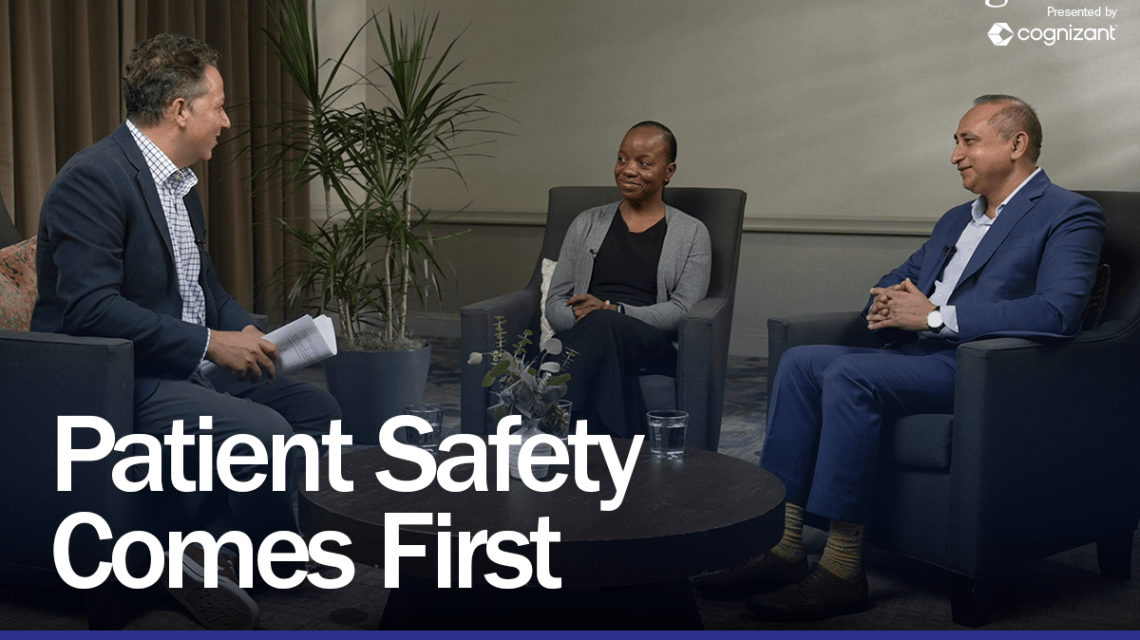
At British drugmaker GSK, finding the right specialist for a drug-safety report can take hours. Reports arrive from various sources, such as emails, paper mail, faxes, and data loggers. Each report needs to be read, assessed for priority, and allocated correctly. As the information transitions between systems, it is often repeatedly entered and reconciled. Lisa-Ann Chiriseri, GSK’s director of drug safety and pharmacovigilance applications, identifies this as a data problem rather than a process issue.
GSK is aiming to improve information flow in pharmacovigilance. The goal is to allow specialists more time to make expert decisions. Chiriseri discussed these efforts during Cognizant’s Seeking Value video series with Mohammad Haque, Cognizant’s global head of intelligent enterprise platforms, and Gabriel Snyder, Newsweek’s executive editor, enterprise, moderating the conversation.
Cognizant collaborates with GSK to automate drug-safety workflows. Haque pointed out that improving single tasks offers limited value if the next team must still reconstruct the same information. Their joint focus is on the journey of a safety report from arrival through various processes.
The problem has not gone away, it has just moved,Haque explained.
GSK aims to streamline information flow without overhauling existing systems entirely. Automation decisions usually start with problem identification and assessing if technology offers a reliable fix. Chiriseri noted that some tasks are repetitive and predictable, even when handled by highly skilled specialists.
GSK employs both AI-based and conventional automation to classify safety reports, prioritize them, and direct the information to the right experts. Structuring data upfront helps maintain context during subsequent evaluations.
Haque proposed a model integrating Cognizant’s services with an AI-driven platform covering seven drug-safety operation areas. This model uses up to 40 specialized AI agents to support activities like intake, coding, verification, and evidence retrieval, allowing parallel execution of tasks.
Despite initial automation initiatives, the coordinated agent architecture remains a future goal. Human judgment is crucial due to the regulatory implications of drug safety decisions. Conventional automation manages predictable tasks, while AI may assist in more complex assessments.
The proposed model involves two oversight forms. In one, agents prepare work requiring professional approval before regulation. In the other, agents execute defined workflows while employees manage thresholds, monitor performance, and step in when needed. GSK prioritizes traceability in their applications, enabling audit trails that help track information handling and decision-making.
Haque stressed the importance of outcome measurement for technology investments. Reducing case processing time and efforts by 50%, and shortening decision time by 40% are some of the targets. Cognizant also aims for over 90% consistency in quality-control activities.
Chiriseri highlighted that GSK is transitioning from pilots to production use, with early positive results validating the approach. Another success metric is employee adaptation to technology. While AI job displacement concerns exist, GSK encourages staff to engage with technology and improve their processes.
Citizen development, involving employees in creating applications or workflows, is emphasized. Chiriseri sees the advantage in using existing knowledge and technologies effectively.
Haque advised other companies under strict regulations to map their business processes and data before deploying AI agents, recommending visibility and accountability throughout the decision process.
 Talcott Financial Group Launches Innovative Retail Annuity Platform
 Toyota’s Digital Transformation: Streamlining Supply Chain and Embracing AI
 The Health Impacts of Vaping Highlighted by Selena Gomez’s Experience
 Brain Games and Their Effectiveness
 U.S. Faces Severe Measles Outbreak, Focuses on Vaccination
 Parker McCollum’s Love for the Outdoors and Family