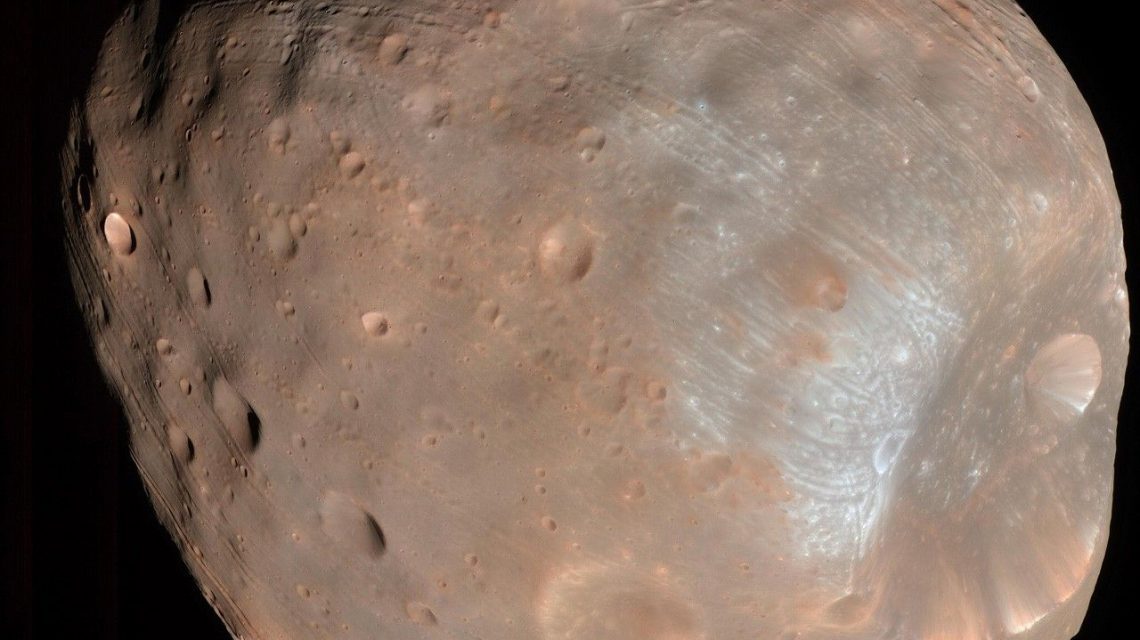
A Japanese spacecraft launched toward Mars on Tuesday to explore its enigmatic moons and retrieve samples. This mission, collaborative among five global space agencies, will attempt a robotic landing on Phobos, Mars’ larger moon. The Japan Aerospace Exploration Agency, spearheading the mission, initiated the launch from Tanegashima Island’s spaceport.
NASA has successfully landed nine spacecraft on Mars over the past five decades, while China achieved its touchdown in 2021. However, Phobos and Deimos remain unexplored, and no one has returned samples from Mars or its moons. If successful, the mission will deliver dust, soil, and rock specimens from Phobos to Earth by 2031. NASA astrophysicist Tom Statler described the endeavor as filled with ‘adrenaline and excitement.’ Japan’s expertise in asteroid sample returns enhances its position.

Phobos, measuring about 22 kilometers across, is a potato-shaped rock. Investigating Phobos’ composition could reveal insights into the formation of Mars’ moons and potentially other celestial bodies. The Martian Moons Exploration (MMX) mission is a $578 million project featuring a 5-ton spacecraft aimed at reaching Mars by next summer. Upon arrival, it will synchronize with Phobos’ orbit and deploy the Idefix rover, named after a character from the Asterix comics.
The rover, no larger than a microwave oven, will descend on Phobos, experiencing prolonged bouncing due to the moon’s minimal gravity. Equipped with solar panels, it navigates slowly at 1 millimeter per second. However, challenges include avoiding soft soil or rock entrapment. The rover’s mission is to scout Phobos’ surface for 100 days, preparing for the mothership’s descent for sampling between 2028 and 2029.
Japan aims to collect at least 10 grams of material from Phobos in a brief two-hour landing before departing. The mission will also involve Deimos observations, followed by a return to Earth by 2031. This mission faces several obstacles, highlighted by past failures. Phobos’ name signifies ‘fear,’ and Deimos translates to ‘dread’ — both sons of Ares, the war god in mythology. Russia’s attempts to reach Phobos failed, as did Japan’s previous Mars mission.
Researchers aim to determine whether Mars’ moons resulted from a cosmic collision or are captured asteroids. Discovering Mars remnants on Phobos offers valuable insights into planetary evolution and potential life origins. These findings will influence future Mars missions, including those involving astronauts, according to NASA’s Lindsay Hays.
China plans a similar mission in 2028, while NASA deliberates on retrieving samples from the Perseverance rover. Japan and China target 2031 for sample delivery, with investments of $350 million from Japan, $87 million from NASA, $68 million from the French Space Agency, $56 million from the German Space Agency, and $17 million from the European Space Agency.
Support trusted journalism and civil dialogue.
 Researchers Narrow Timeline of Early Human Migration to North America
 Marine Life Decline in Gulf of Mexico Post-Deepwater Horizon Spill
 Search for Amelia Earhart’s Missing Plane Nears Possible Discovery
 Investigating Amelia Earhart’s Possible Final Resting Place on Nikumaroro
 Tropical Storm Rachel and Coastal Hazards for Southern California
 Exploring Spider Webs, TV Pixels, and Storytelling in Science