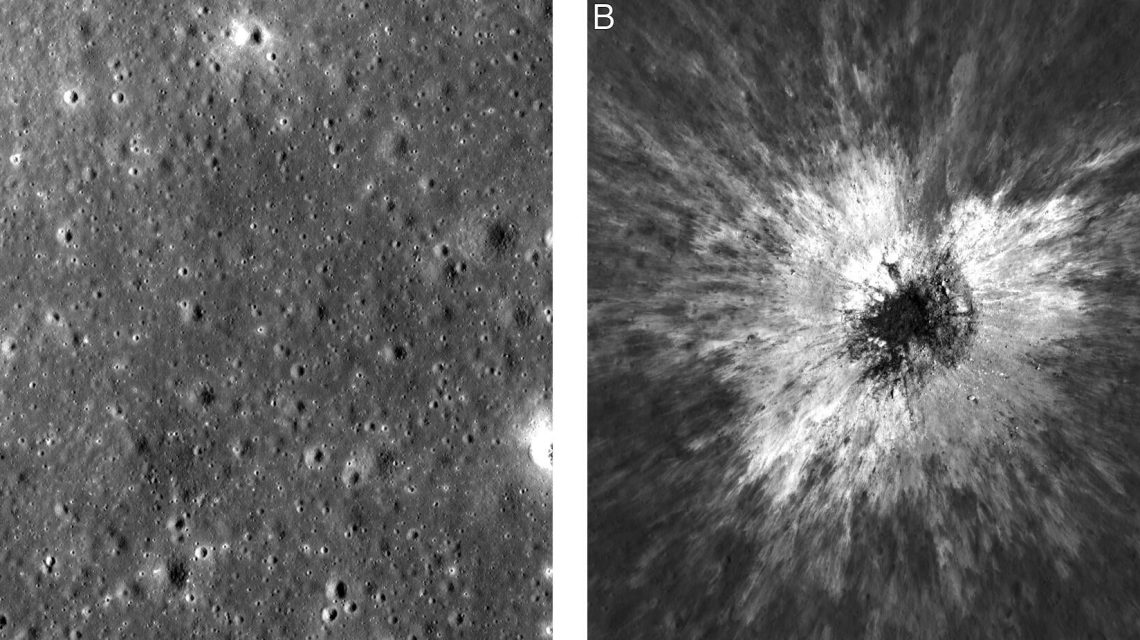
Scientists have identified a massive crater on the moon, larger than the Roman Colosseum, caused by a significant impact two years ago. Initially undetected, the crater measures about 728 feet across and up to 141 feet deep. According to NASA, this makes it the largest known impact crater in the solar system in recent times.
Such events are estimated to occur only once every 132 years. The information obtained is valuable as NASA plans to establish a lunar base for astronauts. The scientists described the finding as an incredibly rare observation in one of two studies published in the journal Science Advances.
“This event constitutes a statistically rare, effectively once-in-a-lifetime observation,” the scientists wrote.
NASA’s Lunar Reconnaissance Orbiter (LRO) captured images between April 11 and May 22, 2024, shortly after the impact. The strike, caused by a fragment of an asteroid or comet the size of a three- to six-story building, went unnoticed by telescopes on Earth and in space. The images from LRO were eventually identified in August 2025, and the discovery was confirmed early this year.
The newly discovered crater, named after Thomas McGetchin, a former director of the Lunar and Planetary Institute, is three times larger than the previous record-holder found a decade ago. The impact churned the lunar surface across more than 66 miles.
Dust and rocky soil from the impact were thrown at a higher angle than expected. According to Mark Robinson, chief scientist for the LRO’s cameras, this was a surprising finding. A separate study noted a 4-mile-wide cold spot around the crater, indicating a loosening of the moon’s topsoil.
“We’re now thinking of impacts as a way to garden the regolith — churning the sediments and putting stuff above that’s usually below the surface,” David Paige of UCLA explained.
Since 2009, the LRO has been orbiting the moon, offering close-up views of its surface. The LRO’s crater discoveries show that the moon’s top inch of soil is overturned by ejected material every 80,000 years, faster than previously believed, Robinson noted.
Despite the belief that Apollo astronauts’ lunar footprints would last forever, they will not remain intact over time. The next task is to assess the risk posed by crater material to NASA’s planned moon base. This will help engineers design structures to minimize potential damage.
Technology and scientific developments continue to unfold as experts work on building a sustainable presence on the moon. With this new crater discovery, researchers gain insights that will influence future lunar missions.
 The Challenges of Regulating AI Unveiled
  New Species of Wild Cat Discovered: Tilcayo Tiger Cat
  Challenges of the Digital Markets Act in the EU
  Ancient Warhorse Unearthed in Egypt: A Glimpse into Military Life
  Insights into Grief Observed in Humpback Whales
  AI Chatbot Concerns: Families and Legislation