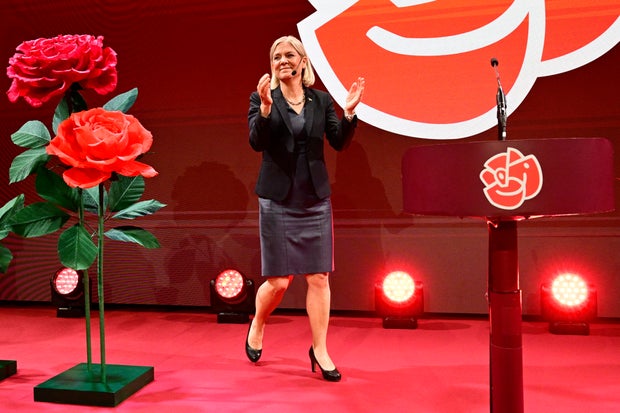
Sweden is experiencing political uncertainty following an intense election that left the left-wing opposition with a slight lead while votes are still being tallied. The election posed difficulties for the far-right Sweden Democrats, who saw their first decline since entering parliament 16 years ago.
Both Social Democrats leader Magdalena Andersson and outgoing conservative Prime Minister Ulf Kristersson expressed intentions to explore coalition options in order to secure power and form a new government. However, both sides need to make major concessions to achieve a majority.
Despite the left-wing’s narrow lead, forming a government may prove difficult due to extensive negotiations expected to last several weeks. The parliament can vote on a new prime minister as early as September 29.
According to political analyst Mats Knutson from public broadcaster SVT, both political blocs might face a “stalemate,” leading to a prolonged government formation process potentially resulting in a snap election. He suggested that parties might need to compromise on their strict policies.
With 95% of votes counted, the four opposition parties exceed Kristersson’s alliance’s by three seats in the 349-seat parliament. However, there are warnings that results could change, as some votes are due for counting by Wednesday.
A construction worker named Mikko Duvaldt commented on the increasingly polarized political scenario, voicing concerns about challenging government formation.
A Culture of Negotiation
Should the left-wing majority solidify, Andersson would need to form a government with the Greens, the Left, and the Center parties, despite fundamental ideological differences within the bloc. The Center has refused to support any government involving the Left, while the Left demands inclusion.
Kristersson is considering collaboration with the Center Party, which left the right-wing group in 2019. However, political science expert Annika Freden noted the Center’s fundamental opposition to joining the far-right, signaling hurdles for Kristersson’s plans.
Despite challenges in forming a government, Freden believes parties aim to avoid a new vote. On the left, negotiations hinge on making compromises where possible.
There exists a strong reluctance in Sweden to call for a snap election, owing to a cultural emphasis on negotiation.
Far-Right Retreats
The Sweden Democrats, an anti-immigration party, fell to 17.6% from their previous 20% share. Observers link the decline to stricter migration policies becoming mainstream.
This party, which emerged from Sweden’s extreme-right fringe and entered parliament in 2010, previously supported Kristersson’s minority government externally, influencing policies on immigration and crime without formal responsibility for government departments.
Political analyst Freden noted the reduction in migration-related issues since their peak between 2015-2016. This has weakened the Sweden Democrats’ political standing, as many parties now favor restrictive policies. Consequently, the party struggles to address other significant matters.
 A Mother’s Tragic Journey Under Abortion Ban
  U.S. Strategic Goals Remain Unmet Amid Prolonged Conflict
  New Photos Reveal Damage from Iranian Strikes in the Middle East
  Assassin of Chilean Diplomat Orlando Letelier Faces Deportation 50 Years After Assassination
  Gorillaz and Macklemore Respond to Controversy Over Israel-Palestine Statements
  Investigation into Lion Deaths in Tanzania