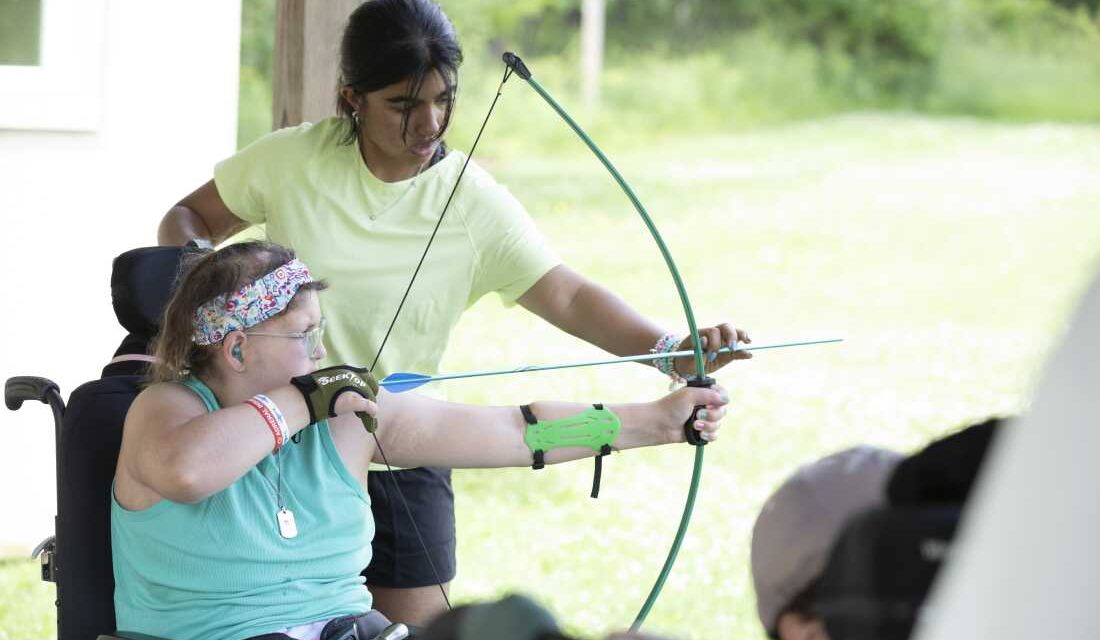
At Camp Cranium in Millville, Pennsylvania, arrows slice through the humid June air, hitting their targets. Campers and counselors cheer during archery hour. Drew Meyer, operations director, wipes away tears behind his sunglasses. He sees potential and surprise in the campers, all survivors of brain injuries. “They’ll shoot for hours and start hitting the target,” he says.
Started in 2008, Camp Cranium serves children aged 10 to 21 in Pennsylvania’s Columbia County. Some campers face severe brain injuries, requiring them to relearn basics like talking and tying shoelaces. Despite challenges, these young individuals climb rock walls, swim, and zip line through lush forests. Such camps respond to a growing trend over decades: more people, including children, now survive brain injuries, attributed to seat belt laws and quick trauma care.
Christopher Currid climbs the rock wall at Camp Cranium, showcasing the resilience these campers display. Unfortunately, efforts to track and prevent traumatic brain injuries face challenges after Congress didn’t renew funding for research on such injuries. Mass firings at the Centers for Disease Control and Prevention (CDC) in early 2025 disrupted plans for a nationwide concussion surveillance system.
Rebeccah Wolfkiel, executive director of the National Association of State Head Injury Administrators, highlights the importance of brain injury tracking. “This community deserves more,” she says. Lucas Hardy, 14, scales a 30-foot rock wall using a hoist. He sustained a traumatic brain injury at age 3 due to a falling tree branch. Annually, 2.8 million Americans experience traumatic brain injuries, including 475,000 children, according to the Brain Injury Association of America.
Brianna Engleman, a camper since 2018, collects song requests for a dance. She plans to return as a counselor. Engleman first attended Camp Cranium at 5, after a hemispherectomy for seizures. Engleman expresses her growth in confidence, finding community at camp. “It made me think, well, there’s actually good people out there,” she shares.
Massing the CDC disrupted the team studying traumatic brain injuries. The CDC is now managing these efforts through other staff within the National Center for Injury Prevention and Control. Emily Hilliard of Health and Human Services states: “The Trump Administration remains committed to supporting efforts to prevent traumatic brain injuries.” Investments are allocated for educational campaigns, injury prevention programs, and surveillance.
Federal funding remains uncertain. Tony Sadowski recalls when his son Bryan suffered a brain bleed at age 6. Now 18 and preparing to study occupational therapy, Bryan has attended Camp Cranium for years. “We’re very lucky to be able to be here,” says Tony Sadowski, the camp’s executive director. Though Congress has supported funding through reauthorizing the Traumatic Brain Injury Act multiple times, it has lapsed since 2024, and its future is under consideration.
Despite funding gaps, donations support camps like Camp Cranium and Alabama’s Bright Ideas TBI Camp. Rick Willis, president of the Brain Injury Association of America, emphasizes the importance of preserving federal funding. “The TBI Act is the only piece of federal funding for traumatic brain injury at the federal level,” Willis says.
Camp Cranium resounds with laughter, cheers, and chatter. Activities like zip lining, archery, and dance build community and combat social isolation. Tony Sadowski notes these events offer support and connection for campers and parents.
 Federal Relief Funds Used for Anti-Racism Training in Albuquerque Schools
  Florida Man Claims ‘Lion Diet’ Transformed Health and Life
  Concerns Over Food Safety and Its Impact on Families
  A Mother’s Tragic Journey Under Abortion Ban
  Medical Diagnosis Errors: Understanding the Crisis
  Lymphatic Drainage and Ice Sculpting: Emerging Wellness Trends