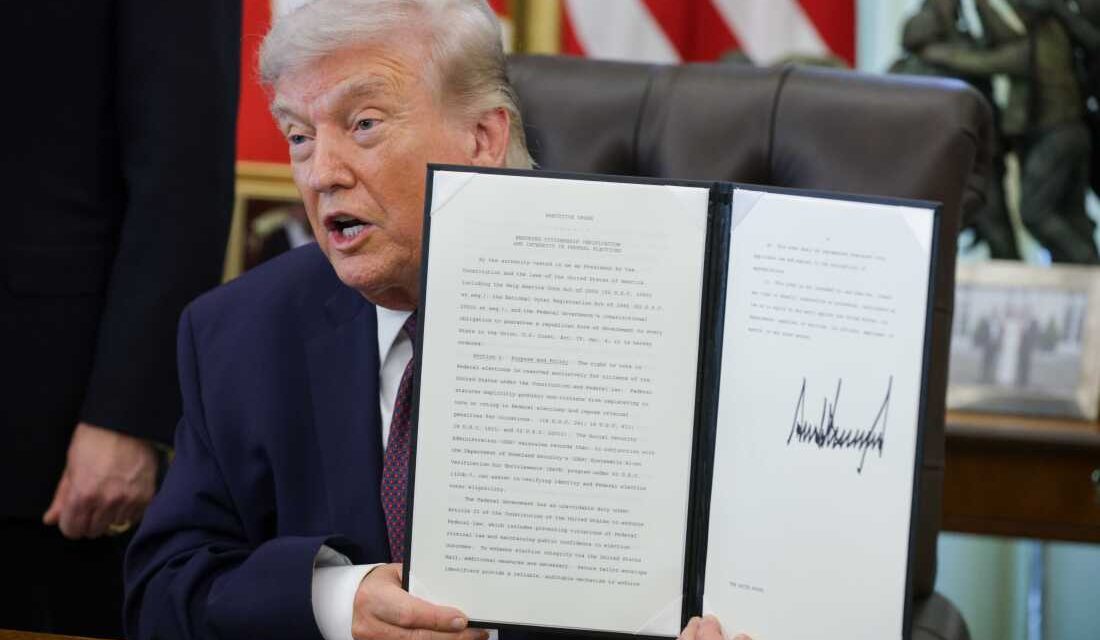
The Supreme Court has temporarily halted a lower court’s decision that blocked key parts of President Trump’s executive order to restrict mail-in voting. This decision affects approximately two dozen states and Washington, D.C.
As absentee voting for the midterms approaches, challenges remain regarding the ability of the U.S. Postal Service and other federal agencies to implement Trump’s directives.
On Monday, the court’s action reflected the ongoing legal battles concerning Trump’s March directive, a component of his broader attempts to control election processes.
In a separate but related case, the U.S. Postal Service continues to be barred from following Trump’s order due to a ruling by U.S. District Judge Indira Talwani from Boston on August 11.
The Supreme Court has not addressed the legality of Trump’s executive order, which has not affected the eligibility of absentee voters to use mail-in ballots.
Previously, in June, Judge Talwani blocked significant parts of Trump’s order in 23 states and Washington, D.C., which are primarily Democratic-led. Trump’s order instructed the Department of Homeland Security to create lists of adult U.S. citizens and required the Postal Service to acquire lists of eligible mail voters from states.
The order mandated the delivery of mail-in ballots solely to individuals on these lists. Election officials would also need to include specific barcodes on their mail ballot envelopes.
The Postal Service has responded to Trump’s order by issuing a final rule for federal ballot mail. Despite voting by mail himself in Florida this year, Trump stated this order aimed to prevent illegal voting by non-citizens, an exceedingly rare occurrence according to research.
Talwani’s June ruling determined that Trump had exceeded his constitutional authority, which reserves election rule-setting for state legislatures and Congress. Additionally, the Postal Service has no legal grounds to manage mail-in voting.
The Supreme Court has agreed to pause Talwani’s June ruling upon emergency requests from the administration and 12 Republican-led states but has not addressed Trump’s order’s legality.
The actual impact of the Supreme Court’s decision on mail-in voters remains uncertain, with ongoing lawsuits spearheaded by Democrats and voting rights organizations persisting as the election nears.
The administration has acknowledged the diminishing opportunity to enact Trump’s order this midterm season. U.S. Solicitor General D. John Sauer highlighted in a July court document that the legal challenges might not conclude in time to implement changes effectively for November’s election. Sauer noted the need for policy changes to commence as early as mid-August due to the early start of mail-in voting in some states.
Editor’s note: USPS supports NPR financially.
Edited by Benjamin Swasey.
 Universities Should Reject Political Influence on Research Funding
  Trump’s Approach to China: Trade Dynamics and Challenges
  Media Outlets Sue After White House Ban
  American Public Opinion on Press Freedom
  Media Lawsuit Against Trump Administration for White House Ban
  The Cost of Challenging Beijing