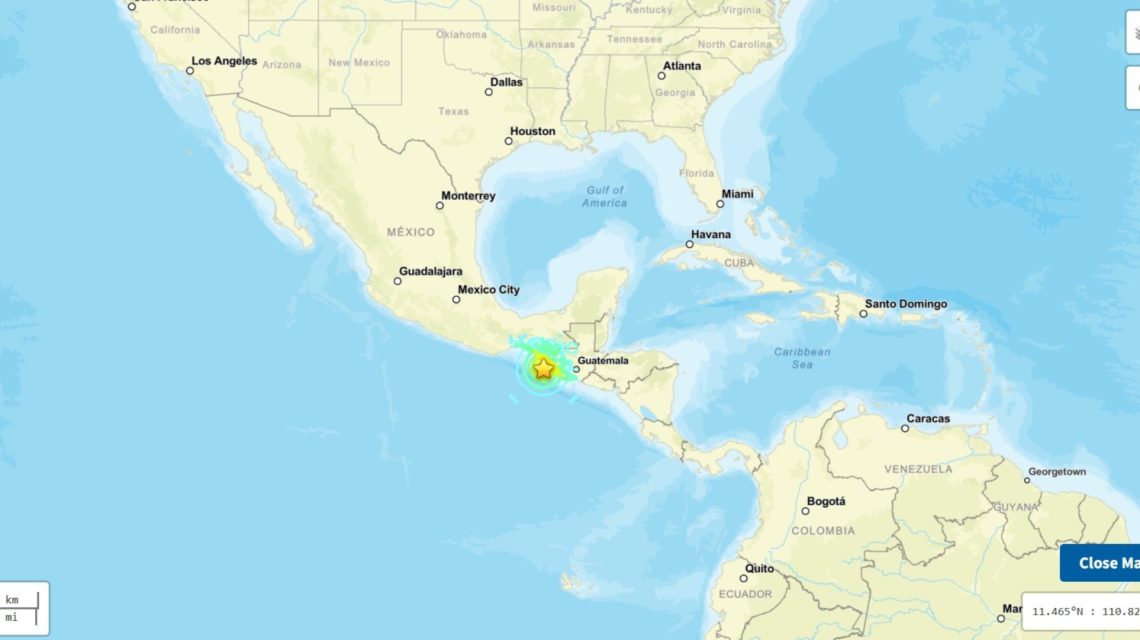
An earthquake with a magnitude of 7.3 struck off the southern coast of Mexico early Friday morning. The tremor prompted emergency reviews of infrastructure by officials in the region. According to the U.S. Geological Survey (USGS), the quake occurred near the Pacific coast of Chiapas state. It struck at a shallow depth of about 9 miles, which can often enhance the intensity of shaking and extend its reach.
This main tremor was part of a broader series of seismic activity affecting the area. There were several weaker quakes recorded both before and after the main event. These included a 4.7 magnitude quake near Aquiles Serdán and tremors of 5.1, 5.3, and 6.0 magnitudes near Puerto Madero.
Epicenter and Magnitude
The USGS placed the earthquake’s epicenter roughly 30 miles southwest of Aquiles Serdán, near Puerto Madero by the Guatemala border. It struck at 8:48 a.m. local time. Earthquakes of magnitude 7.0 or higher are major events that may cause severe to catastrophic damage, especially near the epicenter and in regions with fragile structures. According to USGS assessments, quakes of this strength have the potential for serious structural damage, fatalities, landslides, liquefaction, and widespread infrastructure failures.
Impact and Responses
Immediately after the earthquake, there were no reports of casualties or significant damage. Authorities were expected to assess infrastructure and watch coastal areas for possible tsunami impacts. Videos on social media showed strong shaking during the event.
The NWS Tsunami Alerts stated that a tsunami was not expected in the U.S. However, due to the quake’s behavior, a tsunami could be possible. Matthew Cappucci, a senior meteorologist at MyRadar Weather, highlighted the potential tsunami threat within 200 miles of the epicenter due to the characteristics of the quake.
Comparison to Historic Earthquakes
Mexico’s history includes the September 19, 1985, Mexico City earthquake, one of the deadliest and most devastating events. That earthquake measured 8.0–8.1 in magnitude and caused substantial damage in Mexico City due to the amplification of shaking by soft lake-bed sediments. The death toll was officially estimated between 5,000 and 10,000, with 30,000 people injured and thousands of buildings damaged or destroyed.
Aftershocks
After a 7.3 magnitude earthquake, officials typically advise residents in affected areas to stay updated on local emergency instructions and be prepared for aftershocks. These can continue for weeks, decreasing in frequency and intensity over time. While the largest aftershocks are expected in the initial hours and days, significant aftershocks can occur much later.
 Fat Bear Week 2026 Highlights: Meet the Competitors
  Annual Fat Bear Week Begins at Katmai National Park
  Understanding Hurricane Development
  California Prepares for El Niño-Fueled Storms with Emergency Declaration
  California’s Growing EV Adoption: Challenges and Benefits
  Data Centers in Virginia face Growing Opposition