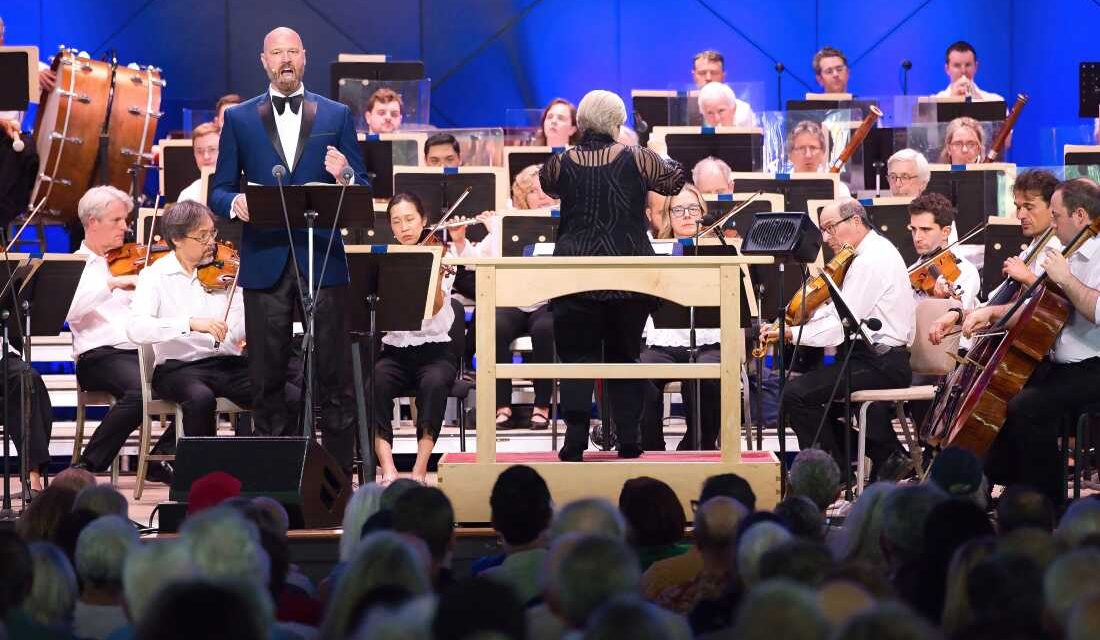
Baritone Zachary James and the Boston Symphony Orchestra, under the baton of conductor Karen Kamensek, performed Philip Glass’ Symphony No. 15 ‘Lincoln’ at Tanglewood in Lenox, Massachusetts on July 5, 2026. Despite initial plans for its premiere at the Kennedy Center during the United States’ 250th anniversary, the symphony debuted at Tanglewood, a prominent venue for the Boston Symphony Orchestra.
Philip Glass, an acclaimed American composer and recipient of the National Medal of Arts in 2015, centered this symphony entirely on Abraham Lincoln. Glass had previously portrayed Lincoln in several works, such as ‘The Civil Wars’ and ‘Appomattox.’ His opera, ‘The Perfect American,’ features an animatronic Lincoln in a duet with Walt Disney.
“Symphony No. 15 is a portrait of Abraham Lincoln, and the values of the Kennedy Center today are in direct conflict with the message of the Symphony,” Glass stated when withdrawing the premiere from the Kennedy Center.
Instead, the Boston Symphony Orchestra’s performance at Tanglewood included a suite from John Williams’ ‘Lincoln’ and Aaron Copland’s ‘Lincoln Portrait,’ narrated by actor Alec Baldwin. The performance highlighted Lincoln’s words, chosen by Glass for their enduring relevance.
Conductor Karen Kamensek has collaborated with Glass for over 30 years. She praised his choice to highlight Lincoln’s text, noting the contemporary and prophetic nature of his words. “It’s more about getting the text across,” Kamensek remarked, recognizing Lincoln’s foresight regarding America’s challenges.
Glass, now 89, did not grant interviews. He emphasized Lincoln’s legacy of unity amid division as an apt subject for the nation’s milestone anniversary.
Zachary James, who portrayed Lincoln, balanced the role’s sung and spoken elements. “I was able to be emotional in a way that you can’t when you’re singing,” James expressed, valuing Lincoln’s plainspoken openness.
“This is who he was,” James said. “He was incredibly open and vulnerable, speaking in a way men of his time did not.”
The symphony concludes with quiet, sustained chords, a departure from the typical exuberant finale. Kamensek interpreted these as four sound columns representing the moral pillars of society. “Focus the sound towards each other,” she instructed the musicians, encouraging the audience to find personal meaning in the simplicity of the ending.
 Engelbert Humperdinck Reflects on Life-Saving Shoelace During Army Service
  Chad Gilbert of New Found Glory Dies at 45
  Gorillaz and Macklemore Respond to Controversy Over Israel-Palestine Statements
  Jack Osbourne Discusses Parenting Without a Nanny and Family Dynamics
  Frankie Muniz Reflects on Personal Challenges Amid Divorce
  Dakota Johnson Reflects on Career and Future Plans