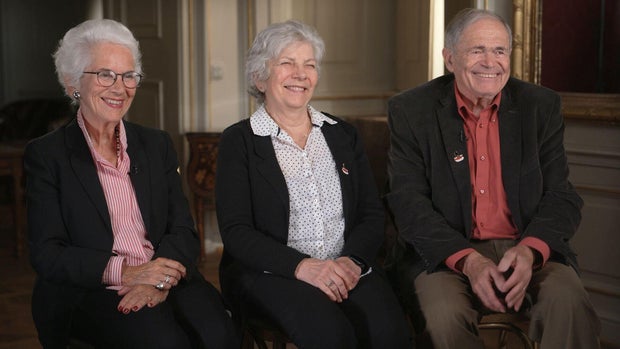
May 2025 marked the 80th anniversary of the end of World War II in Europe, witnessing the liberation of the last Nazi concentration camps. Among the remarkable stories from that era is one of three women who were young, pregnant, and sent to Auschwitz in 1944. Their experiences showcase survival under nearly impossible circumstances.
The Beginning of a Harrowing Journey
In 1944, Eva Clarke, Hana Berger-Moran, and Mark Olsky’s mothers were sent to Auschwitz. Pregnancy in the camps was punishable by death, leading the women to conceal their conditions from Nazi captors. Despite unimaginable adversity, they gave birth to three children who are now Holocaust survivors.
Lesley Stahl spoke with Mark, Hana, and Eva, the ‘babies’ from those times, who are now in their 80s. They are believed to be among the youngest Holocaust survivors.
“Everyone keeps calling you the babies.”
“Yes. And you’re 80.”
“Yes”
Born in April 1945, just before Germany’s defeat, their journey started when Eva’s mother Anka, Mark’s mother Rachel, and Hana’s mother Priska were taken from their homes in Czechoslovakia and Poland.
Life Before the War
Hana’s mother grew up in a small town with a family-owned café. Mark’s mother lived in a textile town while Eva’s mother was a junior swimming champion in Czechoslovakia. Despite the looming war, they found love and married. This period of comparative peace ended when Nazi forces invaded Poland and Czechoslovakia.
Eva’s parents were sent to the Terezin camp, where Eva was conceived. Hana’s and Mark’s parents were taken to ghettos in Warsaw and Lodz, enduring brutal conditions.
Later, under Nazi occupation, Jews were relocated to ghettos and camps. Pregnancy was considered a crime meant to eliminate Jewish lineage, yet these women continued to fight for survival.
Auschwitz and the Path to Survival
By 1944, the massacre accelerated. Expectant mothers like Eva’s, Hana’s, and Mark’s mother were transported to Auschwitz, often separated from loved ones. Mark’s mother spoke to her husband only once post-arrival, emphasizing the importance of maintaining hope.
Prisoners in Auschwitz faced selections often led by Dr. Josef Mengele. The three women hid their pregnancies during these examinations, risking their lives for the unborn. Eventually, they were transferred to a labor camp in Germany, where they worked in dire conditions.
Living on minimal sustenance, they toiled in a porcelain factory making airplane parts. The harsh conditions made concealing pregnancies difficult, but wearing oversized clothes from Auschwitz helped.
The Final Days and Liberations
By spring 1945, as the Allies advanced, remaining laborers faced extermination. Hana was born on a camp floor under the watchful eyes of guards before transport to a ‘death train.’ This train journey was a final push from the Nazis to eliminate evidence of atrocities.
A Glimpse of Hope
During the transport, Eva’s mother received milk from a passing farmer, which she credited for saving her life.
Eventually, their train arrived at Mauthausen, an Austrian camp. The camp, depleted of gas, saw its last execution the day before their arrival.
Days later, American troops stumbled upon the camp. Among these was medic Leroy ‘Pete’ Petersohn who treated ailing prisoners, including saving baby Hana. His story continued to live on as he pondered Hana’s fate long after the war.
Reunion and Remembrance
Post-liberation, the mothers sought remaining family. Despite knowing their husbands had perished, only Mark’s and Eva’s mothers remarried. The children grew as only children, learning of their families’ pasts through their mothers’ fragmented accounts.
In 2005, Hana tracked down Petersohn, meeting him 60 years after liberation. Eva, upon discovering Hana’s existence, reached out, eventually meeting with Mark. Their children aided in the reconnections, leading to a reunion at Mauthausen 65 years later.
Tributes to Endurance and Legacy
In 2025, at the 80th anniversary, they returned to Mauthausen, where survivors and liberators gathered to honor memories. Their collective story serves as a testament to human resilience, with their descendants symbolizing continuity and hope.
Mark, Hana, and Eva, now in their 80s, view each other as siblings, bonded by fate. They continue to cherish their mothers’ strength, passing stories to future generations.
“Let’s live. To our mothers.”
 Historical Discrepancies and Diplomatic Sensitivities in U.S.-China Relations
  Escalating Tensions: Russia’s Nuclear Threat and the Kaliningrad Conundrum
  Marco Rubio Discusses Thwarted UK Terror Plot and Global Threats
  New Leads Emerge in 2014 Ayotzinapa Student Disappearance Case
  Concerns Over U.N. Secretary-General Candidate’s Alignment
  Possible Shipwreck Exposed After Nor’easter in Nantucket