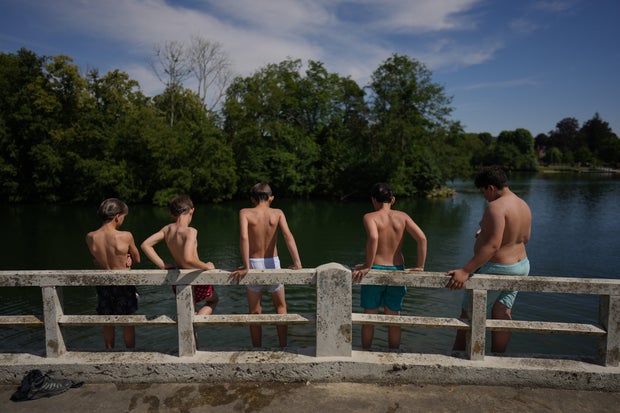
On June 21, 2026, France implemented emergency measures to deal with a severe heat wave affecting parts of Europe. Emergency services and military forces were placed on alert, outdoor sports events were canceled, and public alcohol consumption was restricted. Approximately one-third of France faced heat red alerts as temperatures were expected to reach 104 degrees Fahrenheit. A hotter forecast awaited Monday.
Across Europe, authorities enacted various measures to mitigate the heat’s risks. In Paris, misting stations were installed at the Eiffel Tower and other venues to cool crowds. Visitors to Rome sought relief in fountains, while in Spain’s Basque Country, some cultural and sports events were canceled due to the heat.
During France’s annual Music Day, which draws large international crowds, the government prohibited public drinking in red alert zones and urged event organizers to limit alcohol consumption to allow emergency services to focus on vulnerable individuals. In regions with limited air conditioning, the heat poses significant threats. The WHO reported that over 200,000 Europeans had died from heat-related causes over the past four years, highlighting the preventability of most fatalities.
Climate change is increasing extreme weather events, with UN climate agency projections indicating more heat records will be broken in the coming years. A recent study linked human-induced climate change to approximately 1,500 deaths during last month’s unusually early European heat wave. Concerns center around those living in urban heating zones and elderly individuals isolated at home or in nursing facilities. During a 2003 heat wave in France, 15,000 elderly individuals died, prompting a national reevaluation.
France enhanced wildfire readiness and intensified surveillance of water supplies for nuclear reactors, closing 845 schools on Monday. Train services were disrupted, with thousands of additional staff deployed to manage heat-related rail and electrical issues.
French Prime Minister Sebastien Lecornu is convening a government meeting to address heat crises and planning long-term adaptations, including air conditioning.
Spain began summer with heat alerts as temperatures hovered around 104 degrees, affecting regions like Basque Country. Authorities suspended outdoor activities in response. Italy expanded heat warnings to eight cities in the north and center, where temperatures ranged from the high 90s to low 100s. Fans and sprinklers were used to keep livestock cool at a farm outside Milan, while tourists in Rome used fountains to cool off.
Thunderstorms posed additional threats in various regions. The UK issued an extreme heat warning for southern England and parts of Wales, predicting temperatures up to 95 degrees, nearing a record set in 1976. Germany encountered temperatures in the mid-90s. Tragedies occurred as a 23-year-old man drowned in a lake near Rheinstetten, and three individuals went missing in the Rhine River’s strong currents. French reports indicated the drowning of four children.
 South China Sea Tensions Rise after Collision between Chinese and Philippine Ships
  North Korea’s Hypersonic Weapon Test Amid Global Tensions
  Austin Tice: A Search for Answers
  U.S., Denmark, and Greenland Forge New Security Agreement
  Secretary Rubio Discusses Middle East Conflict and NATO Relations
  Israeli Leader’s Upcoming U.N. Assembly Speech Marked by Controversy