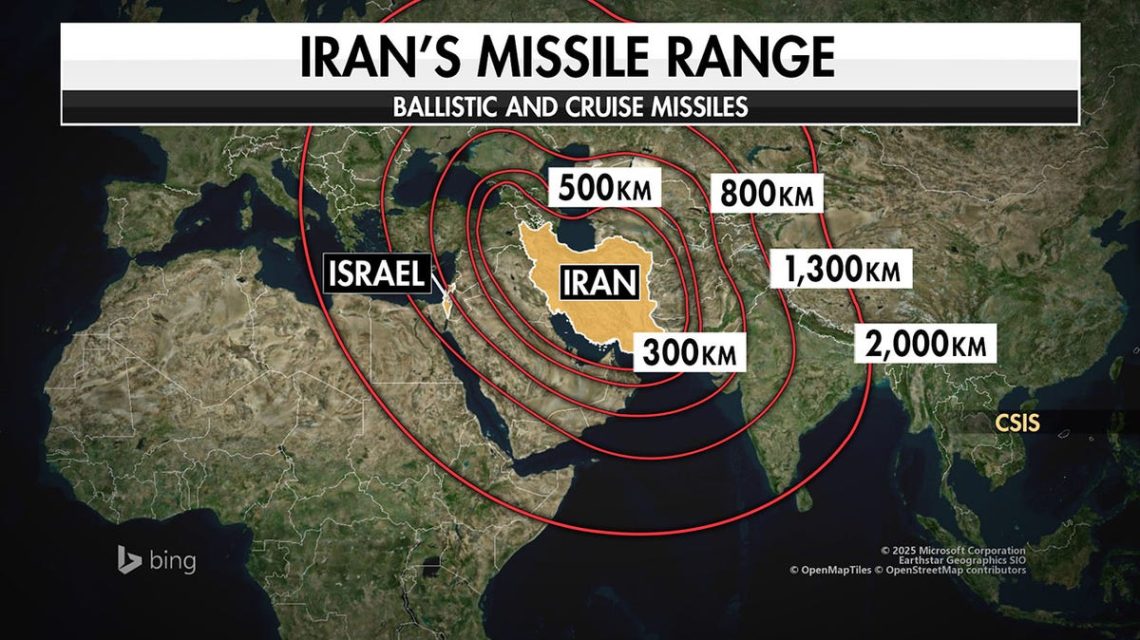
For months, senior officials in the Trump administration emphasized Iran’s ballistic missile arsenal as a significant threat. They argued it shielded Tehran’s nuclear ambitions, leading to the U.S. decision to initiate Operation Epic Fury.
In a surprising shift, President Donald Trump suggested that Iran possessing missiles may not pose an issue. Speaking at the G7 forum, Trump highlighted the fairness of Iran having missiles if neighboring countries like Saudi Arabia and Qatar possess them.
Trump expressed that missiles impact specific locations without global implications. He reiterated the importance of discussing non-nuclear issues, including Iran’s ballistic missiles and its terrorist proxies, with Gulf nations.
A map displayed Iran’s missile range, emphasizing areas within reach.
The comments marked a departure from previous assertions by administration officials regarding Iran’s missile threat. Secretary of State Marco Rubio stressed preventing Iran from hiding behind its ballistic missile inventory.
Other senior officials, such as War Secretary Pete Hegseth and Press Secretary Karoline Leavitt, described degrading Iran’s missile capabilities as crucial to Operation Epic Fury. They aimed to destroy Iran’s missile production and inventory.
Heavy weaponry showcased during Tehran’s Holy Defense Week underscored Iran’s military capabilities.
“Iran can never have a nuclear weapon, and we will not allow them to hide behind massive ballistic missile inventories,” Rubio stated.
Despite Trump’s accommodating stance on missiles, his administration pursued a memorandum of understanding with Iran. This agreement left unresolved disputes over Iran’s nuclear enrichment.
The framework allowed for 60 days of negotiation on Iran’s 60% enriched uranium stockpile. The proposed outcome involved down-blending this uranium under IAEA supervision, without resolving future enrichment rights.
Trump’s G7 remarks hinted at openness to Iran using nuclear power for electricity, contrasting past hardline positions. Trump highlighted the unfairness of restricting Iran’s nuclear capabilities when neighboring states have them.
Special envoy Steve Witkoff previously emphasized zero tolerance for enrichment capability, with the end of Iranian enrichment as a non-negotiable red line. White House officials showcased Trump’s recent missile comments when questioned about these positions.
 Debate Over Livestreaming Execution of Fort Hood Shooter
  Controversy Surrounds Pennsylvania’s 10th Congressional Race
  Pope Leo XIV Labels Death Penalty an Assault on Human Dignity
  Advocating for Clean Slate Act to Remove Employment Barriers
  EPA Contract Cancellation Sparks Legal Battle
  Press Secretary Criticizes El-Sayed Amid Michigan Senate Race Polls