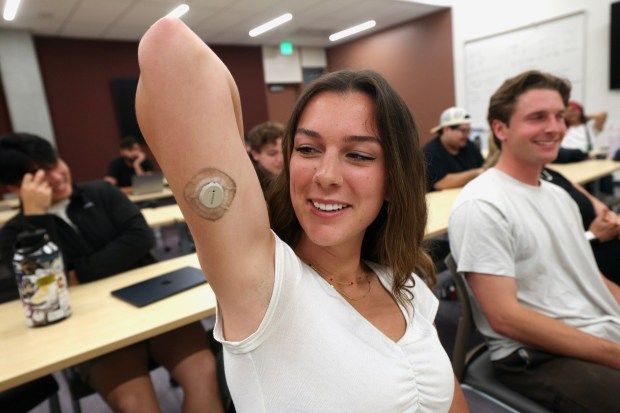
Adam Van Voorhees frequently enjoyed orange chicken, consuming it three times a week, but a concerning white patch on his arm prompted a change. Like many 22-year-olds, he didn’t scrutinize his diet until his continuous glucose monitor signaled a spike in his blood sugar to prediabetic levels after a meal at Panda Express. Now, he opts to pack his lunch.
Although Van Voorhees isn’t diabetic, he wears a monitor typically used by Type 1 diabetics for a class at UC San Diego. Previously requiring a prescription, these monitors are now available over-the-counter, as UCSD cognitive science professor Mary Boyle sees potential for these devices in helping people better understand their bodies. When San Diego-based Dexcom launched its monitor, Stelo, aimed at health-conscious buyers, Boyle incorporated it into her class study to explore its influence on healthier habits.
In the Metabolic Health Analytics class, students use continuous glucose monitors (CGMs) to understand how their bodies react to different environments and choices. For example, a person can monitor a sugar spike after eating a candy bar and observe a decrease following a brief walk. The technology is well-established for diabetics, where behavioral change is crucial for survival. However, Boyle aims to evaluate its impact on healthy individuals, gathering pilot data that has led to unexpected findings.
Boyle noted how predictable some data was, like the perceived healthiness of Panda Express. Students also observed unexpectedly high glucose levels from certain foods. Brain and metabolic health are closely linked; Type 2 diabetes can severely affect brain health, resembling Alzheimer’s when neurons starve from impaired glucose absorption. Other factors like sleep, exercise, and stress also affect metabolism.
The research on healthy individuals is minimal, according to Dr. Robert Thomas, an endocrinologist at UCSD. The class employs an N-of-1 approach, where each student uses three monitors to test personal hypotheses. This diverges from typical research, which involves larger groups to answer common queries. One class session began with a student unboxing a Stelo disk, inserting it, and syncing to a phone for two-week glucose monitoring.
Students didn’t incur costs for the monitors due to a Dexcom grant. Sharing experiences in class, some students noted glucose dips when they were hungry; others debunked the belief that hangriness is purely psychological. Katie Lam detailed how stress, particularly before exams, affected her glucose levels. When she took time to relax, her monitoring turned favorable. Boyle emphasizes the connection between hormones and metabolism, noting how cortisol influences glucose levels.
Besides students, Boyle has involved menopausal women in her studies, promoting awareness of glucose dynamics. The experiment not only highlights how our choices impact blood sugar but also helps participants adjust their habits. While these real-time insights can sometimes cause stress, as noted by student Rithika Muttukuru, they provide valuable information for improving lifestyle choices.
Dr. Thomas points out the value in measuring only when the data will inform actionable steps. For highly health-conscious or prediabetic individuals, a short trial could be beneficial. Student experiences, like Leyva’s encounter with information overload from various platforms, underscore the value of personal data from CGMs. Seeing the direct impact of choices encourages forming a relationship with health metrics, moving beyond mere advice to actionable understanding.
 Challenges Revealed in Drone Deliveries: Conor McGregor’s Experience
  Joe Biden’s Prostate Cancer Progression and Current Healthcare Insights
  Vibrio Vulnificus: A Deadly Threat in Coastal Waters
  The Journey of Annelise Camp: A Family’s Battle and Tragic Loss
  Understanding N95 Respirators: What You Need to Know
  Ethan Suplee’s Journey to Sustainable Weight Management