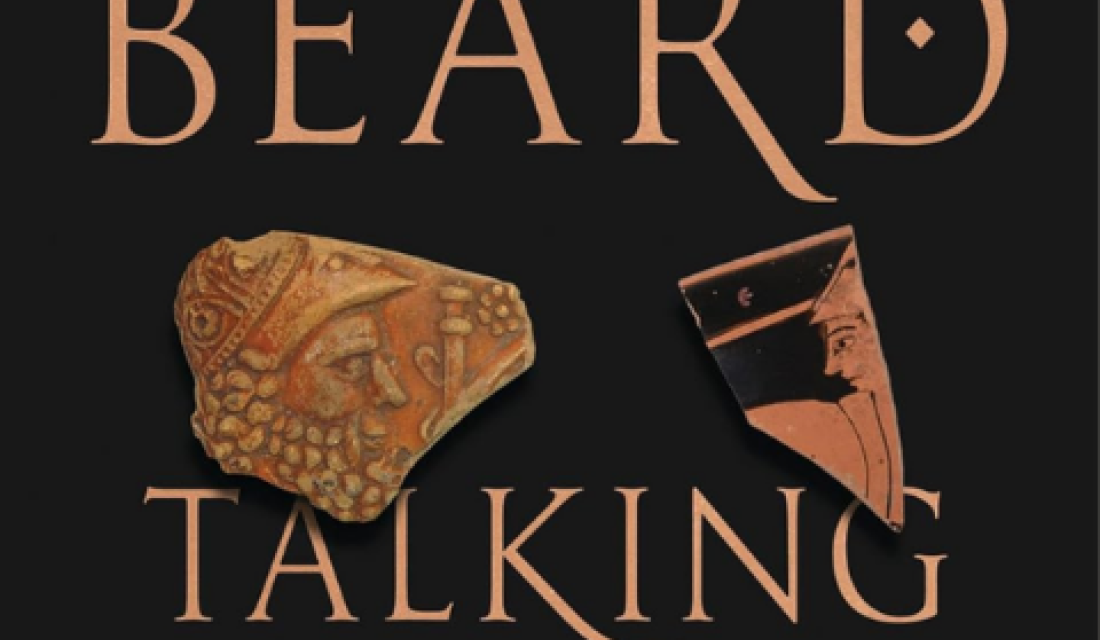
Wine comes in at the mouth, And love comes in at the eye; This line from Yeats’ poem “A Drinking Song” describes the kind of transformative experience encountered by Mary Beard, a distinguished classics scholar. Her new book, Talking Classics, recounts Beard’s early exposure to historical wonders. Raised in a middle-class village in England, Beard’s first visit to London in 1960 inspired a life-long fascination with antiquity. Her mother led her through the British Museum, stopping to see the mummies. Yet, it was the display case of everyday objects, particularly a 4,000-year-old piece of bread, that captivated Beard.
In a charming anecdote, Beard describes how her mother attempted, unsuccessfully, to lift her for a closer view, hindered by Beard’s squirming as a child. A curator approached, opening the display case and presenting the ancient bread to Beard for inspection. The experience was, in Beard’s words, a moment of thauma, which in Greek means “wonder.” This wonder became central to Beard’s work in unlocking the deep past and sharing that wonder with others.
Much of Talking Classics stems from four lectures Beard delivered at the University of Chicago in 2023. Her lively style defies traditional expectations associated with lectures. Beard’s unconventional approach includes candid remarks such as calling Medea’s husband a “slime-bag” and encouraging readers to “dial down the pious reverence” when exploring ancient history.
Beard challenges the exclusive nature of studying the classics and criticizes those who wish to perpetuate classical architecture simply for its apparent authority, referring to them as “the column crowd.” A profound question Beard addresses is whether classical architecture and forms are irreparably tarnished by associations with figures like Mussolini or extremist groups today. She highlights the radical power within the classics, noting revolutionaries like Karl Marx, Nelson Mandela, and Bobby Seale who drew inspiration from ancient texts.
The main question driving Beard’s work, and her slim book, is: “What on earth was it like to be there?” This curiosity propels contemporary reinterpretations of the ancient world, found in works like Madeline Miller’s novels, The Song of Achilles and Circe, and Christopher Nolan’s upcoming film, The Odyssey. Yet Beard also stresses the alien nature of classical civilization, describing it as at times incomprehensible.
She notes that everyday understandings of the body, identity, and family could be baffling, leading to ancient humor centered around mistaken identity. Such reflections reinforce the value of studying classics, encapsulated in Beard’s assertion that classics, and humanities education, equip individuals to “read difficult things.” Amid today’s environment rife with misinformation, these skills are indispensable.
As Beard reflects on the profound allure of an ancient piece of Egyptian bread, she invites readers to engage deeply with Talking Classics, offering much to contemplate and digest.
 The Curious Case of Mark Jackson’s NBA Hoops Card
  Communities Continuing Recovery from Hurricane Helene Explored through Graphic Novel
  Art Institute of Chicago Returns Nazi-Looted Painting to Heirs
  Chicago History Museum Responds to Protest with Aquí en Chicago Exhibit
  Ari Emanuel’s Memoir Explored
  Benito Juarez Community Academy Students Celebrate Día de los Muertos Through Art