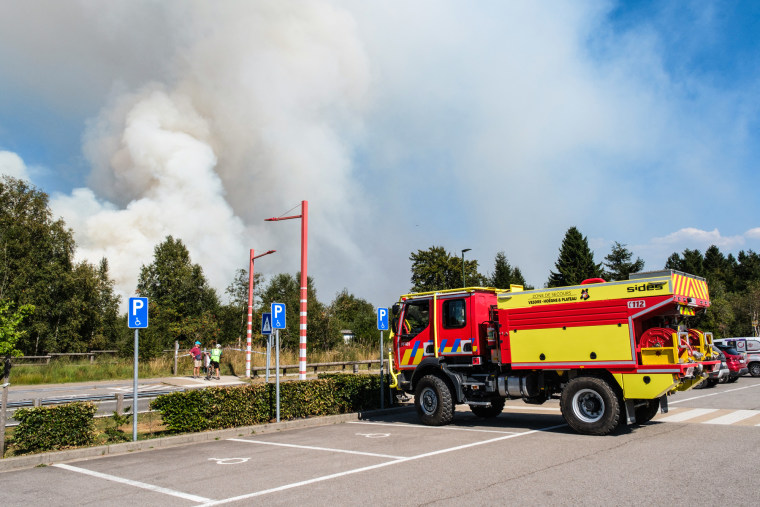
Firefighters are battling intense wildfires across Europe, impacting regions in both Belgium and Greece. In eastern Belgium, a significant fire has scorched about 30 square kilometers (12 square miles) of the High Fens, a prominent nature reserve. This incident marks one of Belgium’s most severe wildfires in recent history.
Belgium’s Fierce Blaze
Approximately 600 residents from the municipalities of Waimes and Bütgenbach in Liège province had to evacuate as winds changed direction, spreading smoke over the area. Tourists were advised to leave, and a gymnasium was set up to shelter evacuees.
Liège’s provincial governor, Hervé Jamar, stated that over 250 emergency personnel, including more than 100 firefighters from Belgium and Germany, were deployed. Support also came from police, military officers, and civil protection staff. Helicopters from Belgium’s federal police and the Netherlands assisted in firefighting efforts.
A fire truck stands stationed as smoke rises during the wildfire in the High Fens nature reserve in Jalhay, Belgium.
Tragic Loss in Greece
On the Greek island of Salamina, west of Athens, wildfires claimed the lives of two individuals. Their bodies were found in Peristeria village, where strong winds propelled the rapid spread of the fire. Another fire was reported in the Selini area, prompting evacuations by firefighting and coast guard vessels.
About 260 firefighters, along with 15 ground teams, 10 aircraft, and eight helicopters, responded to the blazes. With high wildfire risk conditions and nearly gale-force winds, the fire rapidly moved into nearby residential areas.
“These conditions enabled the fire to quickly reach dangerous proportions and spread rapidly within seven minutes toward nearby residential areas,” remarked Fire Brigadier General Vasileios Vathrakogiannis.
Escalating Crisis in Belgium
The ongoing blaze in Belgium is the largest in the country’s history, surpassing a 2011 fire that covered around 14 square kilometers (5.4 square miles) in the same region. Nicolas Yernaux from the Public Service of Wallonia indicated that unusually dry soil conditions have worsened the situation.
Rene Dahmen of the Department of Nature and Forest highlighted the fire’s difficult access area.
“On the eastern flank, there’s a line at least a kilometer long where the fire is slowly advancing toward a municipal forest. That’s the first priority now,” Dahmen noted.
A Royal Netherlands Air Force Chinook helicopter aids in firefighting within the High Fens reserve.
International Assistance
Belgium sought help from the European Union’s civil protection mechanism. EU Commissioner Hadja Lahbib confirmed the engagement of European nations. Sweden dispatched two water-bombing planes, while three helicopters from the Netherlands and the Czech Republic were also involved.
Unusually hot and dry weather conditions, reaching temperatures of 37 C (98.6 F), have plagued Belgium’s High Fens, complicating fire control efforts.
Other European Wildfires
In France, firefighters successfully contained a wildfire in the Landes region. Authorities reported no major flare-ups, with a total of 17 square kilometers (6.6 square miles) affected. Earlier in the summer, two major wildfires hit the southwestern region, with one in Gironde burning 420 square kilometers (162 square miles) and causing the evacuation of approximately 220,000 people.
In the U.K., emergency responders tackled 14 wildfires in South Wales, aided by military personnel. Despite the easing heat wave, drought conditions continue to pose wildfire risks. More than a dozen homes in central England were destroyed during the hottest day of the year, reaching 38.1 C (100.6 F).
Meanwhile, Germany made advancements in containing a fire in the Hürtgen Forest. About 2,000 evacuated residents of Gey were allowed to return home after the area was secured.
 U.S. Records Warmest September on Record Since 1895
  States Lead in Energy Policy Amid Federal Setbacks
  The Impact of Modern Windows on Home Temperature Regulation
 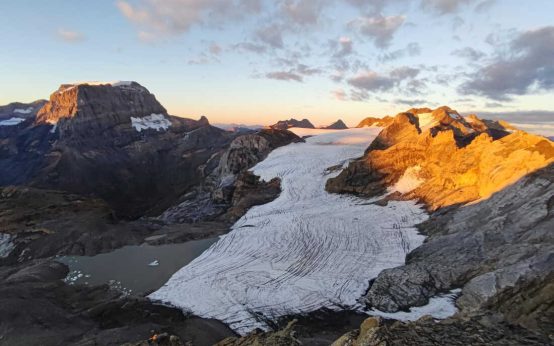 Swiss Glaciers Continue Rapid Ice Loss Due to Global Warming
  Hidden Water Reserves in Climate-Resistant Rock Glaciers
 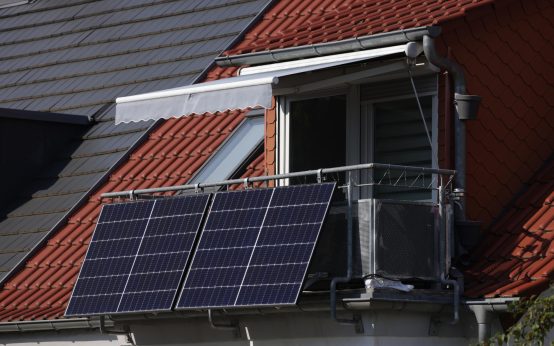 California’s Plug and Play Solar Act: A Step Forward for Renters