As the Republican Party contemplates its direction post-President Trump, Utah presents a unique example. This reliably Republican state last voted for a Democrat in 1964 with Lyndon B. Johnson. Despite its conservative background, Utah has had a complex relationship with Trump. In 2016, Utahns gave him the smallest margin of victory among Republican states, with less than 50% of the vote. Although Trump increased his support in 2020 and 2024, he never surpassed 60%.
Current Republican candidates in Utah’s congressional primary are firmly conservative but omit Trump’s name in their campaigns. This approach appears deliberate, as noted by Chris Karpowitz, a political science professor at Brigham Young University. Trump’s style and policies might not resonate with Utah voters as strongly as they do with other Republican states.
“Many Republican voters in Utah have reconciled with Donald Trump enough to vote for him,” Karpowitz stated. “But they don’t necessarily endorse his political style or specific policies.” They support the party rather than the president.
Utahns are both fiscally and socially conservative but have historically been alienated by Trump’s stance on issues like immigration. Disparaging comments about Islam and other faiths have also detracted certain voters, especially in a state heavily linked to the Church of Jesus Christ of Latter-day Saints and founded on religious freedom. As Trump’s presidency nears its end, his approval among Utahns dropped to 44% in April, according to a Deseret News/Hinckley Institute of Politics poll. Support among Utah Republicans fell by 10 points.
Utah’s 3rd Congressional District GOP Primary
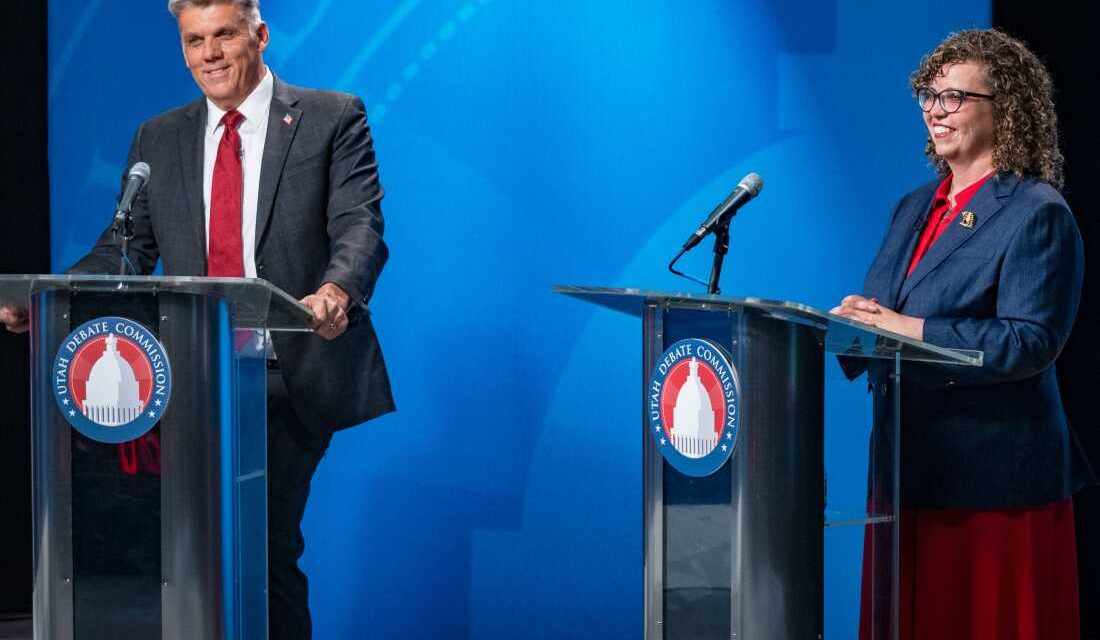
The Republican primary in Utah’s 3rd Congressional District features candidates who are conservative and Trump-supporting. Yet, neither Rep. Celeste Maloy nor former state Rep. Phil Lyman extensively mention Trump, instead relying on traditional campaigning strategies.
Both candidates focus on district-specific issues. Maloy, a policy-centric candidate, represents the establishment. Lyman aligns with the America First, Freedom Caucus. This primary election may indicate the GOP brand preferred by Utah’s expansive third congressional district.
The district emerged from mid-decade redistricting after a Utah judge ruled existing maps violated a voter-approved initiative. It is the state’s largest district, stretching from the northern region to the southern border with Arizona. Its vast rural areas include all five of Utah’s national parks, the ski destination Park City, and portions of blue-leaning suburbs near Salt Lake City. It also encompasses Brigham Young University in Provo and southwestern Utah, one of the nation’s fastest-growing regions.
According to the Cook Political Report, this district is one of the most Republican in the U.S. Maloy, who did not respond to NPR’s interview requests, faced challenges from the GOP electorate. She won a 2023 special election but narrowly emerged victorious in the 2024 primary after a loss at the nominating convention. Even with Trump’s endorsement before the 2024 election, Maloy’s victory margin was just over 200 votes.
Lyman seeks to leverage voters’ ambivalence towards Maloy. He is recognizable to Utahns after a gubernatorial run in 2024. He pivots between campaigning strategies, emphasizing grassroots efforts and distrust of centralized government. Lyman, once pardoned by Trump for leading an illegal protest, advocates limiting federal power, enhancing rural viability, and increasing transparency, especially in elections.
“What’s at stake is whether we will follow a centralized model or maintain individual autonomy,” Lyman explained to NPR. “I support the Constitution, favor government limits, and prefer governance closer to the people.”
Lyman perceives the Freedom Caucus as loyal to the Constitution and constituents, though he expresses a lack of endorsement for all members. He distances his campaign from explicit Trump support.
Engaging With Voters
Campaign strategies shift under Lyman’s direction, evident when volunteers canvassed Utah County. Volunteers conveyed consistent messages focused on Lyman’s transparency and efforts against government corruption without mentioning Trump.
Maloy defended her work during the 3rd Congressional District debate, emphasizing achievements like passing tax cuts from the One Big Beautiful Bill Act. She avoided referencing “Trump tax cuts.” Maloy also cited her committee involvement, asserting it benefits her constituents.
“People in CD3 look for representation on national stages solving problems,” Maloy told reporters. “I enjoy addressing policy; that’s my political motivation.”
Maloy and Lyman avoided discussing Trump during the debate unless prompted. Maloy supported the president’s intervention in Iran despite his “no new wars” stance, underscoring a focus on achieving peace. Despite her first full term, Maloy gained credibility, winning at the latest nominating convention by a slight margin.
Damon Cann from Utah State University described Utah’s GOP delegation as successfully navigating Trump-related tensions.
“They run as Republicans supported by Trump previously rather than Trump-focused,” he said.
With Utah’s primary election approaching, Trump endorsed Maloy again via Truth Social. He shared similar endorsements for other Utah Republican incumbents, including a candidate absent of primary opposition. Karpowitz predicts Trump’s endorsement might not harm Maloy but lacks significant impact compared to other states like Texas and Kentucky.
“Utah Republicans’ ambivalence towards Trump undermines endorsement effectiveness,” he noted.
 Court Rules Against Third-Country Deportation Policy
  Trump Administration Bars News Networks from White House
  Lawsuit Filed Over Preeclampsia Death in Texas Amid Abortion Ban Controversy
  Cook County’s Loan Program Assists Suburban Agencies Amid Property Tax Delays
  Freddy Cazares: Navigating the Limbo of Immigration Detainment and Uncertain Release
  Concerns Over Political Influence in Academia