U.S. stocks fell on Wednesday as speculation grew that the Federal Reserve might raise interest rates this year to curb inflation. While higher rates can control rising prices, they often slow down the economy and affect investment values.
The S&P 500 dropped 1.2%, losing earlier modest gains, as the Fed released projections showing that nine out of 18 policymakers expect at least one rate increase this year. The Dow Jones Industrial Average swung from a morning gain of 280 points to a drop of 507 points, or 1%. The Nasdaq composite decreased by 1.3%.
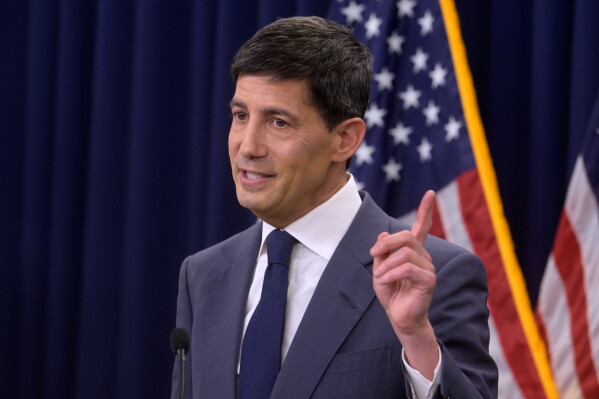
Federal Reserve Chairman Kevin Warsh, in his first press conference, did not predict where the federal funds rate might end in 2026. He mentioned a revamp in how the Fed communicates with financial markets and households. Warsh has already ended the tactic of hinting at future rate directions, a practice known as “forward guidance.”
Warsh emphasized that Wall Street should respond to economic data such as inflation and job reports based on their impact on prices rather than reacting to Fed policies. He noted potential changes to the usual three-month release of forecasts on rates, the economy, and inflation.
The Fed decided to maintain the federal funds rate at the current meeting. Reacting to the latest projections, Treasury yields increased. The 10-year Treasury yield, affecting mortgage and other loan rates, climbed to 4.49% from 4.43%. The two-year Treasury yield, closely related to Fed expectations, increased to 4.21% from 4.05%.
Traders upped the odds of an interest rate hike to 84%, up from 59.5% the previous day, reflecting inflation concerns. High yields in bond markets globally threaten economic growth and investment prices.
SpaceX observed a 4.9% drop in stock, marking its first decline since its recent U.S. stock market debut. Microsoft, Amazon, and Nvidia also experienced drops, impacting the S&P 500. However, La-Z-Boy’s stock jumped 14.8% after reporting better-than-expected profits and revenues.
Overall, the S&P 500 fell 91.25 points to 7,420.10. The Dow Jones Industrial Average reduced by 507.12 to 51,492.55, and the Nasdaq composite declined by 354.69 to 26,021.66.
Despite challenges, a report indicated retailers across the U.S. experienced faster revenue growth in May, providing hope that consumer spending can bolster the economy. However, high inflation continues to concern consumers.
Oil prices remained steady after previous declines, reflecting optimism over a provisional U.S.-Iran agreement that might restore global oil flow. The price per barrel of Brent crude oil rose 0.7% to $79.55, above its pre-war price but below the recent high of over $100.
Internationally, market indices showed mixed results in Europe and Asia. Notably, South Korea’s Kospi increased by 1.6%, while Hong Kong’s Hang Seng fell by 0.7%.
AP Business Writers Chan Ho-him, Matt Ott, and Elaine Kurtenbach contributed to this report.
 Stocks Rise as Job Cuts Affect Market Outlook
  Consider a 3-Year CD for Your $10,000 Investment
  U.S. Stock Market Rallies Amid Rising Corporate Profits and Easing Oil Prices
  Benefits of a 2-Year CD for Savers
  Kospi Index Sees Unprecedented Surge Amid AI Stock Rebound
  Rise in U.S. Unemployment Benefit Applications Despite Low Layoffs