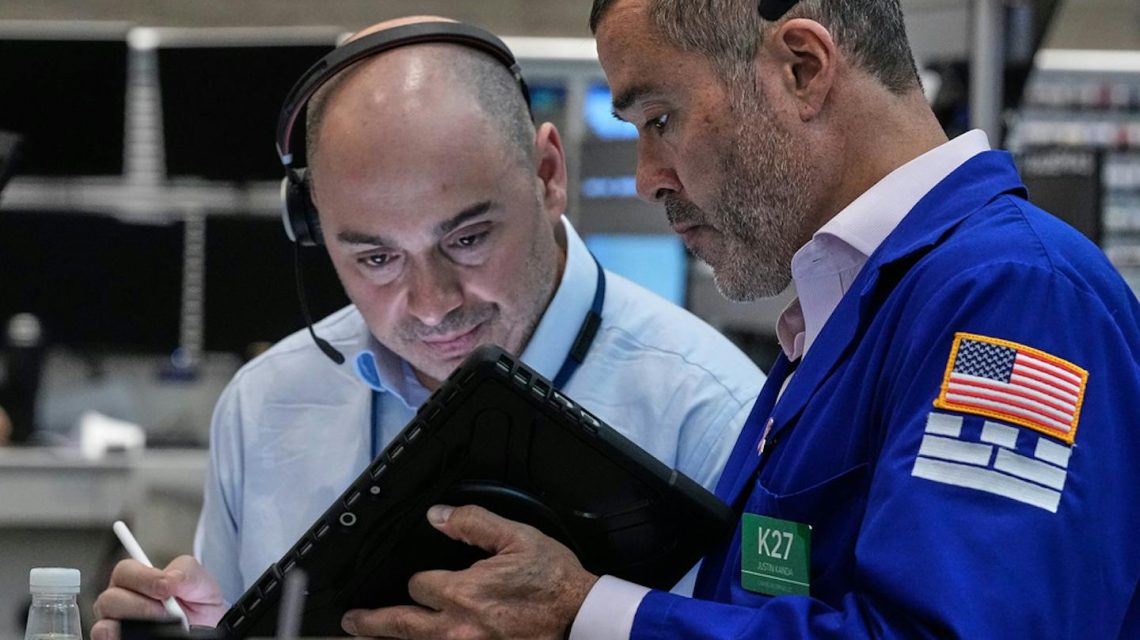
On Wednesday, the U.S. stock market rallied as Wall Street analyzed the fallout from significant losses for President Donald Trump’s party in the recent midterm elections. The early hours saw a positive performance from solar-power companies. However, investors remain cautious about the future of Trump’s social-media entity, the AI sector, and Elon Musk’s businesses, which face new challenges following Musk’s Republican contributions.
Uncertainty lingers, with U.S. stock futures oscillating between losses and gains before the market’s opening. As of now, the S&P 500 rose 1.2% in early trading, while the Dow Jones Industrial Average increased by 1,178 points or 2.3%. The Nasdaq composite also experienced a 1.1% rise.
Financial strategists advise that the election’s long-term impact on stock prices could be minimal. Historically, U.S. stocks perform well in the six months post-midterms irrespective of election outcomes. The direction of corporate profits and interest rates are more critical factors. This is echoed by Brian Jacobsen, chief economic strategist at Annex Wealth Management, who notes that, ”Earnings trump elections.”
Democrats gaining control of both the Senate and the House may offer a counterbalance to the Trump-led White House. Wall Street often favors split political control as it potentially reduces the likelihood of major economic changes.
Despite these shifts, Trump’s authority over defense, foreign policy, and some trade matters remains intact. ING Bank’s global chief of macro, Carsten Brzeski, describes Trump as ”not now a lame duck, but an angry duck,” predicting potential reignition of tariff tensions and pressures on NATO allies. Alternatively, Brzeski suggests Trump could become a ”tame duck,” focusing more on peaceful resolutions and low-profile trade dealings.
Trump Media and Technology Group experienced significant decline post-election. The company’s stock fell 9.1% with a year-to-date loss of 55.1%, mainly due to declining approval ratings. Tesla dropped by 5.2%, and SpaceX by 4.8%, with Elon Musk’s businesses potentially facing Democratic scrutiny.
The AI industry also faces pressure, with past support from Trump now possibly counteracted by Democratic regulatory interests. Political concerns around AI persist. Democratic wins in Texas might impede AI data center expansions. Nvidia, a key player in AI stocks, fell 1.5%, while AMD rose 0.3% despite surpassing profit expectations.
Conversely, renewable energy sectors reacted positively. Solar and wind companies might benefit from Democratic Congressional control. First Solar’s stock shot up 15.1%, and Enphase Energy climbed 12.1%.
In the bond market, Treasury yields decreased, indicating that investors perceive a reduced risk of additional debt accumulation by Washington.
The yield on the 10-year Treasury declined to 4.92% from 4.95%, reflecting expectations of constrained governmental spending.
Internationally, stock indices climbed globally except for Japan’s Nikkei 225, which fell 1.4%. Easing oil prices provided a boost, with Brent crude dropping 3% to $100.54. The oil market remains in flux amid geopolitical tensions involving Iran.
 Wall Street Faces Major Setback With AI Stocks Leading the Decline
 Gold Faces Its Worst Year in Over a Decade
 Impact of Rising Mortgage Rates on the Housing Market
 U.S. Stocks End Winning Week as Oil Prices Drop, Despite Inflation Concerns
 Consider a 2-Year CD for Secure Savings in an Uncertain Economy
 Impact of Federal Reserve Rate Decisions on Gold and Silver