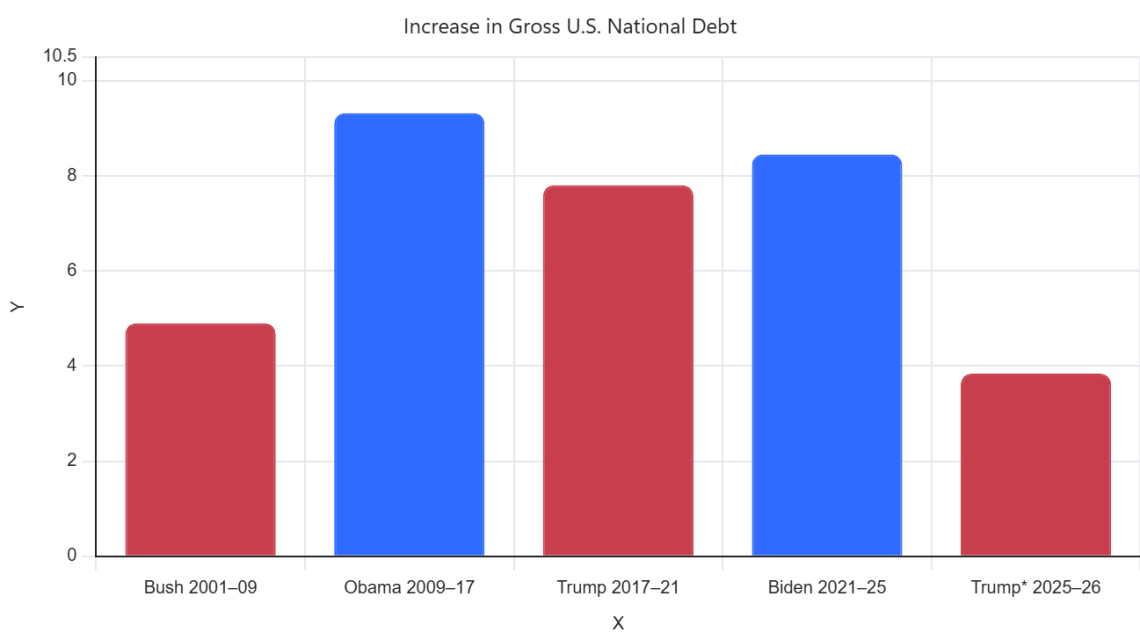
The United States’ gross national debt has reached an unprecedented $40.05 trillion, according to recent Treasury Department data. This figure significantly exceeds the $19.95 trillion reported at the start of Donald Trump’s presidency in January 2017. Federal borrowing has rapidly increased, a trend seen across both Republican and Democratic administrations, driven by various factors including wars, recessions, tax reductions, and emergency expenditures.
Debt Growth Across Different Administrations
Newsweek analyzed the debt growth under the presidencies of Donald Trump, Joe Biden, Barack Obama, and George W. Bush. During Trump’s nonconsecutive terms, the debt increased by about $11.6 trillion. Under Joe Biden, it rose by approximately $8.4 trillion. Meanwhile, during Barack Obama’s tenure, the debt climbed by roughly $9.3 trillion, and under George W. Bush, it increased by $4.9 trillion. Various crises and interest costs contributed to these figures, not solely the actions of each president.
It’s not about one administration but rather multiple administrations dealing with crises without implementing significant austerity measures afterward.– Kevin Thompson, 9i Capital Group CEO
Importance of the $40 Trillion Debt
This milestone represents the total public debt outstanding, or the gross federal debt. It comprises around $32.27 trillion in debt held by investors and roughly $7.78 trillion in intragovernmental holdings, such as federal trust fund securities. The significance of this number lies in the government’s obligation to pay interest on these debts while also funding Social Security, Medicare, Medicaid, defense, and other federal programs.
Interest expenses have become one of the federal government’s largest expenditures, totaling nearly $1.2 trillion during fiscal year 2026, according to Treasury data. The Congressional Budget Office (CBO) projects the public debt will grow from about 101 percent of GDP in 2026 to 120 percent by 2036.
Debt Increase During George W. Bush’s Presidency
Under George W. Bush, the federal debt rose from $5.73 trillion to $10.63 trillion, marking an 85.5 percent increase. Factors contributing to this rise included the wars in Afghanistan and Iraq, tax reductions, and the 2007-2009 financial crisis. The recession added complexity during the transition between Bush and Obama, affecting initial fiscal policies during Obama’s administration.
Barack Obama’s Approach to Debt
Obama’s administration faced the Great Recession, the most severe economic downturn since the Great Depression. Initiatives to stimulate the economy and address high unemployment were put in place as federal revenue fell. The national debt increased by about $5.81 trillion during his first term and $3.51 trillion in his second term, reflecting a combination of economic recovery efforts and sustained spending.
At $40 trillion, the interest bill becomes a significant concern, limiting flexibility for future economic challenges. – Michael Ryan, finance expert
The Debt During Donald Trump’s First Term
Trump’s first term saw the debt rise from $19.95 trillion to $27.75 trillion, a 39.1 percent increase. The 2017 Tax Cuts and Jobs Act and COVID-19 pandemic-related spending contributed heavily to this growth.
No recent president has avoided an increase in the national debt. – Michael Ryan
Debt Trends Under Joe Biden
Biden’s administration saw the largest four-year dollar increase, from $27.75 trillion to $36.21 trillion. Continued spending on pandemic recovery, infrastructure, and clean energy, along with rising interest expenses, significantly contributed to this increase.
The rising debt may result in a declining dollar value and an expanding wealth gap.
Trump’s Second Term and Future Expectations
Since Trump’s return to office, the debt has continued its upward trajectory, reaching $40.05 trillion, a $3.84 trillion increase in 19 months. Recent legislation has extended provisions of the 2017 tax law, further affecting debt levels. The Congressional Budget Office anticipates this will increase federal debt by approximately $4.2 trillion through 2034.
Treasury Secretary Scott Bessent stated that economic growth could potentially mitigate the impacts of reaching this debt level. Future debt increases are expected unless spending and revenue achieve balance. Without changes, the Peter G. Peterson Foundation projects the debt could reach $50 trillion within six years.
Congress bears the most responsibility, as it enacts spending and tax legislation that ultimately shapes our fiscal future.– Kevin Thompson