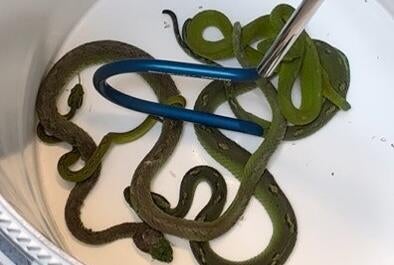
U.S. border agents made a significant discovery involving endangered reptiles hidden within a vehicle attempting to cross from the U.S. into Mexico. This incident occurred when agents noticed a suspiciously moving pillowcase in a car driven by Georgina Bribiesca Chavez, who was stopped at the border due to an outstanding arrest warrant.
Chavez, a 66-year-old resident of Tijuana, Mexico, stands accused of engaging in a complex reptile trafficking operation. Authorities allege she collaborated with Salvador Pelayo, who faced similar charges in July. The U.S. Attorney’s Office for the Southern District of California provided these details in a statement.
The arrest took place on August 10 as Chavez attempted to cross the border. Customs and Border Protection officers, discovering the outstanding warrant linked to wildlife trafficking, apprehended Chavez and secured her vehicle. A subsequent search of the car revealed hidden compartments behind the rear seats. Officers found pillowcases tied and taped, containing the live reptiles.
“Even after her arrest, Chavez never told CBP officers about the live animals in her car, leaving them abandoned for nearly 24 hours in the August heat in San Ysidro,”stated the news release.
The animals were transferred to the San Diego Zoo, where zoo personnel discovered 60 abronia lizards, four yellow-blotched palm pit vipers, three caimans, one baby crocodile, and one indigo snake. Most of these species are protected under international conservation agreements. Unfortunately, the three caimans did not survive.
U.S. Attorney Adam Gordon underscored the severity of the case:
“These animals were not cargo — they were living creatures subjected to dangerous conditions for profit,”he said.
During a court appearance, Chavez pleaded not guilty to the trafficking charges. Her alleged partner, Pelayo, also entered a not guilty plea. The U.S. Attorney’s office shared that their trafficking activities likely began in 2023, with the intent to profit from the illegal sale of these reptiles.
The U.S. Fish and Wildlife Service conducted an undercover investigation, revealing Chavez and Pelayo’s involvement in selling protected turtles. Other evidence showed they used shipping centers in the San Diego area to facilitate their operations. Authorities believe the alleged duo earned tens of thousands of dollars from these illegal activities.
 Alaska and Arctic Environmental Changes Amidst NOAA’s Transition
  Legal Environmental Group Challenges U.S. Government on Deep-Sea Mining Plans
  Trump Suspends Canadian Tariffs, Suggests Keystone XL Pipeline Revival
  Trump Administration Proposes Changes to Roadless Rule on Public Forest Lands
  Governor Walz Blocks Mining Near Boundary Waters
  The enduring impact of swamp coolers in the Southwest United States