The current U.S. military strategy in the Middle East, primarily focusing on Iran, is challenging American aircraft carrier resources. The USS George Washington is transitioning from the Pacific to replace the USS Abraham Lincoln in the Middle East. This carrier shift is due to concerns about mental health and supply issues on the heavily used Lincoln, whose deployment has extended beyond the expected return date in May.
Analysts highlight the strain on American sailors due to continuous operations, suggesting the U.S. focus on Iran detracts from Asia-Pacific commitments. Greg Poling, the Southeast Asia Program director at the Center for Strategic and International Studies, notes a divergence from prior goals. The absence of carriers in the Pacific could be brief if the Navy sends another in the coming months. Yet, regional allies express concern over U.S. unpredictability while China may leverage this distraction.
The Pacific region’s economic importance remains significant, even as the U.S. shifts focus. Bryan Clark, a defense analyst at the Hudson Institute, suggests China’s military activities portray it as a dominant power, as demonstrated through recent naval exercises with Indonesia and aggressive actions near Japan and the Philippines.
Amidst these developments, Adm. Frank Bradley reassured allies of U.S. commitment during visits to the Philippines and plans for Japan trips. Aircraft carrier presence offers psychological assurance to allies, as noted by Evan Sankey from the Cato Institute, highlighting distractions by Middle East conflicts.
President Trump largely depends on carriers for military operations, as showcased by the USS Gerald R. Ford’s extended deployment. Issues such as fires leading to operational disruptions emphasize the carrier crew’s challenges. Robert Farley, an expert in national security, stresses the importance of rest and recovery for maintaining crew efficiency.
The current carrier deployment strategy reflects a lack of long-term planning, according to Bryan Clark. Potential carrier deployment adjustments may alleviate some pressures, but ongoing maintenance requirements could limit future carrier availability.
Concerns regarding carriers’ role in modern warfare are raised by Michael Swaine from the Quincy Institute. Advancements in drone and missile technology pose threats to stationary carriers, increasing interest in smaller, versatile military assets. Top Navy officials, including Adm. Daryl Caudle, express interest in diversifying operational reliance beyond aircraft carriers.
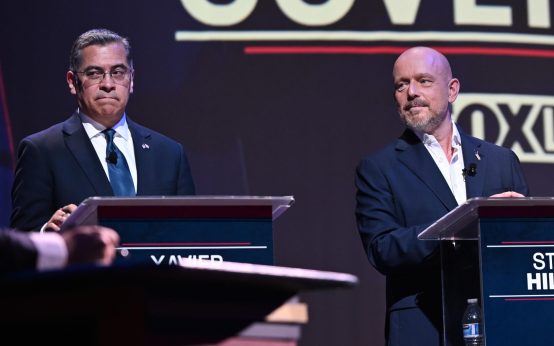 California Gubernatorial Debate: Becerra vs. Hilton
 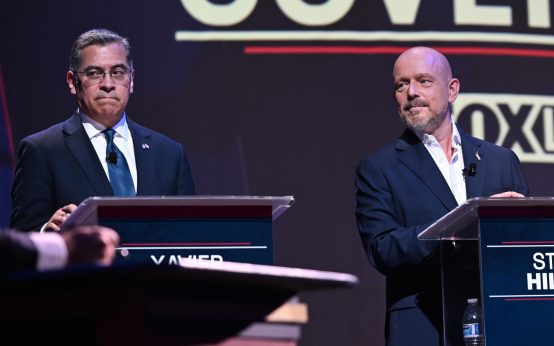 California Gubernatorial Debate: Key Highlights
 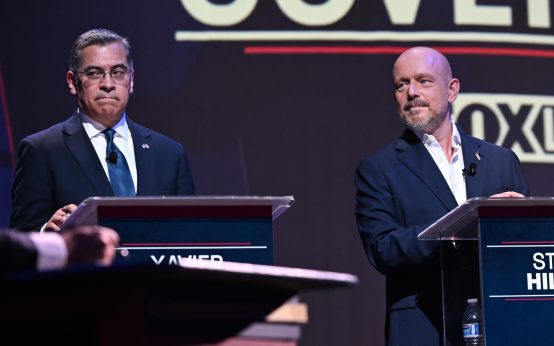 Debate Highlights: Xavier Becerra vs. Steve Hilton
  Tiffany and Crowley Neck and Neck in Wisconsin Governor’s Race
  Xavier Becerra and Steve Hilton Face Off in Crucial Debate
  Gavin Newsom Looks to Bill Clinton for Political Inspiration Amid 2028 Speculation