Poor air quality has spread across many U.S. states recently. This has been caused by a mix of smoke from Canadian wildfires, regional wildfires, and summer ozone pollution. Conditions could be unhealthy for millions.
Factors Behind Air Quality Alerts
No single factor is responsible for the recent alerts. Smoke from Canadian wildfires has moved into parts of the Midwest and Northeast. Wildfires in the western U.S. also create localized smoke. By July 19, 2026, the National Interagency Fire Center reported 40,560 wildfires in the U.S. this year. These fires have burned over 3.8 million acres.
Additionally, hot and stagnant air can worsen ozone pollution at ground level. Sunlight and heat interact with pollutants from vehicles, industries, and more. Light winds may prevent this pollution from dispersing. This leads to high levels of ozone and fine particles near the ground.
States With Air Quality Alerts
The National Weather Service issued Air Quality Alerts around July 19 and 20. These alerts cover several states, including:
- Indiana
- Illinois
- Ohio
- Pennsylvania
- Colorado
- Idaho
- Washington
- West Virginia
- Michigan
- Minnesota
- Iowa
- Wisconsin
- Oregon
In Michigan, officials have issued a statewide Air Quality Alert for elevated fine particulate pollution from wildfire smoke. Levels are expected to be in the “Unhealthy for Sensitive Groups” range, with the possibility of ozone quickly increasing.
In Minnesota, heavy smoke has affected east-central and south-central regions. The Air Quality Index may reach “Red,” or “Unhealthy,” levels. Iowa also reported PM2.5 levels deemed unhealthy near cities like Dubuque and Cedar Rapids.
Wisconsin is under a statewide advisory. PM2.5 levels could reach “Unhealthy” to “Very Unhealthy” levels in some areas. Illinois alerts are due to smoke, particulates, and high ozone levels. Indiana and Ohio issued alerts concerning PM2.5, smoke, and ozone.
Further west, states like Oregon, Idaho, and Washington are also affected. Colorado has advisories in some areas due to regional wildfires.
Growing Threat from Wildfires
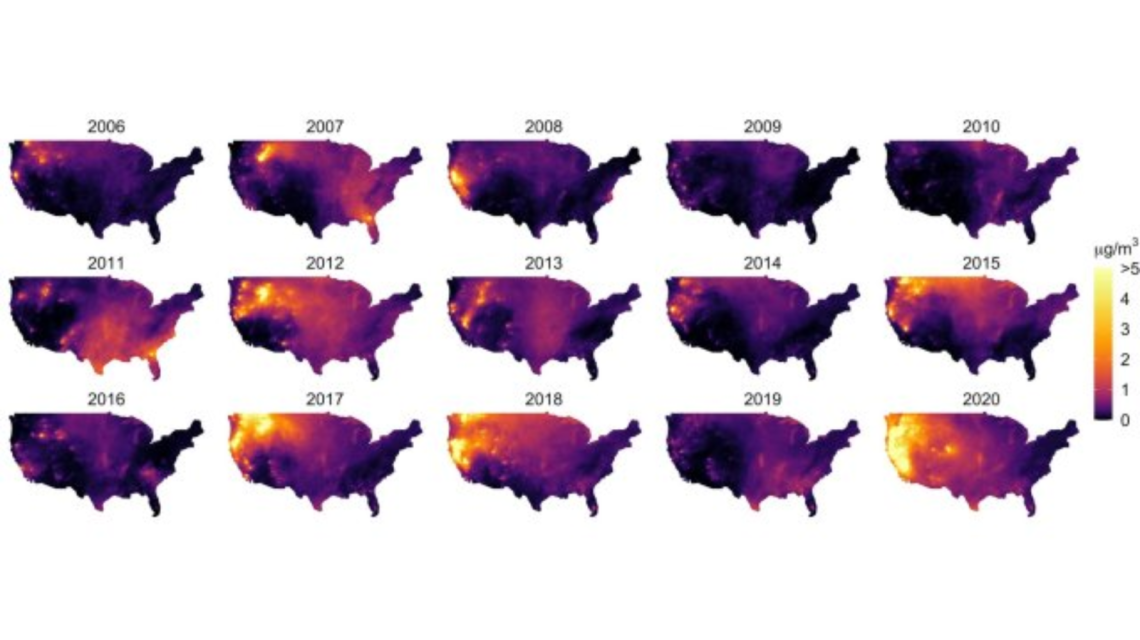
Wildfire smoke is increasingly impacting air quality in the U.S. The Environmental Protection Agency notes a rise in large wildfires over the years. This includes fires in the U.S., Canada, and Mexico, often blanketing wide regions with smoke.
EPA data from 2006 to 2020 indicates increased smoke concentrations affecting more areas. Distant communities are facing poor air quality due to smoke traveling long distances.
Health Risks from Wildfire Smoke
Wildfire smoke contains PM2.5 particles, which can penetrate lungs and enter the bloodstream. The Centers for Disease Control (CDC) warns that smoke can affect people far from the fire. Studies link this exposure to more emergency visits and hospitalizations.
Those at most risk include children, older adults, pregnant individuals, outdoor workers, and people with certain health conditions. During “Unhealthy” AQI levels, the general public may also feel symptoms like:
- Coughing or wheezing
- Shortness of breath
- Burning eyes or throat
- Chest tightness
- Fatigue or dizziness
- Heart palpitations
Long-term Health Effects
A 2026 study in Science Advances estimated that long-term exposure to wildfire-smoke PM2.5 caused 24,100 deaths per year in the lower U.S. states between 2006 and 2020. It found a link between smoke PM2.5 and higher mortality with no evidence of a “safe” level.
A separate 2025 Stanford study estimated 41,380 smoke-related deaths annually in the U.S. during 2011–2020. Future projections point to a 70% increase in such deaths by 2050. This may result in $608 billion per year in economic damage.
Research by Harvard T.H. Chan School of Public Health showed health effects from smoke PM2.5 lasting up to three months after exposure, raising risks for heart diseases, strokes, hypertension, and respiratory conditions.
Impact of Physical Activity
Officials often caution against vigorous outdoor activity during smoke events. Breathing harder increases particle intake. Studies indicate that during exercise, inhalation can rise over eightfold from rest. Activities like jogging, hiking, or cycling can increase exposure.
The EPA associates wildfire smoke episodes with spikes in asthma-related emergency visits. The CDC also reports smoke exposure exacerbating chronic conditions. The American Heart Association links smoke to more emergency visits for heart conditions.
A 2025 NIH-led study connected PM2.5 exposure to genetic mutations leading to cancer in nonsmokers, indicating a broader health issue.
Protective Measures
Public health officials suggest checking AirNow.gov or local forecasts before heading outdoors. When levels are high, consider:
- Staying indoors, keeping windows and doors closed
- Using air conditioning with a high-efficiency filter if possible
- Minimizing strenuous outdoor activities
- Exercising indoors
- Wearing an N95 mask in smoky conditions
- Having quick-relief medication at hand if you have asthma
- Seeking medical assistance for severe symptoms
 California Prepares for El Niño-Fueled Storms with Emergency Declaration
  California’s Growing EV Adoption: Challenges and Benefits
  Understanding School Shooting Preparedness Drills
  Data Centers in Virginia face Growing Opposition
  Influencer Brothers Logan and Jake Paul Visit the Pentagon
  Florida Reports First Dengue Fever Death as Outbreak Expands