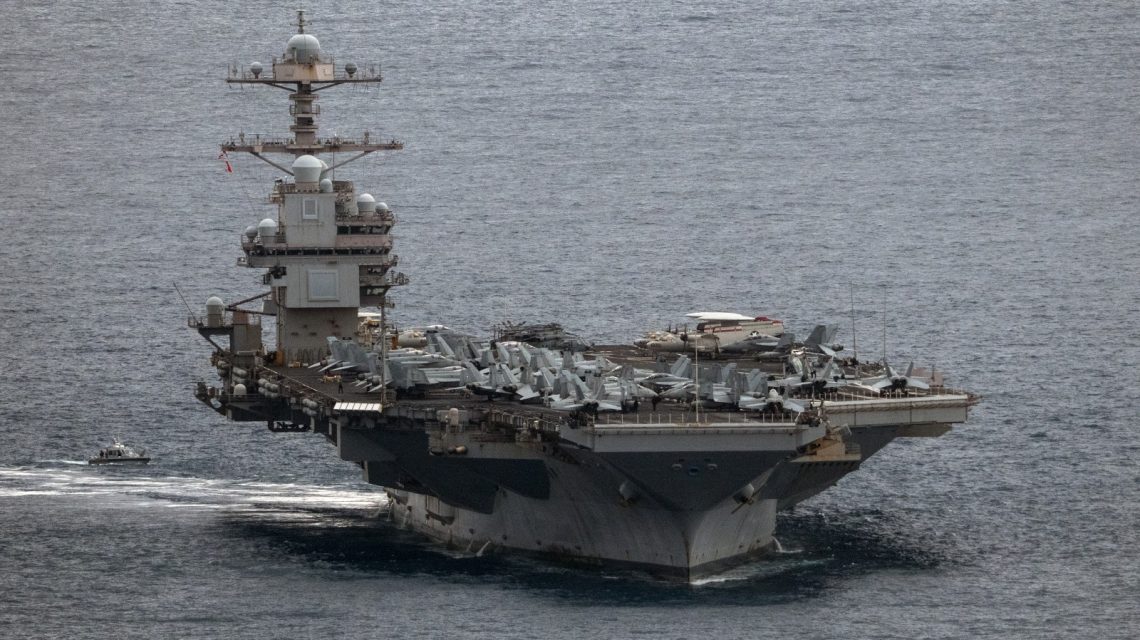
President Donald Trump’s initiative to modify the design of the U.S. Navy’s newest aircraft carriers has raised alarms among defense analysts, contractors, and former officials. These experts warn that the proposed alterations could escalate costs, delay construction, and undo years of design progress by the Navy.
Trump signed a national security memorandum directing the Pentagon and Navy to devise a plan within 60 days to replace the Electromagnetic Aircraft Launch System (EMALS) and Advanced Weapons Elevators on the USS Doris Miller. This upcoming Ford-class aircraft carrier may feature steam catapults and hydraulic systems instead. The Ford class represents the latest generation of aircraft carriers, set to replace the aging Nimitz-class fleet over the next several decades.
The debate intensified as the Washington Post reported that Navy officials are considering moving the island, or command tower, on Ford-class aircraft carriers forward to align with Trump’s vision for the ships’ appearance.Former Navy officer and defense analyst Bryan Clark from the Hudson Institute stated that such a move would be a significant redesign and highly disruptive.Navy officials explained to the Washington Post that the island was positioned toward the rear of Ford-class carriers for practical reasons. This placement allows for more aircraft parking near launch areas, increases aircraft launch efficiency, reduces turbulence during landings, and enhances safety. The Navy had previously examined relocating the island in Trump’s first term, finding that it might cost billions and significantly delay progress.
Steam Catapult Debate
Trump has criticized EMALS, arguing it is overly complex compared to traditional steam catapults. The new memorandum stresses a preference for reliable, proven, and affordable technologies. However, the Navy has underlined several benefits of EMALS. The electromagnetic system enables a higher aircraft launch rate and requires fewer personnel than the older Nimitz-class carriers. For instance, EMALS reduced the number of sailors needed to operate catapults on the USS Gerald R. Ford from around twelve to two. This system is also described as easier to maintain and requires less shipboard space.
Internationally, debate over the technology continues. China’s newest aircraft carrier uses electromagnetic catapults, and France plans to employ similar technology.
Cost and Delay Risks
General Atomics, the EMALS manufacturer, cautions that altering the USS Doris Miller’s launch system could have severe repercussions as work is already underway. The company reported that catapult and arresting gear production is approximately 50% complete, and changing course now would lead to significant cost, schedule, and integration risks. A contract worth nearly $1.2 billion was secured in 2023 related to the carrier’s launch and recovery systems.
Bryan Clark warned that modifying core carrier systems after finalizing a design could cause major disruptions since changes would affect multiple aspects of the ship’s construction. The Navy already grapples with shipbuilding delays and maintenance backlogs across various programs. Trump’s memorandum highlighted cost overruns, delays, and cancellations associated with design complexity as motives for seeking procurement reforms.
Additionally, the Navy faces broader operational and shipbuilding challenges. Aircraft carriers have played key roles in Iran-related operations, and lawmakers and military families have voiced concerns about the USS Abraham Lincoln’s long deployment and impact on sailors. Trump dismissed deployment concerns, while Defense Secretary Pete Hegseth claimed reports on conditions aboard the carrier were inaccurate.
Criticism from Experts
Defense analysts doubt the value of the proposed changes, questioning whether they’re worth the disruption. Todd Harrison, a defense budget analyst and former Air Force officer, told Politico that Trump’s sought modifications are “highly unusual and disruptive” since they are changes the Navy hadn’t requested.
Senator Mark Kelly, a former Navy pilot and astronaut, criticized the proposal, expressing his disapproval in a post. He emphasized his aviation and engineering expertise but explained he wouldn’t dictate carrier system designs to Navy engineers. In an interview, Kelly noted that redesigning ships under construction would “probably” incur billions in costs.
Kelly further commented that Donald Trump lacks knowledge in this area, asserting it wouldn’t make sense to suggest the Navy change a ship system design at this stage. Critics argue that redesigning vessels under construction could counteract efforts to control costs, extend timelines, and roll back modernization initiatives, including electromagnetic launch systems and other Ford-class technologies.
For this story, contact Newsweek editor Anthony Murray.
 The Evolution and Impact of Electronic Shelf Labels in Supermarkets
  Trump’s Use of Taxpayer Dollars for Political Advertising Sparks Controversy
  Reforming the Jones Act: Evidence for Change
  J. Dennis Hastert’s Legacy and Controversies
  Growing Support for White Nationalism Among Young White Men in the U.S.
  Erratic Policy Shifts Before Midterms Reflect Tensions in Trump Administration