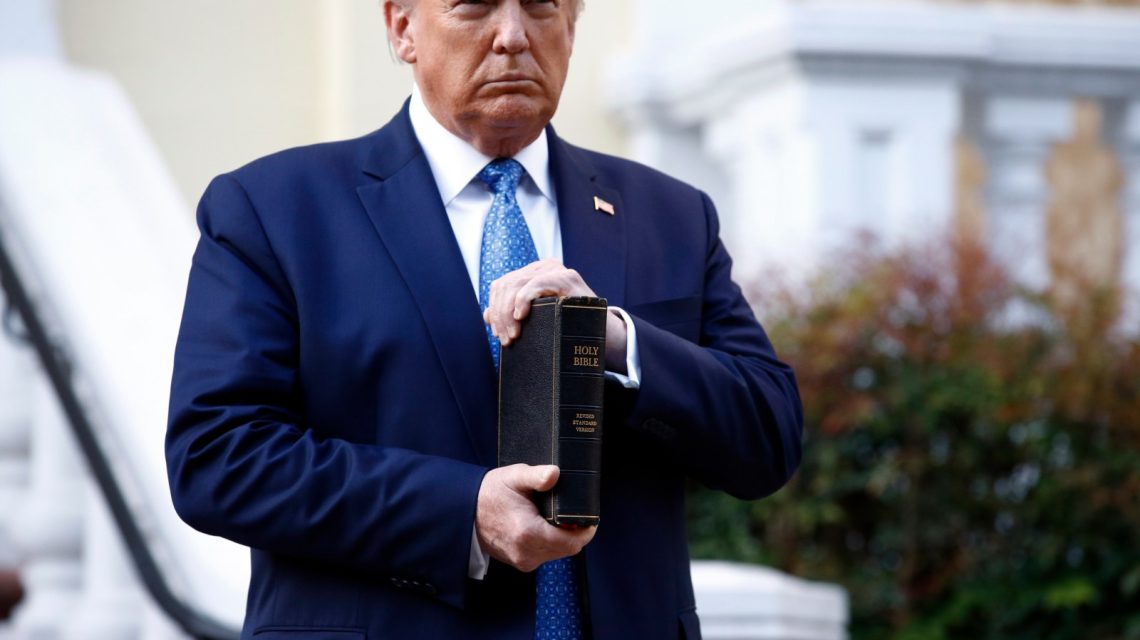
President Donald Trump has issued a stark warning to Iran, transforming the tense situation in the Strait of Hormuz into a biblical conflict. He declared that for every missile, rocket, or drone launched at a ship, the United States would retaliate by bombing an Iranian bridge or power plant. This ‘eye-for-an-eye’ strategy is both straightforward and theatrical, in line with Trump’s characteristic approach.
On Truth Social, Trump stated that if Iran attacks any ship in the Strait, the U.S. would “bomb and destroy ONE BRIDGE OR POWER PLANT,” including locations in or near Tehran. The message leaves no room for doubt and is likely to resonate with his supporters. However, the question arises: How practical is this biblical arithmetic in the volatile Strait of Hormuz?
The notion of harm for harm suits Trump’s preference for easily understood policies. His trade strategies followed a similar straightforward approach, termed as a “Fair and Reciprocal Plan,” intended to counteract perceived unfair trade practices. This form of arithmetic retaliation also appeared when the U.S. killed Iranian General Qassem Soleimani in January 2020. Trump then warned of 52 Iranian targets, a symbolic numeric match to the 52 Americans held hostage in 1979. In June 2019, Trump preferred proportionality when he called off strikes after Iran shot down a U.S. drone, citing a disproportionate potential death toll.
The Strait of Hormuz, however, isn’t merely a venue for symbolic actions. According to the U.S. Energy Information Administration, it is crucial, with around 20 million barrels of oil passing through daily as of 2024, representing a significant portion of global petroleum liquids consumption. Disruptions here have few alternatives. U.S. Central Command recently reported that Iran has attacked over 30 commercial vessels in three months, posing risks to maritime free passage.
A defined deterrent model has its logic. Iran’s leadership can count ships and bridges, making this strategy potentially effective if Tehran believes three things: that Trump will act on his threats (which is plausible), that the U.S. can control subsequent escalations (doubtful), and that the cost to Iran outweighs any propaganda gain from absorbing strikes near Tehran (which remains uncertain until tested).
This biblical instinct in policy has always relied on legal and strategic considerations. Trump’s latest threat might serve more as a bargaining tactic, simplifying deterrence, dominating media discussions, and compelling Tehran to weigh the potential costs of its actions. Iran faces options: cease its shipping attacks, test the threat with minimal strikes, or engage in escalating retaliation, turning potential deterrence into complex exchanges, each incidentlier than the last.
This strategy reflects a challenge with mixing geopolitics and scripture. While memorable, the ‘eye for an eye’ doctrine doesn’t consider the imperative of keeping the Strait of Hormuz open and stable.
 A Mother’s Tragic Journey Under Abortion Ban
  U.S. Strategic Goals Remain Unmet Amid Prolonged Conflict
  New Photos Reveal Damage from Iranian Strikes in the Middle East
  Assassin of Chilean Diplomat Orlando Letelier Faces Deportation 50 Years After Assassination
  Gorillaz and Macklemore Respond to Controversy Over Israel-Palestine Statements
  Investigation into Lion Deaths in Tanzania