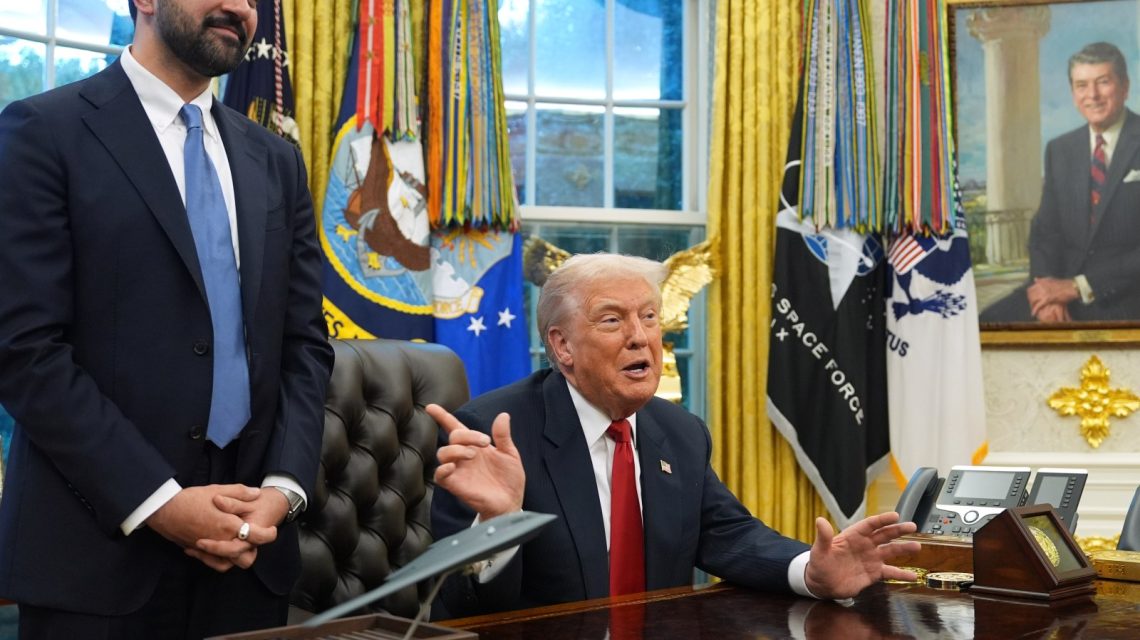
The latest Harvard CAPS/Harris poll highlights the differing net favorability ratings of President Donald Trump and New York City Mayor Zohran Mamdani. Both politicians are viewed unfavorably by more voters than favorably, yet Trump’s rating is slightly better.
President Trump has a net favorability rating of -8%, with 42% of registered voters viewing him favorably and 50% unfavorably. Mayor Mamdani stands at a net favorability rating of -14%, with 25% favorable views and 39% unfavorable.
Conducted from August 28-30, 2026, the poll surveyed 2,100 registered voters and has a margin of error of 2.1%. The significance of these figures lies in the public perception of both men as emblematic of their respective party’s ideologies.
Trump’s influence has shifted the Republican Party towards his MAGA movement, while Mamdani’s rapid ascension has positioned him as a leading figure within the Democratic Party’s progressive faction. Despite their high profiles, the poll illustrates that neither has captured a majority’s favor.
Poll results also reveal a divided perception among voters. A substantial 51% believe the Democratic Party is veering towards the far left, contrasted with 45% who see the Republican Party as tilting to the far right.
Mamdani’s political journey illustrates transformation within the Democratic Party. His unexpected victory over establishment candidate Andrew Cuomo in New York’s mayoral race has catapulted him into the national spotlight, prompting debates over aligning with his progressive vision. Trump, similarly, poses a challenge for the GOP as his approach and style remain central to Republican strategies.
The political paradox is clear: both Trump and Mamdani are central figures for their parties, but neither enjoys widespread approval. The upcoming 2026 midterm elections could see voters deciding between their political influence or seeking alternatives.
Expert opinions offer insights into the current political climate. Grant Davis Reeher, a Syracuse University political science professor, explains that negative messaging by Trump and Republicans targeting socialism and Mamdani has likely impacted perceptions.
Mamdani has faced challenges, affecting his ‘young phenom’ status, yet national awareness might dilute the impact, as suggested by Reeher. Although Trump is seen as a de facto party leader when it comes to division issues, Mamdani’s leadership role remains limited to the Left wing.
According to Craig Agranoff, politics professor at Florida Atlantic University, shifts in favorability are typical, driven by news cycles. Mamdani is still establishing recognition beyond New York, contrasting Trump’s established prominence. However, neither man unequivocally leads their party.
The Harvard CAPS/Harris Poll indicates only Health and Human Services Secretary Robert F. Kennedy Jr. and Secretary of State Marco Rubio with positive net favorability. Trump’s figures rank below several key political figures, though better than others like Gavin Newsom and Chuck Schumer.
Other polls show different aspects of Mamdani’s popularity. A Siena College poll in August showed a positive net favorability among New Yorkers. Compared to July’s Harvard poll, Mamdani’s favorability had improved, showcasing variations due to time and context.
In summary, Trump’s net favorability varies across polls with contextual differences, while Mamdani’s ratings reflect his growing presence. Both face distinct challenges in reshaping their respective parties.
 The War on Poverty: A Lesson on Intentions and Outcomes
  Reporters Blocked from White House by Trump Administration
  Universities Should Reject Political Influence on Research Funding
  Trump’s Approach to China: Trade Dynamics and Challenges
  Media Outlets Sue After White House Ban
  American Public Opinion on Press Freedom