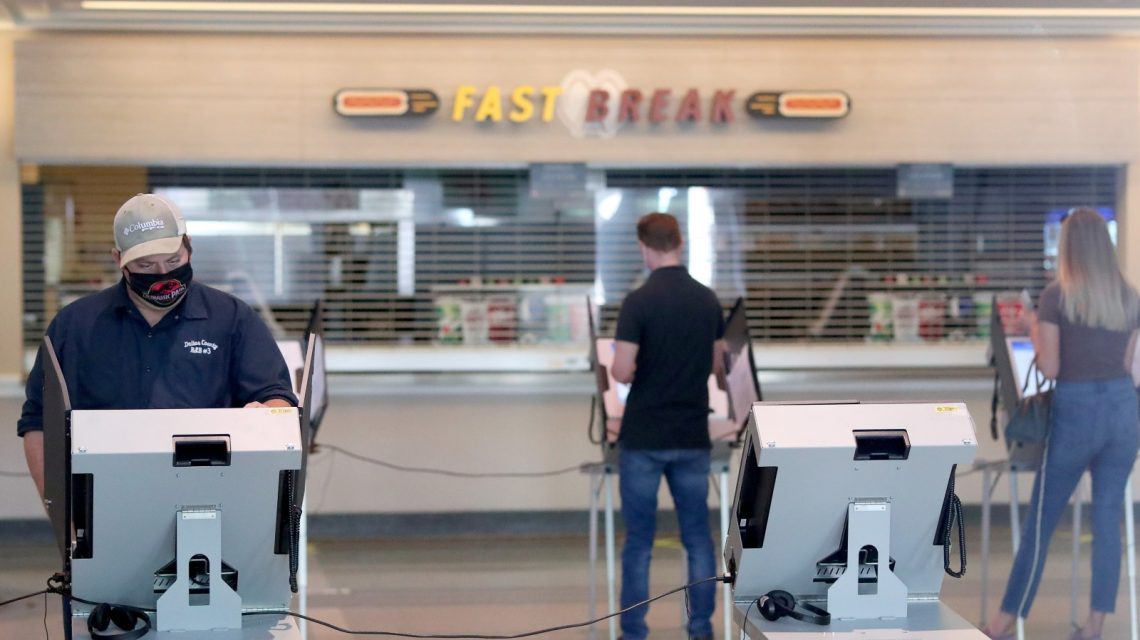
Officials in Tarrant County, Texas, have decided to reduce the number of polling sites ahead of the upcoming midterm elections. The county plans to have 92 fewer polling sites compared to the 2022 elections. This decision has sparked significant backlash from Democrats and voting rights advocates.
The Tarrant County Commissioners Court voted 3-2 to approve the reduction. The three Republicans on the court, County Judge Tim O’Hare and Commissioners Matt Krause and Manny Ramirez, supported the plan. This decision establishes 224 polling locations for the November 3 election, down from 316 in the previous midterms, to serve approximately 1.3 million voters. The two Democratic commissioners, Alisa Simmons and Roderick Miles Jr., opposed the reduction.
Reasons Behind the Reduction
Texas law allows counties to determine the number of polling sites they use. Initially, a proposal suggested cutting 140 sites, but this was reduced after Tarrant County Elections Administrator Clint Ludwig agreed that it would eliminate too many locations. The approved plan also decreases early voting locations from 50 in 2022 to 47 this fall.
Ludwig explained that the reduction aims to position polling locations where voters typically go and ensure that facilities meet ADA accessibility and operational standards. He expressed confidence that the plan would allow anyone wanting to vote the opportunity to do so.
Judge O’Hare, a Republican, countered claims that the reduction suppresses votes. He stated the average distance between early voting locations would be 2.85 miles, and 1.56 miles between Election Day sites. He emphasized the practical reasons for closures, mentioning the need to store early voting equipment securely, as mandated by state law.
Criticism and Opposition
The plan was met with opposition during a commission meeting where over 100 speakers, mainly opponents, testified against the cuts. Critics argue that reducing polling sites, especially in familiar community locations like the University of Texas at Arlington, could inconvenience voters, particularly those with limited transportation options.
“This proposal is a voter suppression tactic designed to impede Black voters and other voters of color from exercising their right to vote,”
Demetria McCain, director of policy at the Legal Defense Fund, stated before the meeting.
Many citizens and Democratic lawmakers called for an increase in polling sites in response to population growth. Alisa Simmons, one of the Democratic commissioners, emphasized the issue as political, not about cost.
Importance of the Decision
Tarrant County, which includes Fort Worth, has become increasingly politically competitive in recent years. This area, growing rapidly, is seen as a potential shift toward the Democratic Party within a predominantly Republican state.
Historically, election results in the county have shown tight races between Republicans and Democrats, indicating its swing potential. The recent victory of Democrat Taylor Rehmet in a special state Senate election in Tarrant County further highlighted this political shift.
The reduction in polling sites is perceived by some as an effort to make voting harder in light of these changing political dynamics.
What’s Next?
Early voting in Tarrant County is scheduled from October 19 to October 30, with Election Day on November 3. Residents have until October 5 to register to vote.
 Nikole Hannah-Jones Reflects on Educational Choices for Her Daughter
  Life and Challenges at Chennai’s Kasimedu Fishing Harbour
  Chicago Bears Eye Potential Move to Indiana: A Look at the Developments
  Amazon Offers Discounts to Employees at Whole Foods
  Inside the American Airman Rescue Mission in Iran
  Trump Comments on China’s Surveillance Amid Reports of Aid to Iran