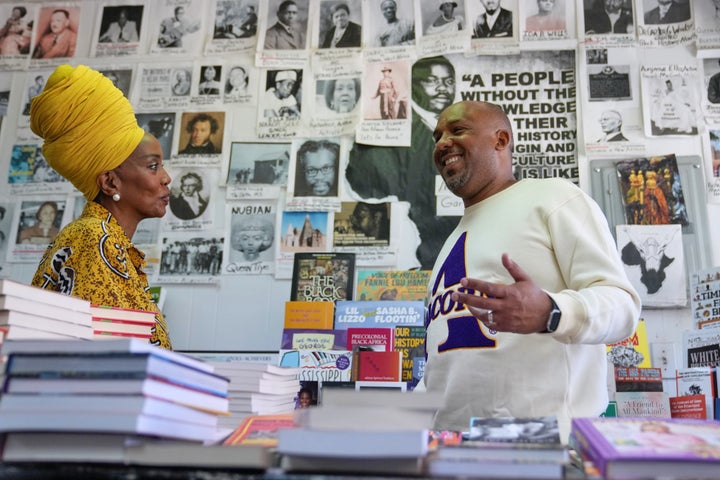
Scott Colom, a Democrat, enters the spotlight as a historic candidate in Mississippi’s U.S. Senate race. As he walks through the Farish Street business district in Jackson, residents cheer him on, seeing him as a symbol of progress. “It’s wonderful to have Scott Colom as our representative,” says Maati Jone Primm, owner of Marshall’s Music & Bookstore, a historic establishment in Jackson.
Mississippi’s vote counting continues, with Colom potentially becoming the first Black senator from the state since post-Civil War Reconstruction. This possibility brings cautious optimism and celebration among Black voters. The state’s population is nearly 40% Black, yet historically, representation has been predominantly white.
“I have faith that the process will be followed correctly,” Colom states. “Everyone needs to calm down and follow the law.” He questions, “Where is Cindy Hyde-Smith? Why can’t she speak for herself?”
Sorie Tarawally, a longtime acquaintance of Colom’s father, expresses his joy, calling Colom “the man, our messiah.” Though the race remains undecided, the counting process is ongoing in Mississippi’s 82 counties. Absentee and provisional ballots play a crucial role as volunteers and lawyers monitor for potential legal challenges.
Colom expresses confidence in local officials carrying out their duties. He believes the ballots counted since the election favor him and criticizes Hyde-Smith for her lack of transparency.
Hyde-Smith has remained absent from public view since election night, when she claimed victory despite close results. She insists the election is not over and vows to ensure the ballot counting process is fair.
Senator Angela Alsobrooks, who campaigned with Colom, observed that his candidacy energizes voters. She notes a shift in belief among Mississippi voters after years of setbacks, recognizing that their votes hold power.
The outstanding ballots primarily include absentee ones, which Mississippi counts if received by the Tuesday following the election. Affidavit ballots also contribute, cast when voters face issues like unlisted names or identification problems. Voters have until Tuesday to address these in person, or officials can verify their status through records.
Counties must certify complete results by Friday. Mississippi law does not allow for statewide recounts, but campaigns can request court-ordered examinations of ballots at the county level.
A Colom victory would signal a significant change in Mississippi, a state where white conservatives have dominated for over a century. This historical trend shifted from Democratic to Republican during and after the Civil Rights Movement, but left Black residents underrepresented.
Initially seen as an unlikely contender, Colom gained increased support in the later stages of the race. His campaign responded to Southern redistricting efforts aimed at boosting Republican power, diminishing Black representation.
Marshall’s Music and Bookstore serves as a backdrop for Colom’s visit. Established in the 1930s, it’s the oldest Black-owned bookstore in the U.S. Primm celebrates Colom’s potential, noting its significance for future generations, especially young Black Mississippians.
Colom emphasizes his commitment to all Mississippians, criticizing policies of former President Donald Trump for their broad impact. He welcomes the prolonged ballot counting as a chance for greater state exposure.
Colom and his supporters recognize the deep importance of his campaign. “We’re motivated by gross inequalities and only one side seems to benefit,” says Tarawally, who immigrated from Sierra Leone. He praises Colom as a candidate who advocates for their interests.
Ending his campaign, Colom released an ad filmed at the home of Medgar Evers, a civil rights leader assassinated in 1963. This powerful message resonated with voters, highlighting the sacrifices made for electoral rights.
 Custody Dispute Involving Rep. Max Miller Delayed
 Attorney General Addresses Post-Midterm Democratic Threats
 Senator Elizabeth Warren and the Future of Crypto Regulation
 Bipartisan Opportunities in Foreign Policy
 Political Shifts and Concerns Post-Midterms
 Closing the Foreign Financing Loophole in American Lawsuits