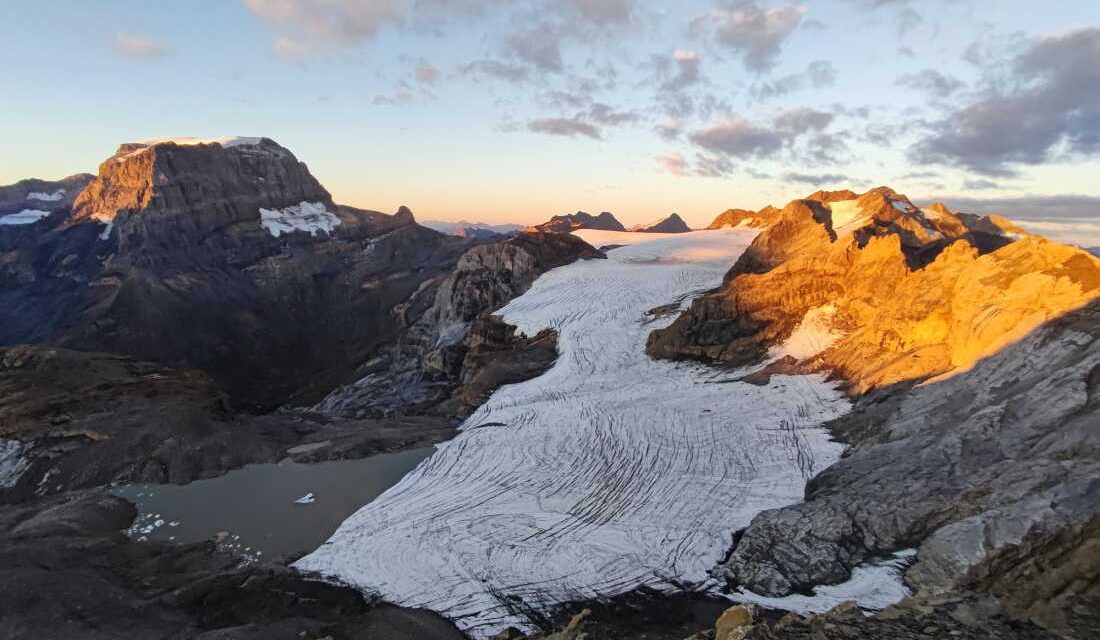
Glaciers in Switzerland showcase the stark impact of ice loss, with exposed rock visible in areas once covered by ice. In 2026, Switzerland’s glaciers lost over 5% of their ice, continuing a trend of rapid decline seen worldwide. Scientists attribute this to global warming.
Matthias Huss, the head of Switzerland’s glacier monitoring network, known as GLAMOS, measures the ice fields each summer. His research highlights the accelerating ice loss, with a peak in 2022—a record 6% loss in a year. After this summer’s heat, Huss observed drastically diminished ice on the glaciers.
Huss described the glaciers as dry and barren. Only small ice blocks remained, melting quickly under the hot sun. In some regions, alpine plants have started growing in areas once thickly covered by ice.
The 2026 glacier report shows a 5.5% ice loss. This slight improvement over 2022 is thanks to more winter snow covering the ice. Despite this, key Swiss glaciers, like the Rhône and Aletsch, experienced their highest ice loss on record.
These significant ice fields, often called Europe’s water towers, store winter snow that melts gradually in spring and summer. This melt replenishes vital waterways like the Rhine and Danube. Their water is crucial for Europe’s food supply and transportation.
During the summer, lower river levels halted freight transport in the Rhine and Danube. Even nuclear power stations cooled by river water had to shut down temporarily. This could worsen if glacier melt continues, as fewer glaciers mean less water for farmers, posing a serious drought risk.
Glaciers and alpine permafrost help stabilize mountain structures; their loss increases landslide and flooding risks. In Switzerland, a glacier collapse led to a landslide that destroyed 300 homes in Blatten, which had been monitored for instability.
This summer, a glacier collapse on Nepal’s border with Tibet resulted in floods that claimed roughly 1,400 lives. Huss notes that while mountain environments are inherently risky, climate change can be a catalyst for such disasters.
He emphasizes that climate change alone doesn’t cause mountain collapses. However, it can trigger them alongside warmer temperatures and permafrost loss, acting as a final factor to induce these disasters.
Huss argues against dismissing climate change, using glacier evidence to advocate for action. The current course of planetary warming threatens the existence of these glaciers. According to predictions, if warming continues at the present rate, Swiss glaciers could vanish by the century’s end.
 Hidden Water Reserves in Climate-Resistant Rock Glaciers
  California’s Plug and Play Solar Act: A Step Forward for Renters
  Challenges Loom Over Colorado River’s Water Levels
  Suncor v. Boulder: Understanding the Supreme Court Case and Its Implications
  Hawaii Faces Challenges from Record-setting El Niño and Hurricanes
  Unexpected Ocean Conditions Bring Challenges to Ventura County