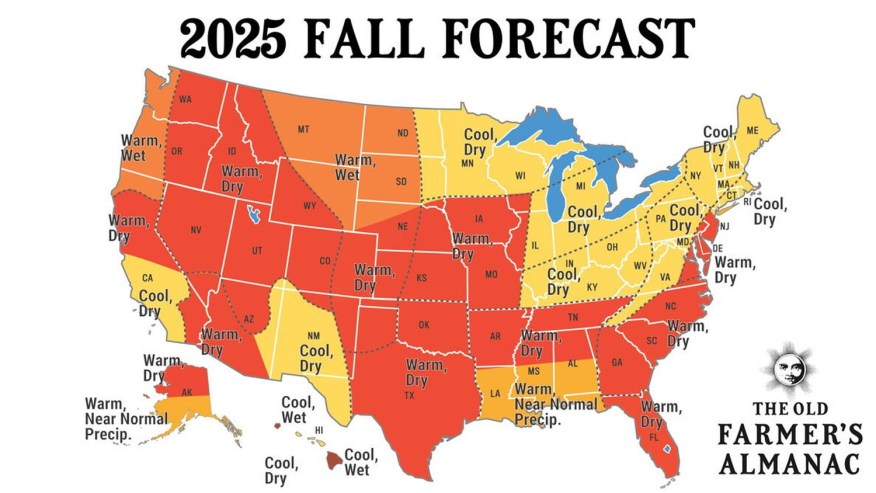
The time of year is approaching when sunsets become earlier and mornings start to feel cooler. The autumnal equinox is nearing, signaling the release of forecasts from both the Old Farmer’s Almanac and the Farmers’ Almanac. These periodicals are distinct and offer extended forecasts along with gardening tips and skywatching advice.
Last month, the Old Farmer’s Almanac predicted a “warmer than average” fall with a “cool, wet” outlook for the Pacific Northwest and northern New England. The Plains and Rocky Mountains may experience a warm and dry fall, while the Midwest, Ohio Valley, and East Coast could face a cool and dry season. This is not much different from last year’s forecast.
The Old Farmer’s Almanac’s predictions often focus on solar science, climatology, and meteorology by comparing solar patterns and historical weather with current activity.
The Farmers’ Almanac recently shared its winter weather predictions, warning of “snow, sleet, and surprises.” They forecast that the U.S. could see precipitation, with snowy conditions in the upper Plains and Midwest, wet areas across the Gulf and southern East Coast, and coastal storms in New England.
Both publications claim an 80% accuracy rate, though studies show the Farmers’ Almanac is only correct about half the time. The Farmers’ Almanac considers the moon’s influence and past weather, while the Old Farmer’s Almanac has used its formula since 1792.
Rich Segal, a retired meteorologist, noted that trusting long-range forecasts can be unreliable since predictions can change within 24 hours.
The National Weather Service will release its winter forecast in mid-October, which might change. Jon Gottschalck from NOAA stated that early forecasts would lack reliability and cannot predict specific major events.
NOAA provides temperature and precipitation outlooks based on probability. For instance, the upper Pacific Northwest might have a warmer fall, whereas the southern Midwest and Ohio Valley could go either way.
Factors such as the expected “super” El Niño, with a potential peak between October and December, might influence a quieter Atlantic hurricane season. Typical El Niño patterns indicate warmer, drier conditions in the northern U.S., while the south might experience a wetter winter.
Sandi Duncan, editor of the Farmers’ Almanac, emphasized that while predictions are refined, nature remains unpredictable.
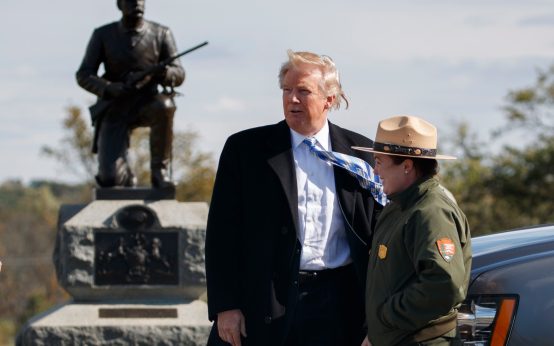 Day of Action Planned Against Trump’s National Parks Agenda
 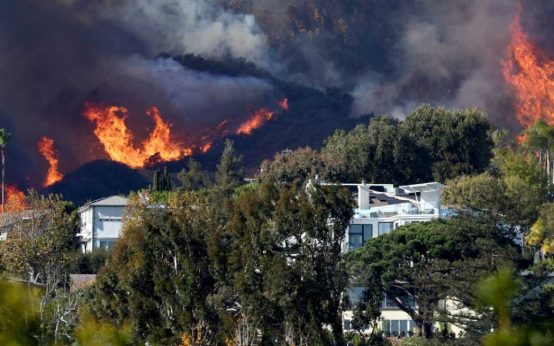 California’s New Wildfire Regulations
 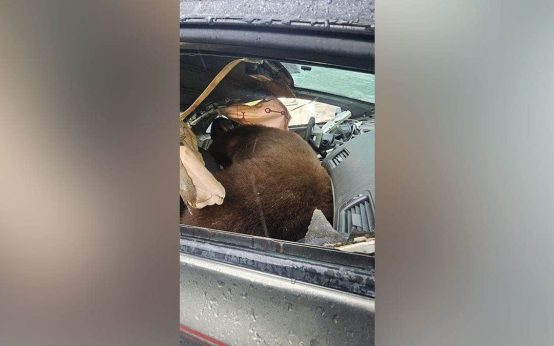 Black Bear Incident Highlights Colorado’s Rising Bear Encounters
  U.S. Border Agents Uncover Reptile Smuggling Attempt
  Bodies of Belgian Climbers Found in Swiss Alps After 34 Years
  Alaska and Arctic Environmental Changes Amidst NOAA’s Transition