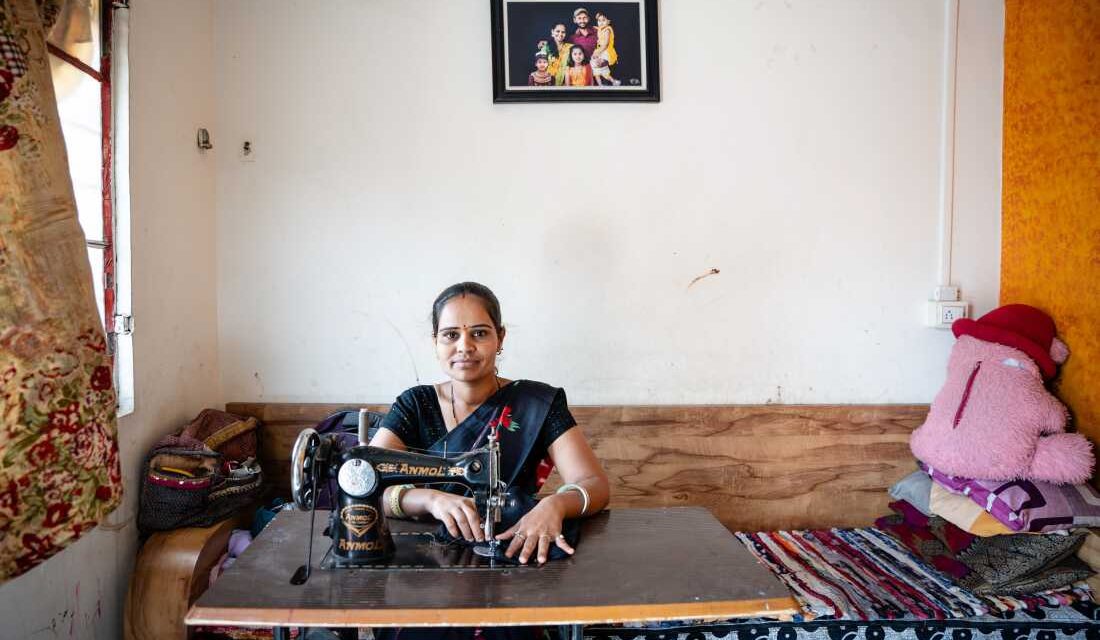
Pooja Gawali and her family transitioned from a tin shack to a modern apartment, gaining privacy and space. Her sewing machine now holds pride of place in the living room. The construction project received an award for innovation.
Pooja once lived in a cramped, one-room home with no plumbing. Tin sheets formed the walls, and a leaking roof worsened conditions. She shared the space with her husband, his family, and two brothers. The lack of relaxation and privacy was constant. This was common in Sanjaynagar, a dense slum in Maharashtra, India. Homes crowded, surroundings muddy. Around 900 people lived in 206 metal shacks.
Gawali’s life changed in 2022. She moved to a new apartment in a three-story building with 33 units. It housed 31 other families from her neighborhood, including her brothers-in-law. Her family wished for a connecting inner staircase, which was granted. “I relish the privacy I have now,” says Gawali. “Life is easier with space for everyone.”
The building is named Swapnapurti, meaning “a dream fulfilled.” Each unit has a living room, bedroom, kitchen, and bathroom. The building features green plants, benches, bamboo screens, and cooling materials like sand and ash bricks.
This design is part of the Sanjaynagar Redevelopment Project. Collaborating with local government, donors, nonprofits, and families, it aims to transform the area. Families pay 10% of construction costs, supported by low-interest loans from Rang De. The federal PMAY scheme and Currystone Foundation philanthropy contribute additional funding.
The project won Silver at the World Habitat Awards for sustainability and innovation. Francesca Lionetti from UN-Habitat calls it a model for community-led design, enhancing communal areas and services.
The project emphasizes community bonds. Sandhya Janardhan, a key architect, designed homes around a central courtyard. It’s a shared space for play, rest, and events, enhanced by corridors bringing light and air.
Initial doubts about the project’s success arose from persuading families to relocate. Snehalaya, a nonprofit active since 2004, built trust by improving local services. Snehalaya’s efforts helped families transition smoothly.
Hanif Shaik from Snehalaya and architect Janardhan worked together to redesign the slum. They secured donors and community consent.
The local government supported temporary accommodations with basic utilities. Residents were given materials for temporary shacks. Younger locals aided older residents with paperwork and understanding the project.
Community representatives like Anjali Naydu played a crucial role. She spent time explaining and persuading families to embrace the redesign plan. Pooja Suryavanshi, another representative, highlights the emotional attachment to old homes. Monitoring meetings ensured diverse group interests were met.
The project maintains community networks, emphasizing mutual support and connection. Many programs offer free medical services.
“Most rehousing programs displace residents,” says Janardhan, “and we didn’t want that to happen.”
Savitha Yadava, a widow, returned to the slum from a village life, gaining a new home and improved life for her family. Her children excel in new living conditions, with better educational and job opportunities.
As families move to redesigned homes, community interest grows. Legal changes could cause delays but hope persists for future advancement. Residents dream of sturdy, enduring homes for better futures.
Kamala Thiagarajan reports on global health and development, writing for major outlets. Find her on X @kamal_t.
 New World Screwworm Threatens Livestock in Texas
  Record Capture of Reticulated Python in Puerto Rico
  Controversy Over Tree Removal at East Potomac Golf Links
  West Virginia’s Nuclear Campus Proposal Faces Local Opposition
  Texas Data Centers Face Scrutiny Over Water Use Reporting
  First U.S. Offshore Mining Lease Sale Announced