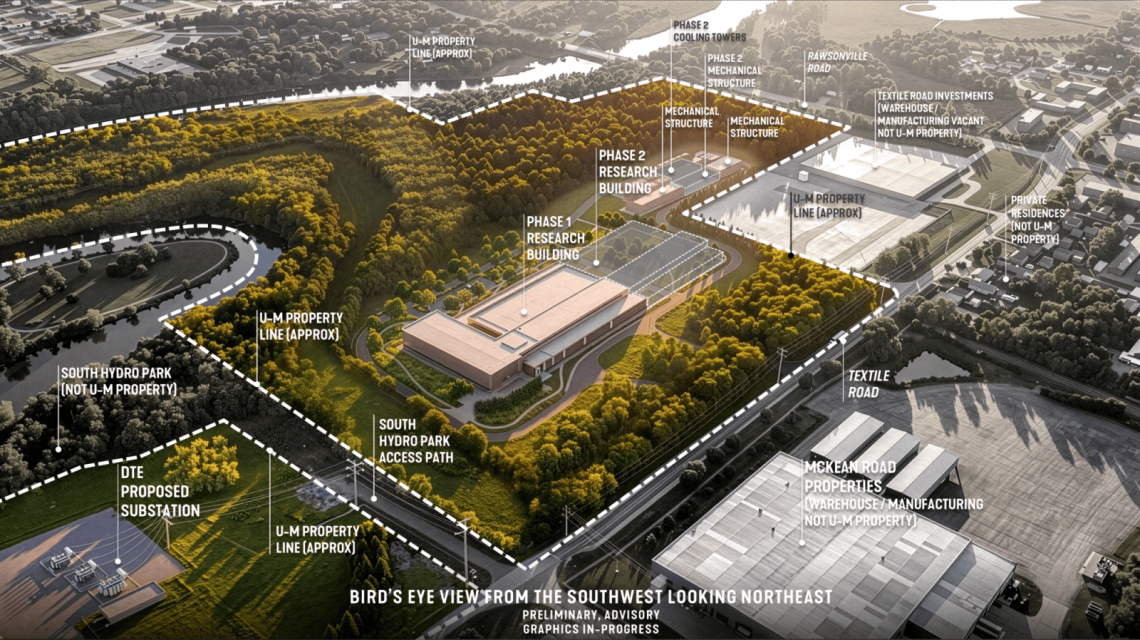
Residents in Michigan’s Ypsilanti Township are opposing a new research project by the University of Michigan, which they believe is being misrepresented. The University’s Board of Regents recently approved $785 million for a $1.25 billion research computing center. This facility, planned for medical, science, clean energy, engineering, and national security research, will be built on a 124-acre site zoned for industrial use, with 20 additional acres for a DTE electrical substation.
University’s Position
University officials assert that this is not a data center or manufacturing site but a “computing and research hub” meant to enhance science and education. University President Domenico Grasso emphasized that the project represents a crucial step forward for the institution’s research capabilities. The university plans to partner with Los Alamos National Laboratory and others to provide 50 megawatts of power, potentially increasing to 100 megawatts as the project progresses. These efforts aim to put Michigan at the forefront of scientific advancement.
Grasso committed to involving the local community, safeguarding the environment, and protecting the Huron River. Additionally, the university pledged $5 million over five years to the Ypsilanti area through its Community Partnership Program.
In communications to Congresswoman Debbie Dingell, Grasso noted that formal agreements between the University of Michigan and Los Alamos National Lab still need to be established, and no financial commitment has yet been made by Los Alamos.
Community Concerns
Opponents view the facility as a disruptive data center. Groups like Stop the Data Center have been protesting for months, emphasizing potential community and ecological disturbances. The United Tribes of Michigan (UTM) stood against the proposal, citing concerns over preserving Native American cultural sites, potential land use conflicts, and resource needs.
Regent Paul Brown voted against the project, expressing dissatisfaction with the university’s lack of community engagement. He labeled the process as “environmental racism,” emphasizing the need for involved community consultations.
Local and Legislative Response
Michigan House Democrats are pushing legislation to revoke the university’s ability to bypass zoning laws. State Representative Jimmie Wilson criticized the university’s approach to land acquisition for the project, describing it as a betrayal of public trust.
Environmental and Job Impact
The university assures that the project will not draw from or impact the Huron River or local groundwater and is exploring efficient cooling technologies to minimize resources used. The project could use up to 650,000 gallons of water daily but aims to mitigate demand via alternative water sources.
The project promises to create 300 construction jobs, over 200 permanent research positions, and 30 to 50 technical support roles. An environmental impact report is underway and construction is expected to start next year, concluding by 2031.
 Tidal’s Ban on AI-Generated Music and Industry Reactions
 President Trump Engages with Nvidia, Considers Government Equity Stake
 Nvidia CEO Jensen Huang Retains Security Clearance Amid Allegations
 Apple AirPods Pro 3: Enhanced Features and Black Friday Deals
 Huawei Convicted: Jurors Find Company Guilty of Trade Secret Theft
 CIA’s Unclassified System Breached in Cyberattack