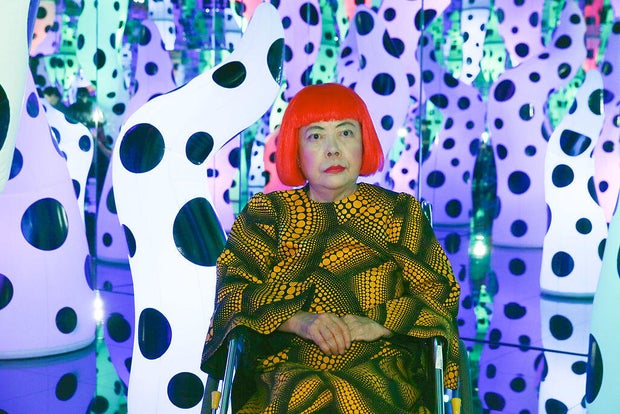
Japanese artist Yayoi Kusama, famed for her distinctive polka dots that adorned paintings, sculptures, and museum installations worldwide, has passed away at the age of 97. Her studio announced that Kusama died on August 14 in a Tokyo hospital. ‘She continued to paint until her final days, never setting aside her brush,’ stated Yayoi Kusama Studio, emphasizing her ongoing exploration of love and the eternal soul. ‘We will carry forward Kusama’s wishes and, through art, continue to bring hope and strength for the future to people around the world.’
Celebrated as one of Japan’s most respected contemporary artists, Kusama’s work was displayed globally in prestigious venues like the Museum of Modern Art and the Whitney Museum of American Art in New York. Her trademark repetitions often featured net-like patterns, swirls, and worms, most famously manifested as dots. These elements vibrantly inhabited her canvases or appeared as luminous spheres in her installations.
In a 2012 interview, Kusama expressed her love for polka dots, stating, ‘Polka dots are fabulous.’ Decked in her signature orange bobcut wig and dot-covered attire, she revealed her artistic ambitions in a childlike yet earnest tone: ‘I want to create a thousand paintings, perhaps two thousand, as many as I can draw. I will keep painting until I die.’
‘Fireflies on the Water’ (2002), by Yayoi Kusama, incorporates mirror, plexiglass, 150 lights, and water. Photograph courtesy of Robert Miller Gallery.
Kusama often explained that her artwork mirrored her own vision of the world, which was covered in spots due to hallucinations she experienced since childhood. Despite her struggles with mental health, involving numerous stints in psychiatric institutions, her illness never hindered her passion. In 1957, she became one of the first Japanese women to pursue art in New York.
Though she exhibited a soft-spoken and shy demeanor, Kusama was resolute in conveying her vision through her art, fearlessly embracing her dotty style over decades and making it popular with the public. As her prominence grew, she collaborated with brands like Louis Vuitton and licensed her illustrations for products, bringing her unique style to a mass audience. Her works achieved notable financial success, with a piece auctioned by Christie’s for $5.8 million in 2008.
In 2016, Japan honored her with the prestigious Order of Culture award. Upon receiving it, Kusama reiterated her unwavering commitment to her art. ‘I feel there is little left in my life, but I am now still fighting to the death for my art,’ she said. ‘I am giving all I have so that many people will continue to be interested in my art, even after I am dead.’
Kusama was labeled by many terms such as pop, avant-garde, and feminist. Yet, she often dismissed these descriptions as not fully capturing her artistic essence. Born into a middle-class family that prioritized tradition, she felt compelled to escape her parents’ expectations, choosing art and America over a conventional path.
Upon her arrival in New York, abstract expressionism dominated the art scene, yet Kusama’s dots stood apart. Although she endured poverty and obscurity, she never abandoned her distinctive style. Her ‘happening’ performances in the late 1960s, which featured polka dots on bodies and objects, attracted media attention despite controversies. In New York, she formed connections with artists like Andy Warhol, Georgia O’Keeffe, and Joseph Cornell, gaining recognition for her innovative style.
‘I wasn’t sure where my ideas came from,’ she remarked, describing her process as mysterious, at times surprising herself with the results. Yet, she actively welcomed media attention and would enthusiastically discuss her art and recite poetry.
Throughout her career, Kusama balanced vulnerability with a defiant spirit. As an artist, she boldly declared herself ‘an artistic revolutionary,’ despite often admitting to constant fears. Her legacy continues to inspire, marked by a unique vision and unyielding dedication to her craft.
 Converse Apologizes and Withdraws Controversial Ad Amid Criticism
  Lucas Museum of Narrative Art Unveils in Los Angeles
  Lonnie G. Bunch III Reflects on His Legacy at the Smithsonian
  A Decade of Impact at the National Museum of African American History and Culture
  Urgent Archaeological Efforts in Quinhagak Stay Ahead of Erosion
  Kennedy Center Faces Potential Bankruptcy and Closure Amid Controversies