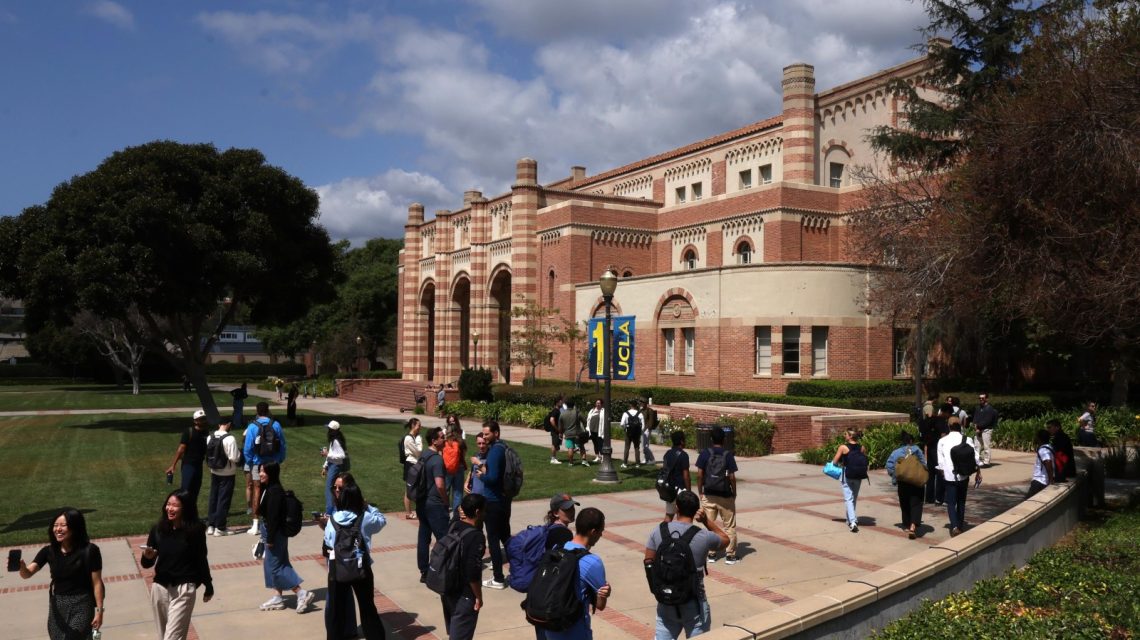
Juan Rosales Jr. made the decision to return to college in his 30s, tired of dead-end jobs. Now a full-time student at Long Beach City College, he works part-time and plans to graduate with an associate degree in film, television, and multimedia. Despite his commitment, Rosales questions his choice, expressing uncertainty about whether the degree will lead to better financial or professional opportunities.
Rosales’ experience reflects a broader societal narrative: invest in education, earn credentials, and enhance your prospects. Yet, he describes this leap as uncertain, hoping for positive outcomes without guarantees. This sentiment outlines the evolving perception of college in 2026.
Traditionally, college represented a reliable investment, offering education, employability, networking opportunities, and preparation for adult life. However, this proposition now faces challenges, notably increasing costs. The College Board estimates that in-state students at public institutions face an annual budget of $30,990, while private nonprofit colleges cost $65,470 per year. Tuition has surged from $5,940 in 1995-96 to $11,950 today for public colleges, and from $25,820 to $45,000 at private colleges.
Aside from tuition, prospective students consider opportunity costs, as attending college means foregoing four years of potential earnings and work experience. Despite these costs, data shows individuals holding degrees still earn more and face lower unemployment. Full-time workers 25 and older with a high school diploma earn $966 weekly, compared to $1,135 for associate degree holders and $1,578 for bachelor’s degree holders.
However, families must evaluate their specific situations. Decisions involve tuition bills, loan interest, and potential earnings. Allison Shrivastava from Niche highlights that the crucial comparison is between today’s college and high school graduates. The cost of living has dramatically risen, affecting early career financial advantages.
Recent graduates face uncomfortable statistics, with an unemployment rate of 5.6% and underemployment at 42%, according to the Federal Reserve Bank of New York. Employers seek tangible skills beyond diplomas, emphasizing the need for graduates to demonstrate practical applications of their knowledge.
College isn’t solely an employment program; its value extends beyond economics into areas like intellectual growth, independence, and cultural exposure. Shannon DeLeon believes in the broader benefits, emphasizing the connections made through university experiences.
The cultural challenges on campuses—protests, free speech issues, and safety concerns—highlight complexities in the college environment. These issues impact whether colleges fulfill their promises of community and personal development.
Rosales acknowledges the intangible value of the college experience, yet struggles to quantify it. Parents increasingly face the same challenge, balancing practical advice with financial considerations. DeLeon advocates college education but questions blanket acceptance of high costs and debt. Her perspective evolved, reflecting new considerations about costs, opportunities, and returns on educational investments.
Overall, while college graduates often achieve higher earnings, the notion of college as an unquestioned choice is evolving into a deliberate calculation involving school selection, major choice, debt management, and employment prospects. Rosales embodies the uncertainty of this decision—a safe choice now requires a strategic approach and willingness to take risks.
 Satisfaction with K-12 Education Hits Record Low
  Understanding Misperceptions and Inaction in Sexual Assault Prevention
  Understanding the Impact of Race-Conscious Admissions Changes on College Enrollment
  Cornell University Faces Scrutiny Over Handling of Sexual Assault Case
  Gen Z Freshmen Opt for Online Classes Over Traditional Campus Life
  Democratic Governors Under Pressure to Join Federal School Choice Program