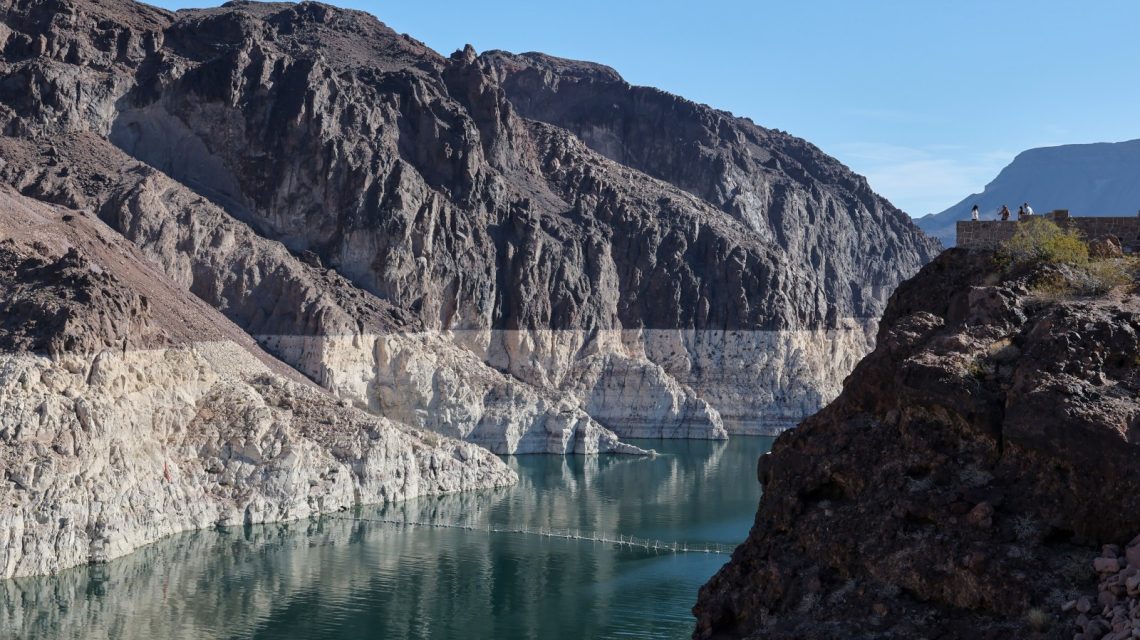
Lake Powell and Lake Mead, the largest reservoirs in the U.S., have reached their lowest combined levels ever. Experts on the Colorado River view this as an important moment in the West’s worsening water crisis.
Record Low for Combined Storage
A report found that, on July 12, the combined live storage at Lake Powell and Lake Mead was 12,675,509 acre-feet. This broke the previous low of 12,677,161 acre-feet recorded on March 14, 2023. An acre-foot is defined as the amount of water required to fill an acre to a depth of one foot.
On July 12, Lake Powell’s surface was at 3,524.32 feet above sea level, equating to 5,505,869 acre-feet of live storage. Lake Mead stood at 1,042.77 feet, equating to 7,169,640 acre-feet. The report indicated that the last instance when both reservoirs held so little usable water was May 23, 1957. At that time, all 12,668,000 acre-feet were in Lake Mead since Lake Powell had not yet started filling.
Although often considered separately, the report suggests that these reservoirs should be seen as a single connected system. Lake Powell is in the Upper Colorado River Basin, and Lake Mead is in the Lower Basin. They exist downstream from major Upper Basin water use and upstream from major Lower Basin needs. The report describes them as “essentially one gigantic reservoir,” separated by the Grand Canyon.
Storage Losses Accelerated in 2026
The decline in water storage is likely to speed up through 2026. Since March, combined storage has been decreasing by about 16,000 acre-feet per day. In May, the decline slowed to about 11,000 acre-feet per day due to Rocky Mountain snowmelt and additional releases from Flaming Gorge Reservoir flowing into Lake Powell.
Depletion rates have varied: 2,626 acre-feet per day in January, 6,494 in February, 15,733 in March, 16,861 in April, 11,001 in May, 16,230 in June, and 16,661 from July 1 to July 13. The report warns that until runoff from the 2026-27 winter snowpack begins next spring, new record lows for storage are likely “every day going forward.” The report underscores this as a crucial moment in the Colorado River’s evolving water supply crisis.
Why the Colorado River Matters
The Colorado River is a vital water system in North America. The Bureau of Reclamation notes that it supplies water, hydropower, recreational opportunities, and habitats across Arizona, California, Colorado, Nevada, New Mexico, Utah, and Wyoming, plus Mexico. Agriculture accounts for about 70% of the river’s water use. About 35 million to 40 million people depend on it for at least some part of their municipal supply.
Scientists warn that by 2028, reservoir levels might drop so low that regular operations, like water deliveries and hydropower generation, could become impossible. Such a “system crash” would threaten millions of people and large agricultural economies relying on the river.
Agreements Near Expiration
As storage levels drop, the federal government is preparing for the next phase of Colorado River management. According to Reuters, a U.S. plan will likely require Arizona, California, and Nevada to cut their Colorado River use by about 20% in 2027 and 2028. Further cuts may follow. Arizona Governor Katie Hobbs has stated that “unreasonable cuts” to her state’s Colorado River allocation are “unacceptable.”
Several operating agreements are due to expire at the end of the year, making upcoming decisions essential for how the shrinking river’s resources are allocated.
As of the latest data from the Bureau of Reclamation, Lake Mead was 27% full, holding 7,061,904 acre-feet. Lake Powell was 22% full, holding 5,424,836 acre-feet.
 California Prepares for El Niño-Fueled Storms with Emergency Declaration
  California’s Growing EV Adoption: Challenges and Benefits
  Data Centers in Virginia face Growing Opposition
  EPA Dismantles Greenhouse Gas Rules, Causing Concern
  How Battery Innovations Transform Renewable Energy
  Data Centers Stir Controversy in Texas Amid Growth Boom