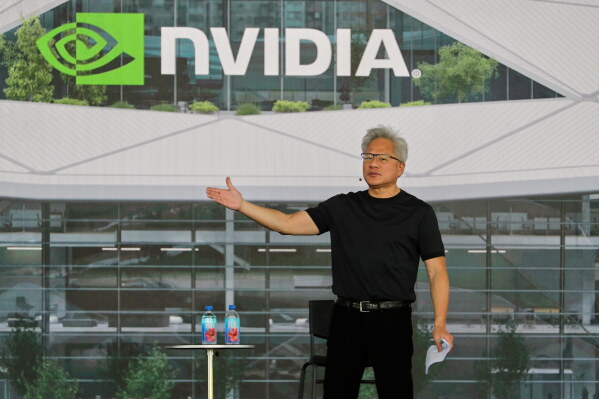
Nvidia CEO Jensen Huang has highlighted the inevitable societal changes due to artificial intelligence (AI) technologies. In his interview with the Associated Press, he shared insights into AI’s potential to drive rapid economic growth and scientific advancements.
Huang, as a leader in AI system development, felt responsible to address concerns over potential job losses and risks to humanity. He stated, We need to create new social norms. I would advocate that everybody use AI. Just go engage it.
AI has become a political topic, with debates over new data centers and concerns about layoffs affecting workers lacking safety nets. Public support for AI faces challenges, particularly concerning job security and economic inequality.
Huang noted AI’s ability to develop websites, analyze documents, guide research, and simplify tasks like kitchen remodeling has bridged technological divides. Users can now perform complex tasks without programming knowledge. He emphasized the need for government regulation and safety standards to prioritize national security.
Huang drew parallels between the societal adjustments to AI and past changes during the automobile’s advent. He reminisced, When I was growing up, I used to play in the streets. When cars came along, you obviously can’t play in the streets now,
illustrating how societal norms adapt over time.
Nvidia’s Market Value and Economic Implications
Nvidia has reached a market valuation of about $5 trillion, becoming the world’s most valuable company. Other AI firms like OpenAI and Anthropic are poised to achieve similarly high billion-dollar valuations once public. This concentration of wealth raises concerns about economic disparity.
Senator Bernie Sanders and OpenAI CEO Sam Altman have suggested that the U.S. government could own shares in AI companies to share economic benefits more broadly. However, Huang expressed skepticism about this idea. He argued that the nation would naturally benefit from AI advancements through investments, taxation, and job creation, stating, Americans have a stake in American companies already, naturally, in a whole lot of different ways.
The Importance of National Security
Nvidia has navigated shifting governmental AI policies, particularly regarding export controls and national security concerns. The Trump administration imposed restrictions on AI firm Anthropic’s models, prompting security concerns and an end to public access.
Huang acknowledged the need for precise government guidance when establishing policies to prevent undesirable effects, emphasizing that National security should always be the top concern of all technologies.
He criticized export controls that hinder Nvidia’s chip sales to China, arguing they might stifle AI ecosystem development.
Energy Infrastructure and AI Development
Addressing AI’s energy demands, Huang identified the U.S.’s lacking energy infrastructure as a vulnerability. The growth in AI computations places a heavy burden on power grids.
While some data centers may build independent energy sources, the nation starts at a disadvantage. Huang commented, The United States is woefully behind in energy production. We just suffocated energy production for too long,
praising Trump’s emphasis on traditional energy like oil, coal, and gas.
The Nvidia CEO participated in an event in Sherman, Texas, focusing on energy-efficient technologies. There, he underscored efforts to cut AI systems’ power consumption through innovative laser development for data transmission among chips.
 Legal Challenges in Pursuing a Wrongful Death Claim Against Utah Valley University
  Man Arrested After Fatal Stabbing on Chicago’s South Side
  Google Fined for Breaching EU Privacy Rules
  AI-Powered Malware Raises Concerns Over Security
  Debate Over ICE Action in Austin Escalates
  Debate Continues Over Virginia’s Data Center Energy Plans