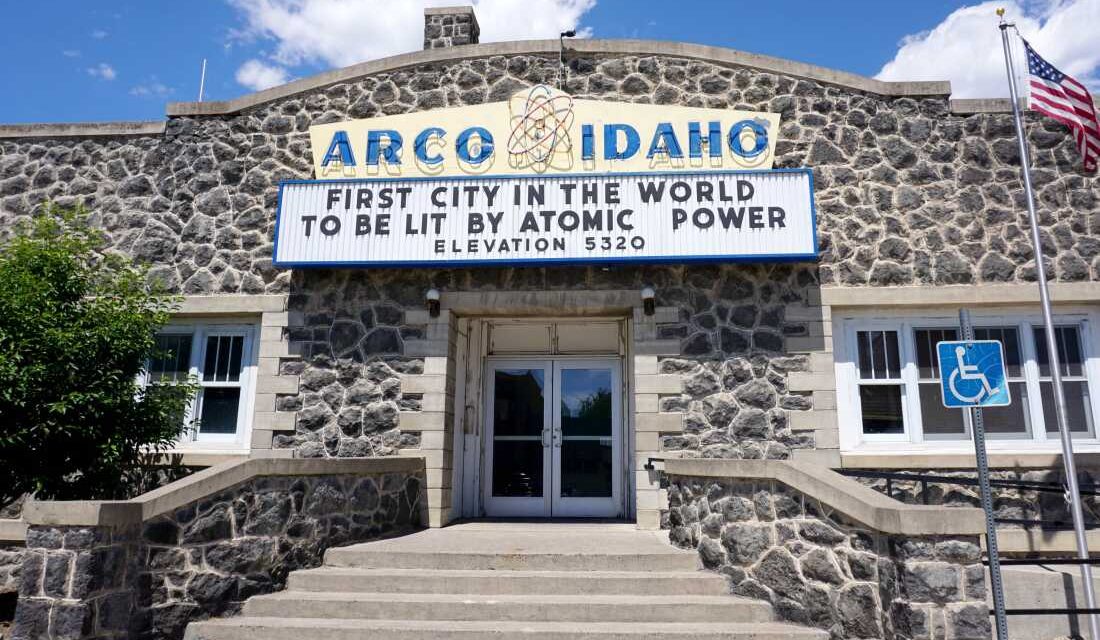
In the small town of Arco, Idaho, known for its long-standing connection to nuclear energy, residents live close to the Idaho National Laboratory (INL). This facility has played a central role in America’s nuclear test programs since 1949.
In Atomic City, another small town near INL, indoor smoking at the local bar is still common. One of the bar’s unique features is wallpaper made of one-dollar bills and a ‘Don’t Tread On Me’ flag. Vickie O’Haro, the bar’s owner, also manages a nearby race track. She has built a rapport with her patrons, who predominantly work at INL. O’Haro offers drinks like cold beers and shots amusingly named ‘atomic bombs.’ Despite the potential risks associated with living near a nuclear facility, O’Haro feels confident about their safety, sharing a casual sentiment with her customers. ‘I live 10 miles away, and I’m fine,’ she said, dismissing any fears of radioactive effects.
O’Haro stands behind the bar at Atomic City Bar & Store, which she owns, along with Atomic Motor Raceway, near INL. Following a period of stagnation, nuclear power is seeing renewed interest. Recent political directives have facilitated new nuclear projects, with newer reactor models set to come online soon. This summer, three companies at INL and one in Utah launched new reactor types.
According to O’Haro, these developments are exciting. ‘I think it’s actually pretty cool to be happening in my backyard,’ she commented. The INL spans 900 square miles, an expansive high desert region nearly as large as Rhode Island. Within this vast area, Deployable Energy, a startup company, has achieved a significant milestone with its test reactor reaching ‘critical.’ This means the reactor had a sustained chain reaction, an essential step to eventually generate electricity. Lance Maul, the company’s COO, views this achievement as a key historical moment for the nation.
‘This could be a real turning point for the energy future,’said Maul, whose distinctive appearance and Australian accent make him memorable. He emphasized the difference in their approach, focusing on smaller, more manageable reactors. These micro reactors could energize around one thousand homes, deviating from traditional, vastly larger plants.
Proponents of nuclear energy, like Maul, foresee these reactors being mass-produced to meet growing energy demands in various settings, notably remote communities and AI data centers. This advancement could accommodate increased energy needs without elevating carbon emissions.
Regulatory changes have simplified reactor permitting, as highlighted by NPR reports. Ed Lyman, the Union of Concerned Scientists’ Nuclear Power Safety Director, expressed apprehensions about these eased regulations. The fear is that vital safety and environmental standards might be compromised due to regulatory relaxations.
Concerns deepen with reports of significant staffing losses at the federal commission overseeing nuclear development, particularly among safety experts. Despite these worries, and the possible risks to surrounding communities, the bar in Atomic City remains a hub of casual reassurance.
O’Haro, confident in her community’s safety, noted, ‘If we weren’t safe, my guys would tell me that we weren’t safe.’ Meanwhile, sentiments across the U.S. remain mixed, with many Americans opposing local nuclear plants but showing increasing support for a broader emphasis on nuclear power.
 SpaceX Starship Completes Orbital Test Flight and Satellite Deployment
  Trump Attends Presidents Cup Amid Divided Reactions
  Studying Black Bears’ Hibernation at Virginia Tech
  Tackling Plastic Pollution: A Shift Toward Flax-Based Alternatives
  Explosives-Related Arrests and Security Measures Near RAF Fairford
  U.S. Navy Confirms Updated Casualty Count in Iran Conflict