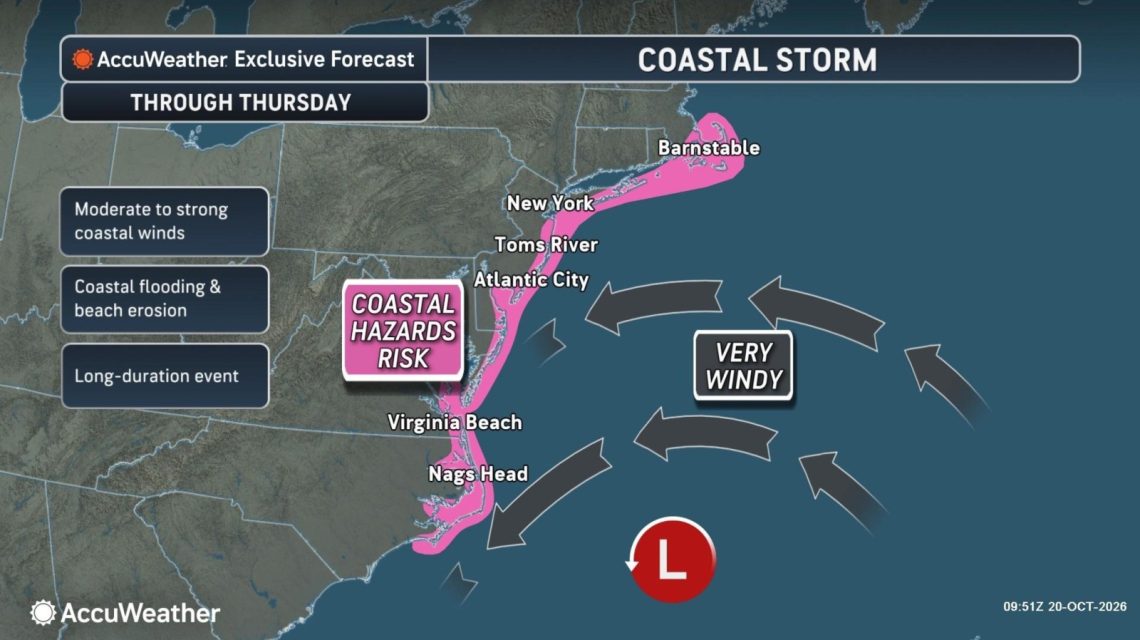
A slow-moving nor’easter is impacting the East Coast, bringing strong winds, coastal flooding, dangerous surf, and beach erosion. This storm could affect states from North Carolina to Massachusetts through Thursday.
Forecasts from AccuWeather show that the storm will move gradually northward offshore. It may acquire tropical or subtropical characteristics as it passes over the warm Gulf Stream waters.
The National Weather Service (NWS) has issued coastal flood warnings for parts of New Jersey, Delaware, Maryland, and Virginia. The storm center will shift from the Carolinas toward the mid-Atlantic, southern New York, and New England. This movement will spread coastal hazards northward during the week. Coastal communities will see the most noticeable effects, while many inland areas could remain dry.
Forecast Details
AccuWeather reports that the strongest winds, ranging from 40 to 60 mph, are expected from Morehead City, North Carolina, to Atlantic City, New Jersey, with isolated gusts reaching 70 mph. Breezy conditions are predicted to develop further north along coastal New Jersey, Long Island, southern Rhode Island, and Cape Cod in Massachusetts later in the week.
Fox Weather forecasts that hazardous conditions will persist through late Wednesday and into Thursday. The flooding threat is most pronounced from the Outer Banks through Chesapeake Bay to Ocean City, Maryland, with water levels potentially rising over 2 feet above normal around high tide.
Possibility of Tropical Development
There is a possibility that this system could briefly become a subtropical or tropical storm. According to Alex DaSilva, AccuWeather’s lead hurricane expert, there is a moderate chance for the low-pressure area off the East Coast to develop tropical or subtropical characteristics. Tropical systems draw energy from warm ocean waters, while subtropical systems use both warm waters and the jet stream.
DaSilva noted, “It is not unusual for a nor’easter in October to attempt gaining tropical characteristics. Water temperatures along the Gulf Stream are still warm enough to energize these storms.” Coastal flooding, dangerous surf, and beach erosion are possible along the mid-Atlantic coast regardless of development.
Understanding Nor’easters
According to the NWS, a nor’easter is a storm along the East Coast of North America, with winds over coastal regions typically coming from the northeast. These storms can form at any time, but they are most common and powerful between September and April.
 Florida Executes 18th Prisoner of the Year Amid Controversy
 Police Respond to Bizarre Doorstep Incident in Texas
 U.S. Housing Market Faces Challenges with Rising Mortgage Rates
 President Trump Campaigns in North Carolina Amid GOP Concerns
 Instacart Settles $5M Over Discriminatory Job Ads Linked to H-1B Visa Green Card Pathway
 Tourist Dies in Accident at Frank Lloyd Wright’s Taliesin West