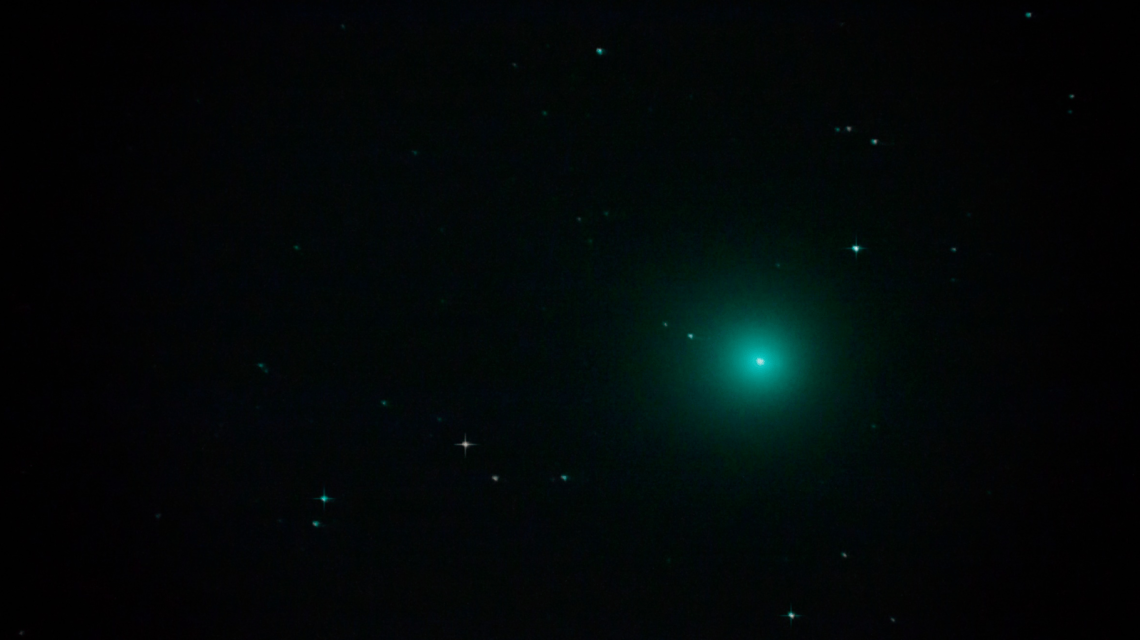
A small object orbiting the Sun named 1998 KY26 is at the center of an intriguing scientific debate. Researchers suggest various possibilities: a fast-spinning asteroid, a ‘dark comet,’ or a long-lost Soviet spacecraft.
Discovery and Initial Observations
Astronomer Tom Gehrels discovered 1998 KY26 on May 28, 1998, as part of the University of Arizona’s Spacewatch project. Initial radar and telescope observations indicated the object was about 30 meters wide, completing a rotation every 10.7 minutes.
Updated Observations
Recent observations led by Toni Santana-Ros at the University of Alicante suggest 1998 KY26 is approximately 11 meters wide and spins every 5.35 minutes. This finding redefines its size and speed.
Another unusual observation is a slight push affecting the object as it moves through space. Unlike expected comets, there is no visible cloud or tail that typically explains such a shift.
Theories About 1998 KY26
Dark Comet Hypothesis
One theory is that 1998 KY26 is a ‘dark comet.’ Normally, a comet’s ice turns to gas near the Sun, propelling it and forming a visible tail. ‘Dark comets’ lack this cloud yet show the extra push. Bryce T. Bolin’s study using Keck I and Gemini North telescopes found the object receives an unusual push, with no visible dust cloud.
Phobos 1 Hypothesis
Abraham Loeb from Harvard University and others explore if 1998 KY26 could be the Soviet probe Phobos 1, which lost communication after its launch in 1988. They suggest the object’s path and unexplained motion may match Phobos 1, potentially influenced by sunlight reflecting off its solar panels. This remains a hypothesis, not confirmation.
Fast-Spinning Asteroid Theory
A simpler explanation is that 1998 KY26 is an unusual asteroid. Santana-Ros used telescope and radar data to clarify its rapid rotation. This could mean it’s a solid, compact rock, not a loose debris assembly. Bolin’s study indicates similarities to an Xe-type asteroid.
Dried-Out, Ice-Less Object
Research by Korbin Hansen and Masatoshi Hirabayashi at Georgia Tech questions if 1998 KY26 ever contained water ice. Their model suggests the object’s warmth would prevent long-term ice retention, leaving a rocky body behind. This challenges whether escaping water vapor could cause its acceleration.
Current Interest
Recent data shows 1998 KY26 is smaller, faster-spinning, and more reflective than once thought. Different studies provide insights into its composition and motion. Meanwhile, the Phobos 1 theory offers an alternate explanation.
Japan’s space agency, JAXA, plans to investigate further. Their Hayabusa2 spacecraft is set to visit 1998 KY26 in 2031. This mission aims to determine the object’s true nature. Scientists anticipate definitive evidence when Hayabusa2 arrives, helping resolve current debates.
 Bayer Settles Massive Roundup Lawsuit Over Cancer Claims
 AI and Mathematics: A Potential Breakthrough on the Riemann Hypothesis
 Mathematicians Race to Solve the Riemann Hypothesis Amid AI Controversy
 Key Developments in California, Melania Trump Series, Controversial Execution, and More
 3,300-Year-Old Sword Found in Italian Lake, Still Sharp
 NASA Explores Unusual Martian Formations