
The announcement of two major Iran-backed militias in Iraq to hand over their weapons marks a significant step towards strengthening state authority. Asaib Ahl al-Haq and Imam Ali Brigades declared their intention to transfer arms to government control, signaling a move towards centralizing military power.
Asaib Ahl al-Haq’s Initiative:
Asaib Ahl al-Haq has initiated a committee to manage the transition. This committee will inventory its personnel, weapons, and coordinate with Iraq’s armed forces’ leadership, showing the group’s commitment to align with calls from Iraq’s Shiite authority and the Coordination Framework, the dominant parliamentary bloc.
Imam Ali Brigades’ Statement:
The Imam Ali Brigades echoed similar sentiments, expressing intent to contribute to a strong, sovereign state. Their focus remains on ensuring arms are solely held by state institutions.
Middle East Conflict Impacts:
The recent Middle East conflict involving U.S. and Israeli strikes on Iran has highlighted weaknesses in Iraqi institutions. These challenges include managing Iran-backed militias, which operate semi-autonomously despite nominal state oversight.
U.S. and Militia Confrontations:
Escalating confrontations between Washington and these factions have complicated the situation. Militias acting as Iran’s regional proxies have increased attacks on U.S. assets, though a ceasefire was brokered in April. Prime Minister Ali al-Zaidi has prioritized a state monopoly on arms, focusing on curbing militia influence under pressure from the United States.
Shiite Cleric’s Militia Reorganization:
Influential cleric Muqtada al-Sadr has announced his militia, Saraya al-Salam, will detach from his political movement and integrate with state structures, furthering efforts to unify weapon control.
Different Faction Responses:
Despite this movement, other factions like Kataib Hezbollah and Harakat al-Nujaba resist disarmament, citing sovereignty issues due to foreign troop presence. Kataib Hezbollah intends to continue its activities as part of “resistance work,” preferring to coordinate with Popular Mobilization Forces instead.
Popular Mobilization Forces Background:
Formed in 2014 to combat the Sunni extremist Islamic State, Popular Mobilization Forces encompass various Shiite groups, many still maintaining independent leadership and connections to Iran.
The changes in militia alignment and disarmament are pivotal in stabilizing Iraq’s political landscape and asserting stronger government control over military resources.
 Don McCullin’s Final Book: A Pioneering War Photographer’s Legacy
  Rep. Alexandria Ocasio-Cortez Defends Macklemore Amid Tour Controversy
  Google Fined for Breaching EU Privacy Rules
  South China Sea Tensions Rise after Collision between Chinese and Philippine Ships
 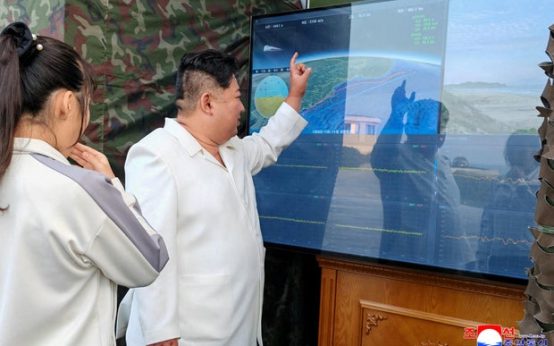 North Korea’s Hypersonic Weapon Test Amid Global Tensions
  Austin Tice: A Search for Answers