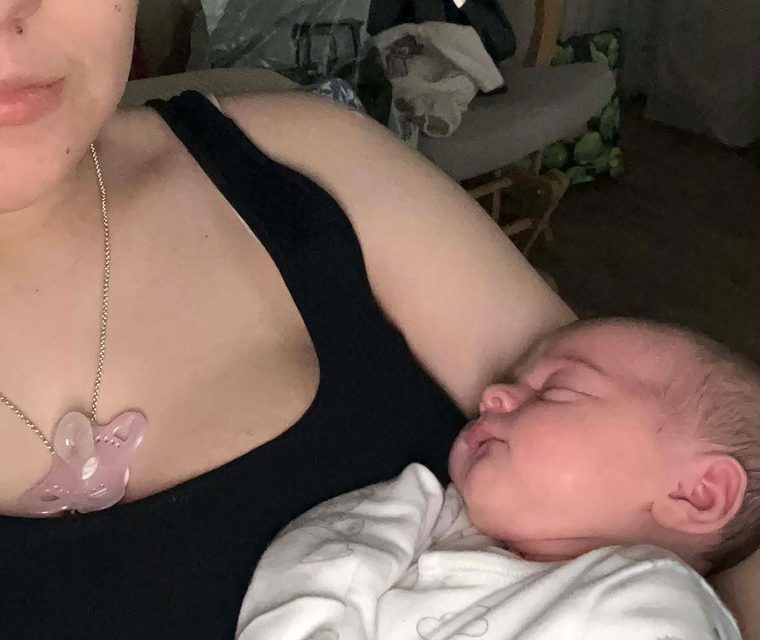
LONDON — Sofii Lewis realized something was profoundly wrong soon after the birth of her daughter, Evie, in January 2023. ‘I didn’t feel connected to my daughter,’ Lewis stated. ‘I didn’t want to be near her.’ She became worried that harm could come to Evie, either by her own hand or someone else’s. The sound of a beeping register haunted her, leading Lewis to fear that someone might ‘buy Evie.’ Her mental state spiraled, and Lewis experienced suicidal thoughts.
Lewis, a 27-year-old from Aberdare, Wales, speculates she was merely ‘hours, days away’ from a severe tragedy. She credits the U.K.’s pioneering maternal mental healthcare system for saving her and Evie’s lives. After being diagnosed with ‘tendencies of postpartum psychosis,’ she received essential support at a Mother and Baby Unit. These facilities offer inpatient care that allows mothers to stay with their babies while receiving treatment. This approach is considered worth emulating globally, according to experts.
Lewis is among many mothers observing the trial of Lindsay Clancy. Clancy is accused of killing her three children in January 2023 in Massachusetts. Her defense claims she was suffering from postpartum psychosis and should not be held criminally liable. Lewis and others familiar with maternal mental health find this case triggering, believing similar experiences could happen to anyone facing postpartum psychosis.
Lindsay Clancy’s severe postpartum mental illness went untreated, according to Veerle Bergink, the Director of Mount Sinai’s Women’s Mental Health Center in New York. Bergink considers Britain’s MBU approach as the ideal way to manage postpartum psychosis.
The U.K. is regarded by many experts as ‘the cradle’ of modern maternal mental healthcare. U.S. efforts lag behind, with its fragmented system offering limited treatment options for severe conditions like postpartum psychosis.
Data from the National Health Service reveals that up to 26% of new and expectant mothers experience perinatal mental health illnesses. In 2025 alone, over 66,000 women sought specialized community-based care for these issues. Postpartum psychosis symptoms can emerge during the initial two weeks after childbirth and vary in severity, including delusions and hallucinations.
Rarely linked with suicide and infanticide, the disorder, according to Action on Postpartum Psychosis (APP), affects 1,200 cases annually in the U.K., only 1 to 5 of which are linked with suicide. Less than 0.05% resulted in infanticide over the last decade, though precise numbers are challenging to pinpoint.
Despite Clancy’s repeated attempts to get help, including psychiatric consultations and calling a suicide hotline, the tragic event unfolded. Prosecutors argue her actions were premeditated, while the defense underscores her mental distress. The jury’s deadlock reflects the complexities of the case.
The trial has attracted significant attention and initiated a dialogue around postpartum psychosis and the demand for improved maternal mental healthcare access in the U.S.
Upon realizing her symptoms, Sofii Lewis sought help from a private counselor who promptly contacted the NHS crisis team. Lewis and Evie were admitted to an MBU, where five months of care likely saved their lives. MBUs offer varying treatment plans, including medication, typically lasting weeks to months.
The NHS has made ‘incredible progress’ in addressing postpartum psychosis realities, states Dr. Sally Wilson, APP’s National Training Coordinator. The U.K.’s large-scale MBU program is largely unique worldwide, offering comprehensive support and treatments.
Despite some countries having similar programs, few match the UK’s comprehensiveness. In the U.S., specialized perinatal psychiatric care is sporadic, lacking a national system akin to MBUs.
APP has been crucial in advocating for awareness and treatment options for postpartum psychosis. Lewis benefited from therapies such as Video Interaction Guidance, which captures positive parent-infant moments, and Eye Movement Desensitization and Reprocessing, addressing trauma-related distress.
Lewis emphasizes that postpartum psychosis doesn’t reflect personal failures. ‘It doesn’t make you a bad person,’ she assures. ‘It’s part of an illness.’
If you need assistance, the National Maternal Mental Health Hotline provides free support in English and Spanish at 1-833-852-6262, and the 988 Suicide & Crisis Lifeline is available at 988lifeline.org.
 Understanding Addiction Risks After Presley Gerber’s Death
  Managing Distress: Insights and Techniques
  Best Practices for Safe Consumption of Fresh Produce
  The Complexity and Prevention of Suicide
  A Journey Through Cancer: Reflections on Diagnosis and Metaphor
  Impact of Sleep Types on Disease Risk